


Page 1990 - Hematology_ Basic Principles and Practice ( PDFDrive )
P. 1990
1764   Part XI  Transfusion Medicine


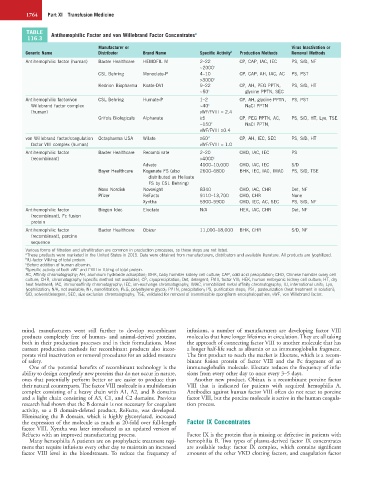
          TABLE   Antihemophilic Factor and von Willebrand Factor Concentrates a
          116.3
                                 Manufacturer or                                                Virus Inactivation or
         Generic Name            Distributor    Brand Name        Specific Activity b  Production Methods  Removal Methods
         Antihemophilic factor (human)  Baxter Healthcare  HEMOFIL M  2–22     CP, CAP, IAC, IEC  PS, S/D, NF
                                                                  ~2000 c
                                 CSL Behring    Monoclate-P       4–10         CP, CAP, AH, IAC, AC  PS, PST
                                                                  >3000 c
                                 Kedrion Biopharma  Koāte-DVI     9–22         CP, AH, PEG PPTN,   PS, S/D, HT
                                                                  ~50 c          glycine PPTN, SEC
         Antihemophilic factor/von   CSL Behring  Humate-P        1–2          CP, AH, glycine PPTN,  PS, PST
           Willebrand factor complex                              ~40 c          NaCl PPTN
           (human)                                                vWF/FVIII = 2.4
                                 Grifols Biologicals  Alphanate   ≥5           CP, PEG PPTN, AC,   PS, S/D, HT, Lyo, TSE
                                                                  ~150 c         NaCl PPTN,
                                                                  vWF/FVIII ≥0.4
         von Willebrand factor/coagulation  Octapharma USA  Wilate  ≥60 d      CP, AH, IEC, SEC  PS, S/D, HT
           factor VIII complex (human)                            vWF/FVIII = 1.0
         Antihemophilic factor   Baxter Healthcare  Recombinate   2–20         CHO, IAC, IEC    PS
           (recombinant)                                          >4000 c
                                                Advate            4000–10,000  CHO, IAC, IEC    S/D
                                 Bayer Healthcare  Kogenate FS (also   2600–6800  BHK, IEC, IAC, IMAC  PS, S/D, TSE
                                                  distributed as Helixate
                                                  FS by CSL Behring)
                                 Novo Nordisk   Novoeight         8340         CHO, IAC, CHR    Det, NF
                                 Pfizer         ReFacto           9110–13,700  CHO, CHR         None
                                                Xyntha            5900–9900    CHO, IEC, AC, SEC  PS, S/D, NF
         Antihemophilic factor   Biogen Idec    Eloctate          N/A          HEK, IAC, CHR    Det, NF
           (recombinant), Fc fusion
           protein
         Antihemophilic factor   Baxter Healthcare  Obizur        11,000–18,000  BHK, CHR       S/D, NF
           (recombinant), porcine
           sequence
         Various forms of filtration and ultrafiltration are common in production processes, so those steps are not listed.
         a These products were marketed in the United States in 2015. Data were obtained from manufacturers, distributors and available literature. All products are lyophilized.
         b IU-factor VIII/mg of total protein.
         c Before addition of human albumin.
         d Specific activity of both vWF and FVIII in IU/mg of total protein.
         AC, Affinity chromatography; AH, aluminum hydroxide adsorption; BHK, baby hamster kidney cell culture; CAP, cold acid precipitation; CHO, Chinese hamster ovary cell
         culture; CHR, chromatography (specific method not available); CP, cryoprecipitation; Det, detergent; FVIII, factor VIII; HEK, human embryonic kidney cell culture; HT, dry
         heat treatment; IAC, immunoaffinity chromatography; IEC, ion-exchange chromatography; IMAC, immobilized metal affinity chromatography; IU, international units; Lyo,
         lyophilization; N/A, not available; NF, nanofiltration; PEG, polyethylene glycol; PPTN, precipitation; PS, purification steps; PST, pasteurization (heat treatment in solution);
         S/D, solvent/detergent; SEC, size exclusion chromatography; TSE, validated for removal of transmissible spongiform encephalopathies; vWF, von Willebrand factor.


        mind,  manufacturers  went  still  further  to  develop  recombinant   infusions,  a  number  of  manufacturers  are  developing  factor  VIII
        products  completely  free  of  human-  and  animal-derived  proteins,   molecules that have longer lifetimes in circulation. They are all taking
        both in their production processes and in their formulations. Most   the approach of connecting factor VIII to another molecule that has
        current  production  methods  for  recombinant  products  also  incor-  a longer half-life such as albumin or an immunoglobulin fragment.
        porate viral inactivation or removal procedures for an added measure   The first product to reach the market is Eloctate, which is a recom-
        of safety.                                            binant  fusion  protein  of  factor  VIII  and  the  Fc  fragment  of  an
           One of the potential benefits of recombinant technology is the   immunoglobulin molecule. Eloctate reduces the frequency of infu-
        ability to design completely new proteins that do not occur in nature,   sions from every other day to once every 3–5 days.
        ones  that  potentially  perform  better  or  are  easier  to  produce  than   Another  new  product,  Obizur,  is  a  recombinant  porcine  factor
        their natural counterparts. The factor VIII molecule is a multidomain   VIII  that  is  indicated  for  patients  with  acquired  hemophilia  A.
        complex consisting of a heavy chain with A1, A2, and B domains   Antibodies against human factor VIII often do not react to porcine
        and a light chain consisting of A3, C1, and C2 domains. Previous   factor VIII, but the porcine molecule is active in the human coagula-
        research had shown that the B domain is not necessary for coagulant   tion process.
        activity,  so  a  B  domain-deleted  product,  ReFacto,  was  developed.
        Eliminating the B domain, which is highly glycosylated, increased
        the expression of the molecule as much as 20-fold over full-length   Factor IX Concentrates
        factor VIII. Xyntha was later introduced as an updated version of
        ReFacto with an improved manufacturing process.       Factor IX is the protein that is missing or defective in patients with
           Many hemophilia A patients are on prophylactic treatment regi-  hemophilia B. Two types of plasma-derived factor IX concentrates
        mens that require infusions every other day to maintain an increased   are  available  today:  factor  IX  complex,  which  contains  significant
        factor  VIII  level  in  the  bloodstream.  To  reduce  the  frequency  of   amounts of the other VKD clotting factors, and coagulation factor

