


Page 1996 - Hematology_ Basic Principles and Practice ( PDFDrive )
P. 1996
1770   Part XI  Transfusion Medicine


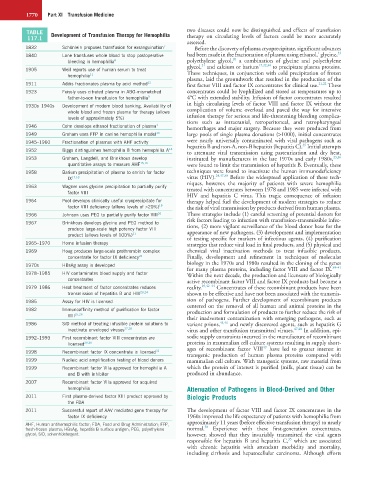
          TABLE   Development of Transfusion Therapy for Hemophilia  two diseases could now be distinguished and effects of transfusion
          117.1                                               therapy  on  circulating  levels  of  factors  could  be  more  accurately
                                                              assessed.
         1832        Schönlein proposes transfusion for exsanguination 7  Before the discovery of plasma cryoprecipitate, significant advances
                                                                                                         1
                                                                                                               33
         1840        Lane transfuses whole blood to stop postoperative   had been made in the fractionation of plasma using ethanol,  glycine,
                                                                             20
                       bleeding in hemophilia 8               polyethylene  glycol,   a  combination  of  glycine  and  polyethylene
                                                                   21
                                                              glycol,  and calcium or barium 17,22,34  to precipitate plasma proteins.
         1905        Weil reports use of human serum to treat   These techniques, in conjunction with cold precipitation of frozen
                       hemophilia 11
                                                              plasma, laid the groundwork that resulted in the production of the
         1911        Addis fractionates plasma by acid method 12  first factor VIII and factor IX concentrates for clinical use. 21,22  These
         1923        Feissly uses citrated plasma in ABO-mismatched   concentrates could be lyophilized and stored at temperatures up to
                       father-to-son transfusion for hemophilia 9  4°C with extended stability. Infusion of factor concentrates resulted
         1930s–1940s  Development of modern blood banking. Availability of   in high circulating levels of factor VIII and factor IX without the
                       whole blood and frozen plasma for therapy (allows   complication  of  volume  overload  and  paved  the  way  for  intensive
                       levels of approximately 5%)            infusion therapy for serious and life-threatening bleeding complica-
                                                              tions  such  as  intracranial,  retroperitoneal,  and  retropharyngeal
         1946        Cohn develops ethanol fractionation of plasma 1  hemorrhages and major surgery. Because they were produced from
         1949        Graham uses FFP in canine hemophilia model 13  large pools of single plasma donations (>1000), initial concentrates
         1945–1960   Fractionation of plasmas with AHF activity  were  nearly  universally  contaminated  with  viral  pathogens  such  as
                                                                                                    35
         1952        Biggs distinguishes hemophilia B from hemophilia A 14  hepatitis B and non-A, non-B hepatitis (hepatitis C).  Initial attempts
                                                              to  attenuate  viral  transmission  using  pasteurization  and  dry  heat,
         1953        Graham, Langdell, and Brinkhous develop   instituted by manufacturers in the late 1970s and early 1980s, 23,36
                       quantitative assays to measure AHF 15,16  were found to limit the transmission of hepatitis B. Eventually, these
         1958        Barium precipitation of plasma to enrich for factor   techniques were found to inactivate the human immunodeficiency
                                                                        24,37,38
                       IX 17,18                               virus (HIV).   Before the widespread application of these tech-
                                                              niques,  however,  the  majority  of  patients  with  severe  hemophilia
         1963        Wagner uses glycine precipitation to partially purify   treated with concentrates between 1978 and 1985 were infected with
                       factor VIII
                                                              HIV  and  hepatitis  C  virus.  This  tragic  consequence  of  infusion
         1964        Pool develops clinically useful cryoprecipitate for   therapy helped fuel the development of modern strategies to reduce
                       factor VIII deficiency (allows levels of >20%) 19  the risk of viral transmission by products derived from human plasma.
         1966        Johnson uses PEG to partially purify factor VIII 20  These strategies include (1) careful screening of potential donors for
                                                              risk factors leading to infection with transfusion-transmissible infec-
         1967        Brinkhous develops glycine and PEG method to   tions, (2) more vigilant surveillance of the blood donor base for the
                       produce large-scale high potency factor VIII   appearance of new pathogens, (3) development and implementation
                       product (allows levels of 100%) 21
                                                              of testing specific for markers of infectious agents, (4) purification
         1965–1970   Home infusion therapy                    strategies that reduce viral load in final products, and (5) physical and
         1969        Hoag produces large-scale prothrombin complex   chemical  viral  inactivation  methods  to  treat  infusible  products.
                       concentrate for factor IX deficiency 22  Finally,  development  and  refinement  in  techniques  of  molecular
         1970s       HBsAg assay is developed                 biology in the 1970s and 1980s resulted in the cloning of the genes
                                                                                                              39–41
                                                              for many plasma proteins, including factor VIII and factor IX.
         1978–1985   HIV contaminates blood supply and factor   Within the next decade, the production and licensure of biologically
                       concentrates                           active recombinant factor VIII and factor IX products had become a
         1979–1986   Heat treatment of factor concentrates reduces   reality. 29,42–44  Concentrates of these recombinant products have been
                       transmission of hepatitis B and HIV 23,24  shown to be effective and have not been associated with the transmis-
         1985        Assay for HIV is licensed                sion  of  pathogens.  Further  development  of  recombinant  products
                                                              centered on the removal of all human and animal proteins in the
         1982        Immunoaffinity method of purification for factor   production and formulation of products to further reduce the risk of
                       VIII 25,26
                                                              their inadvertent contamination with emerging pathogens, such as
         1986        S/D method of treating infusible protein solutions to   variant prions, 45,46  and newly discovered agents, such as hepatitis G
                       inactivate enveloped viruses 27,28     virus and other transfusion transmitted viruses. 47,48  In addition, epi-
         1992–1993   First recombinant factor VIII concentrates are   sodic supply constraints incurred in the manufacture of recombinant
                       licensed 29,30                         proteins in mammalian cell culture systems resulting in supply short-
                                                                                       49
         1998        Recombinant factor IX concentrate is licensed 31  ages  of  recombinant  factor  VIII   have  led  to  greater  interest  in
                                                              transgenic  production  of  human  plasma  proteins  compared  with
         1999        Nucleic acid amplification testing of blood donors  mammalian cell culture. With transgenic systems, raw material from
         1999        Recombinant factor VIIa approved for hemophilia A   which the protein of interest is purified (milk, plant tissue) can be
                       and B with inhibitor                   produced in abundance.
         2007        Recombinant factor VIIa approved for acquired
                       hemophilia                             Attenuation of Pathogens in Blood-Derived and Other
         2011        First plasma-derived factor XIII product approved by   Biologic Products
                       the FDA
         2011        Successful report of AAV mediated gene therapy for   The development of factor VIII and factor IX concentrates in the
                       factor IX deficiency                   1960s improved the life expectancy of patients with hemophilia from
         AHF, Human antihemophilic factor; FDA, Food and Drug Administration; FFP,   approximately 11 years (before effective transfusion therapy) to nearly
                                                                    50
         fresh-frozen plasma; HBsAg, hepatitis B surface antigen; PEG, polyethylene   normal.   Experience  with  these  first-generation  concentrates,
         glycol; S/D, solvent/detergent.                      however,  showed  that  they  invariably  transmitted  the  viral  agents
                                                                                               35
                                                              responsible  for  hepatitis  B  and  hepatitis  C,   which  are  associated
                                                              with  chronic  hepatitis  with  attendant  morbidity  and  mortality,
                                                              including  cirrhosis  and  hepatocellular  carcinoma.  Although  efforts

