


Page 1993 - Hematology_ Basic Principles and Practice ( PDFDrive )
P. 1993
Chapter 116  Preparation of Plasma-Derived and Recombinant Human Plasma Proteins  1767


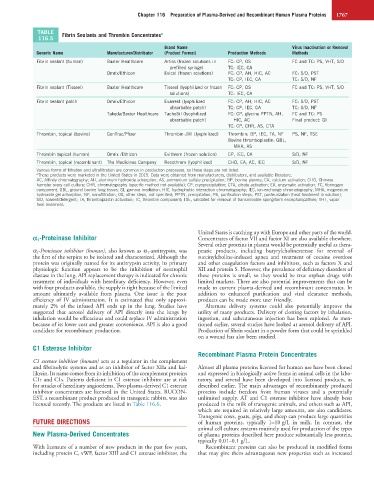
             TABLE   Fibrin Sealants and Thrombin Concentrates a
              116.5
                                                       Brand Name                                Virus Inactivation or Removal
             Generic Name           Manufacturer/Distributor  (Product Format)  Production Methods  Methods
             Fibrin sealant (human)  Baxter Healthcare  Artiss (frozen solutions in   FC: CP, OS  FC and TC: PS, VHT, S/D
                                                         prefilled syringe)  TC: IEC, CA
                                    Omrix/Ethicon      Evicel (frozen solutions)  FC: CP, AH, HIC, AC  FC: S/D, PST
                                                                            TC: CP, IEC, CA      TC: S/D, NF
             Fibrin sealant (Tisseel)  Baxter Healthcare  Tisseel (lyophilized or frozen  FC: CP, OS  FC and TC: PS, VHT, S/D
                                                         solutions)         TC: IEC, CA
             Fibrin sealant patch   Omrix/Ethicon      Evarrest (lyophilized   FC: CP, AH, HIC, AC  FC: S/D, PST
                                                         absorbable patch)  TC: CP, IEC, CA      TC: S/D, NF
                                    Takeda/Baxter Healthcare  TachoSil (lyophilized   FC: CP, glycine PPTN, AH,   FC and TC: PS
                                                         absorbable patch)   HIC, AC             Final product: GI
                                                                            TC: CP, CHR, AS, CTA
             Thrombin, topical (bovine)  GenTrac/Pfizer  Thrombin-JMI (lyophilized)  Thrombin: BP, IEC, TA, NF  PS, NF, TSE
                                                                            Bovine thromboplastin: GBL,
                                                                             MHA, AS
             Thrombin topical (human)  Omrix /Ethicon  Evithrom (frozen solution)  CP, IEC, CA   S/D, NF
             Thrombin, topical (recombinant)  The Medicines Company  Recothrom (lyophilized)  CHO, EA, AC, IEC  S/D, NF
             Various forms of filtration and ultrafiltration are common in production processes, so those steps are not listed.
             a These products were marketed in the United States in 2015. Data were obtained from manufacturers, distributors, and available literature.
             AC, Affinity chromatography; AH, aluminum hydroxide adsorption; AS, ammonium sulfate precipitation; BP, bovine plasma; CA, calcium activation; CHO, Chinese
             hamster ovary cell culture; CHR, chromatography (specific method not available); CP, cryoprecipitation; CTA, citrate activation; EA, enzymatic activation; FC, fibrinogen
             component; GBL, ground bovine lung tissue; GI, gamma irradiation; HIC, hydrophobic interaction chromatography; IEC, ion-exchange chromatography; MHA, magnesium
             hydroxide gel adsorption; NF, nanofiltration; OS, other steps, not specified; PPTN, precipitation; PS, purification steps; PST, pasteurization (heat treatment in solution);
             S/D, solvent/detergent; TA, thromboplastin activation; TC, thrombin component; TSE, validated for removal of transmissible spongiform encephalopathies; VHT, vapor
             heat treatment.


                                                                  United States is catching up with Europe and other parts of the world.
            α 1-Proteinase Inhibitor                              Concentrates of factor VII and factor XI are also available elsewhere.
                                                                  Several other proteins in plasma would be potentially useful as thera-
            α 1 -Proteinase inhibitor (human), also known as α 1 -antitrypsin, was   peutic  products,  including  butyrylcholinesterase  for  reversal  of
            the first of the serpins to be isolated and characterized. Although the   succinylcholine-induced  apnea  and  treatment  of  cocaine  overdose
            protein was originally named for its antitrypsin activity, its primary   and other coagulation factors and inhibitors, such as factors X and
            physiologic  function  appears  to  be  the  inhibition  of  neutrophil   XII and protein S. However, the prevalence of deficiency disorders of
            elastase in the lung. API replacement therapy is indicated for chronic   these  proteins  is  small,  so  they  would  be  true  orphan  drugs  with
            treatment of individuals with hereditary deficiency. However, even   limited markets. There are also potential improvements that can be
            with four products available, the supply is tight because of the limited   made to current plasma-derived and recombinant concentrates. In
            amount  ultimately  available  from  plasma.  One  issue  is  the  poor   addition  to  enhanced  purification  and  viral  clearance  methods,
            efficiency  of  IV  administration.  It  is  estimated  that  only  approxi-  products can be made more user friendly.
            mately  2%  of  the  infused  API  ends  up  in  the  lung.  Studies  have   Alternate  delivery  systems  could  also  potentially  improve  the
            suggested  that  aerosol  delivery  of  API  directly  into  the  lungs  by   utility of many products. Delivery of clotting factors by inhalation,
            inhalation would be efficacious and could replace IV administration   ingestion, and subcutaneous injection has been explored. As men-
            because of its lower cost and greater convenience. API is also a good   tioned earlier, several studies have looked at aerosol delivery of API.
            candidate for recombinant production.                 Production of fibrin sealant in a powder form that could be sprinkled
                                                                  on a wound has also been studied.
            C1 Esterase Inhibitor
                                                                  Recombinant Plasma Protein Concentrates
            C1 esterase inhibitor (human) acts as a regulator in the complement
            and fibrinolytic systems and as an inhibitor of factor XIIa and kal-  Almost all plasma proteins licensed for human use have been cloned
            likrein. Its name comes from its inhibition of the complement proteins   and expressed in biologically active forms in animal cells in the labo-
            C1r and C1s. Patients deficient in C1 esterase inhibitor are at risk   ratory,  and  several  have  been  developed  into  licensed  products,  as
            for attacks of hereditary angioedema. Two plasma-derived C1 esterase   described earlier. The main advantages of recombinantly produced
            inhibitor concentrates are licensed in the United States. RUCON-  proteins  include  freedom  from  human  viruses  and  a  potentially
            EST, a recombinant product produced in transgenic rabbits, was also   unlimited supply. AT and C1 esterase inhibitor have already been
            licensed recently. The products are listed in Table 116.6.  produced in the milk of transgenic animals, and others such as API,
                                                                  which are required in relatively large amounts, are also candidates.
                                                                  Transgenic cows, goats, pigs, and sheep can produce large quantities
            FUTURE DIRECTIONS                                     of  human  proteins,  typically  1–10 g/L  in  milk.  In  contrast,  the
                                                                  animal cell culture systems routinely used for production of the types
            New Plasma-Derived Concentrates                       of plasma proteins described here produce substantially less protein,
                                                                  typically 0.01–0.1 g/L.
            With licensure of a number of new products in the past few years,   Recombinant proteins can also be produced in modified forms
            including protein C, vWF, factor XIII and C1 esterase inhibitor, the   that may give them advantageous new properties such as increased

