


Page 1994 - Hematology_ Basic Principles and Practice ( PDFDrive )
P. 1994
1768   Part XI  Transfusion Medicine


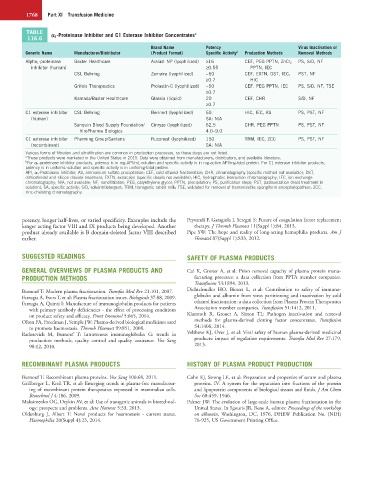
          TABLE   α 1-Proteinase Inhibitor and C1 Esterase Inhibitor Concentrates a
          116.6
                                                  Brand Name        Potency                        Virus Inactivation or
         Generic Name    Manufacturer/Distributor  (Product Format)  Specific Activity b  Production Methods  Removal Methods
         Alpha 1 -proteinase   Baxter Healthcare  Aralast NP (lyophilized)  ≥16  CEF, PEG PPTN, ZnCl 2    PS, S/D, NF
           inhibitor (human)                                        ≥0.55          PPTN, IEC
                         CSL Behring              Zemaira (lyophilized)  ~50     CEF, EXTN, DST, IEC,   PST, NF
                                                                    ≥0.7           HIC
                         Grifols Therapeutics     Prolastin-C (lyophilized)  ~50  CEF, PEG PPTN, IEC  PS, S/D, NF, TSE
                                                                    ≥0.7
                         Kamada/Baxter Healthcare  Glassia (liquid)  20          CEF, CHR          S/D, NF
                                                                    ≥0.7
         C1 esterase inhibitor   CSL Behring      Berinert (lyophilized)  50     HIC, IEC, AS      PS, PST, NF
           (human)                                                  SA: N/A
                         Sanquin Blood Supply Foundation/  Cinryze (lyophilized)  62.5  CHR, PEG PPTN  PS, PST, NF
                           ViroPharma Biologics                     4.0–9.0
         C1 esterase inhibitor   Pharming Group/Santaris  Ruconest (lyophilized)  150  TRM, IEC, ZCC  PS, PST, NF
           (recombinant)                                            SA: N/A
         Various forms of filtration and ultrafiltration are common in production processes, so those steps are not listed.
         a These products were marketed in the United States in 2015. Data were obtained from manufacturers, distributors, and available literature.
         b For α 1 -proteinase inhibitor products, potency is in mg-API/mL-solution and specific activity is in mg-active API/mg-total protein. For C1 esterase inhibitor products,
         potency is in units/mL-solution and specific activity is in units/mg-total protein.
         API, α 1 -Proteinase inhibitor; AS, ammonium sulfate precipitation; CEF, cold ethanol fractionation; CHR, chromatography (specific method not available); DST,
         dithiothreitol and silicon dioxide treatment; EXTN, extraction (specific details not available); HIC, hydrophobic interaction chromatography; IEC, ion-exchange
         chromatography; N/A, not available; NF, nanofiltration; PEG, polyethylene glycol; PPTN, precipitation; PS, purification steps; PST, pasteurization (heat treatment in
         solution); SA, specific activity; S/D, solvent/detergent; TRM, transgenic rabbit milk; TSE, validated for removal of transmissible spongiform encephalopathies; ZCC,
         zinc-chelating chromatography.


        potency, longer half-lives, or varied specificity. Examples include the   Peyvandi F, Garagiola I, Seregni S: Future of coagulation factor replacement
        longer acting factor VIII and IX products being developed. Another   therapy. J Thromb Haemost 11(Suppl 1):84, 2013.
        product already available is B domain-deleted factor VIII described   Pipe SW: The hope and reality of long-acting hemophilia products. Am J
        earlier.                                                 Hematol 87(Suppl 1):S33, 2012.

        SUGGESTED READINGS                                    SAFETY OF PLASMA PRODUCTS

        GENERAL OVERVIEWS OF PLASMA PRODUCTS AND              Cai  K,  Groner  A,  et al:  Prion  removal  capacity  of  plasma  protein  manu-
        PRODUCTION METHODS                                       facturing  processes:  a  data  collection  from  PPTA  member  companies.
                                                                 Transfusion 53:1894, 2013.
        Burnouf T: Modern plasma fractionation. Transfus Med Rev 21:101, 2007.  Dichtelmuller  HO,  Biesert  L,  et al:  Contribution  to  safety  of  immuno-
        Farrugia A, Evers T, et al: Plasma fractionation issues. Biologicals 37:88, 2009.  globulin and albumin from virus partitioning and inactivation by cold
        Farrugia A, Quinti I: Manufacture of immunoglobulin products for patients   ethanol fractionation: a data collection from Plasma Protein Therapeutics
           with primary antibody deficiencies - the effect of processing conditions   Association member companies. Transfusion 51:1412, 2011.
           on product safety and efficacy. Front Immunol 5:665, 2014.  Klamroth  R,  Groner  A,  Simon  TL:  Pathogen  inactivation  and  removal
        Ofosu FA, Freedman J, Semple JW: Plasma-derived biological medicines used   methods  for  plasma-derived  clotting  factor  concentrates.  Transfusion
           to promote haemostasis. Thromb Haemost 99:851, 2008.  54:1406, 2014.
        Radosevich  M,  Burnouf  T:  Intravenous  immunoglobulin  G:  trends  in   Velthove KJ, Over J, et al: Viral safety of human plasma-derived medicinal
           production  methods,  quality  control  and  quality  assurance.  Vox  Sang   products: impact of regulation requirements. Transfus Med Rev 27:179,
           98:12, 2010.                                          2013.

        RECOMBINANT PLASMA PRODUCTS                           HISTORY OF PLASMA PRODUCT PRODUCTION

        Burnouf T: Recombinant plasma proteins. Vox Sang 100:68, 2011.  Cohn EJ, Strong LE, et al: Preparation and properties of serum and plasma
        Grillberger L, Kreil TR, et al: Emerging trends in plasma-free manufactur-  proteins.  IV.  A  system  for  the  separation  into  fractions  of  the  protein
           ing of recombinant protein therapeutics expressed in mammalian cells.   and lipoprotein components of biological tissues and fluids. J Am Chem
           Biotechnol J 4:186, 2009.                             Soc 68:459, 1946.
        Maksimenko OG, Deykin AV, et al: Use of transgenic animals in biotechnol-  Palmer JW: The evolution of large-scale human plasma fractionation in the
           ogy: prospects and problems. Acta Naturae 5:33, 2013.  United States. In Sgouris JR, Rene A, editors: Proceedings of the workshop
        Oldenburg  J,  Albert  T:  Novel  products  for  haemostasis  -  current  status.   on  albumin,  Washington,  DC,  1976,  DHEW  Publication  No.  (NIH)
           Haemophilia 20(Suppl 4):23, 2014.                     76-925, US Government Printing Office.

