


Page 2017 - Hematology_ Basic Principles and Practice ( PDFDrive )
P. 2017
1788   Part XI  Transfusion Medicine


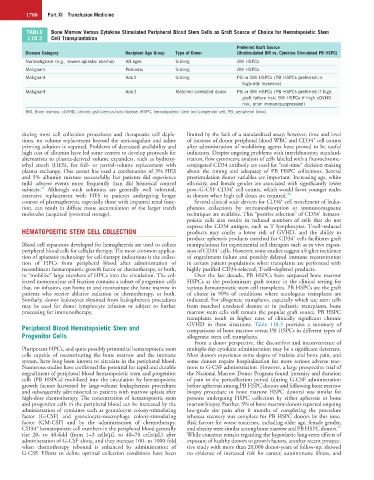
          TABLE   Bone Marrow Versus Cytokine Stimulated Peripheral Blood Stem Cells as Graft Source of Choice for Hematopoietic Stem
          118.3   Cell Transplantation
                                                                               Preferred Graft Source
         Disease Category                 Recipient Age Group  Type of Donor   (Unstimulated BM vs. Cytokine Stimulated PB HSPC)
         Nonmalignant (e.g., severe aplastic anemia)  All ages  Sibling        BM HSPCs
         Malignant                        Pediatric       Sibling              BM HSPCs
         Malignant                        Adult           Sibling              PB or BM HSPCs (PB HSPCs preferred in
                                                                                high-risk leukemia)
         Malignant                        Adult           Matched unrelated donor  PB or BM HSPCs (PB HSPCs preferred if high
                                                                                graft failure risk; BM HSPCs if high cGVHD
                                                                                risk, prior immunosuppression)
         BM, Bone marrow; cGVHD, chronic graft-versus-host disease; HSPC, hematopoietic stem and progenitor cell; PB, peripheral blood.


        during  most  cell  collection  procedures  and  therapeutic  cell  deple-  limited by the lack of a standardized assay; however, time and level
                                                                                                       +
        tions, no volume replacement beyond the anticoagulant and saline   of increase of donor peripheral blood WBC and CD34  cell counts
        priming solution is required. Problems of decreased availability and   after administration of mobilizing agents have proved to be useful
        high cost of albumin have led some centers to develop protocols for   indicators. Despite ongoing problems with interlaboratory standard-
        alternatives to plasma-derived volume expanders, such as hydroxy-  ization, flow cytometric analysis of cells labeled with a fluorochrome-
        ethyl  starch  (HES),  for  full-  or  partial-volume  replacement  with   conjugated CD34 antibody are used for “real-time” decision making
        plasma exchange. One center has used a combination of 3% HES   about  the  timing  and  adequacy  of  PB  HSPC  collections.  Several
        and  5%  albumin  mixture  successfully,  but  patients  did  experience   prestimulation donor variables are important. Increasing age, white
        mild  adverse  events  more  frequently  than  did  historical  control   ethnicity, and female gender are associated with significantly lower
                                                                             +
              25
        subjects.   Although  such  solutions  are  generally  well  tolerated,   post–G-CSF CD34  cell counts, which would favor younger males
        extensive  replacement  with  HES  in  patients  undergoing  longer   as donors when high cell doses are required. 26
                                                                                             +
        courses of plasmapheresis, especially those with impaired renal func-  Several clinical scale devices for CD34  cell enrichment of leuka-
        tion,  can  result  in  diffuse  tissue  accumulation  of  the  larger  starch   pheresis  collections  by  immunoabsorption  or  immunomagnetic
                                                                                                         +
        molecules (acquired lysosomal storage).               techniques are available. This “positive selection” of CD34  hemato-
                                                              poietic  cells  also  results  in  reduced  numbers  of  cells  that  do  not
                                                              express the CD34 antigen, such as T lymphocytes. T-cell–reduced
        HEMATOPOEITIC STEM CELL COLLECTION                    products  may  confer  a  lower  risk  of  GVHD,  and  the  ability  to
                                                                                                 +
                                                              produce apheresis products enriched for CD34  cells facilitates graft
        Blood cell separators developed for hemapheresis are used to collect   manipulations for experimental cell therapies such as ex vivo expan-
                                                                        +
        peripheral blood cells for cellular therapy. The most common applica-  sion of CD34  cells. However, some studies suggest a higher incidence
        tion of apheresis technology for cell therapy indications is the collec-  of engraftment failure and possibly delayed immune reconstitution
        tion  of  HPCs  from  peripheral  blood  after  administration  of   in certain patient populations when transplants are performed with
        recombinant hematopoietic growth factor or chemotherapy, or both,   highly purified CD34-selected, T-cell–depleted products.
        to “mobilize” large numbers of HPCs into the circulation. The col-  Over  the  last  decade,  PB  HSPCs  have  surpassed  bone  marrow
        lected mononuclear cell fraction contains a subset of progenitor cells   HSPCs  as  the  predominant  graft  source  in  the  clinical  setting  for
        that, on infusion, can home to and reconstitute the bone marrow in   various hematopoietic stem cell transplants. PB HSPCs are the graft
        patients  who  receive  ablative  radiation  or  chemotherapy,  or  both.   of  choice  in  99%  of  conditions  where  autologous  transplants  are
        Similarly, donor leukocytes obtained from leukapheresis procedures   indicated. For allogeneic transplants, especially which use stem cells
        may  be  used  for  donor  lymphocyte  infusion  or  subject  to  further   from  matched  unrelated  donors  or  in  pediatric  transplants,  bone
        processing for immunotherapy.                         marrow stem cells still remain the popular graft source. PB HSPC
                                                              transplants  result  in  higher  rates  of  clinically  significant  chronic
        Peripheral Blood Hematopoietic Stem and               GVHD  in  these  situations.  Table  118.3  provides  a  summary  of
                                                              comparisons of bone marrow versus PB HSPCs in different types of
        Progenitor Cells                                      allogeneic stem cell transplants.
                                                                 From a donor perspective, the discomfort and inconvenience of
        Pluripotent HPCs, and quite possibly primordial hematopoietic stem   multiple-day cytokine administration may be a significant deterrent.
        cells  capable  of  reconstituting  the  bone  marrow  and  the  immune   Most donors experience some degree of malaise and bone pain, and
        system, have long been known to circulate in the peripheral blood.   some donors require hospitalization for more serious adverse reac-
        Numerous studies have confirmed the potential for rapid and durable   tions to G-CSF administration. However, a large prospective trial of
        engraftment of peripheral blood hematopoietic stem and progenitor   the National Marrow Donor Program found intensity and duration
        cells (PB HSPCs) mobilized into the circulation by hematopoietic   of pain in the pericollection period (during G-CSF administration
        growth  factors  harvested  by  large-volume  leukapheresis  procedures   before apheresis among PB HSPC donors and following bone marrow
        and subsequently administered to patients with marrow aplasia after   biopsy  procedure  in  bone  marrow  HSPC  donors)  was  similar  for
        high-dose chemotherapy. The concentration of hematopoietic stem   persons  undergoing  HSPC  collection  by  either  apheresis  or  bone
        and progenitor cells in the peripheral blood can be increased by the   marrow biopsy. Further, 3% of bone marrow donors reported ongoing
        administration of cytokines such as granulocyte colony-stimulating   low-grade  site  pain  after  6  months  of  completing  the  procedure
        factor  (G-CSF)  and  granulocyte-macrophage  colony-stimulating   whereas recovery was complete for PB HSPC donors by this time.
        factor  (GM-CSF)  and  by  the  administration  of  chemotherapy.   Risk factors for worse toxicities, including older age, female gender,
             +
                                                                                                               27
        CD34  hematopoietic cell numbers in the peripheral blood generally   and obesity were similar among bone marrow and PB HSPC donors.
        rise  20-  to  40-fold  (from  1–3  cells/µL  to  40–70  cells/µL)  after   While concerns remain regarding the hypothetic long-term effects of
        administration of G-CSF alone, and they increase 100- to 1000-fold   exposure of healthy donors to growth factors, another recent prospec-
        when  chemotherapy  rebound  is  enhanced  by  administration  of   tive study with more than 20,000 donor-years of follow-up, showed
        G-CSF.  Efforts  to  define  optimal  collection  conditions  have  been   no  evidence  of  increased  risk  for  cancer,  autoimmune  illness,  and

