


Page 2125 - Hematology_ Basic Principles and Practice ( PDFDrive )
P. 2125
1886   Part XII  Hemostasis and Thrombosis


                                                    Injury                                     Legend
                     Intrinsic pathway                                   Extrinsic pathway        Enzymes
                        Factor XII                                           Exposed              Inhibitors
                       Prekallikrein                       Circulating     Tissue factor
                         HMWK                              Factor VIIa   Anionic membrane         Zymogens
                        “Surface”                                             Ca 2+               Complexes


                                AT                      Factor X
                          FXIa           Intrinsic tenase                 Extrinsic tenase   Factor IX
                                                                  TFPI
                                           Factor IXa             AT        Factor VIIa
                                           Factor VIIIa                    Tissue factor
               Factor IX       FIXa                           FIXa                           Factor X
                                        Anionic membrane                 Anionic membrane
                                             Ca 2+                            Ca 2+
                                                  FXa   Prothrombinase  FXa
                          FXIa               AT
                                                                          TFPI
                      AT                                  Factor Xa        AT           Fibrinogen
                                           Factor II      Factor Va
                                                       Anionic membrane
                     Activated platelets                    Ca 2+              Factor XIII
                        factor XI
                                                                                                 FPA
                                                                         Factor IIa
                                                       AT   FIIa                        FIIa
                                                                         AT
                          FIIa                                                                   FPB
                         (FXIIa)                                                 FXIIIa
                                          FVa i
                                                          Thrombin
                                         FVIIIa i       Thrombomodulin                  Crosslinked
                                                APC                        TAFIa
                                                       Anionic membrane                   fibrin
                                                            Ca 2+
                                                         Protein Case
                                              Protein C                 TAFI
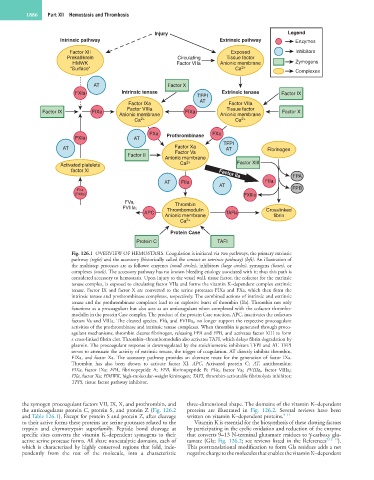
                        Fig. 126.1  OVERVIEW OF HEMOSTASIS. Coagulation is initiated via two pathways, the primary extrinsic
                        pathway (right) and the accessory (historically called the contact or intrinsic pathway) (left). An illustration of
                        the multistep processes are as follows: enzymes (small circles), inhibitors (large circles), zymogens (boxes), or
                        complexes (ovals). The accessory pathway has no known bleeding etiology associated with it; thus this path is
                        considered accessory to hemostasis. Upon injury to the vessel wall, tissue factor, the cofactor for the extrinsic
                        tenase complex, is exposed to circulating factor VIIa and forms the vitamin K–dependent complex extrinsic
                        tenase. Factor IX and factor X are converted to the serine proteases FIXa and FXa, which then form the
                        intrinsic tenase and prothrombinase complexes, respectively. The combined actions of intrinsic and extrinsic
                        tenase and the prothrombinase complexes lead to an explosive burst of thrombin (IIa). Thrombin not only
                        functions as a procoagulant but also acts as an anticoagulant when complexed with the cofactor thrombo-
                        modulin in the protein Case complex. The product of the protein Case reaction, APC, inactivates the cofactors
                        factors Va and VIIIa. The cleaved species, FVa i  and FVIIIa i , no longer support the respective procoagulant
                        activities of the prothrombinase and intrinsic tenase complexes. When thrombin is generated through proco-
                        agulant mechanisms, thrombin cleaves fibrinogen, releasing FPA and FPB, and activates factor XIII to form
                        a cross-linked fibrin clot. Thrombin–thrombomodulin also activates TAFI, which delays fibrin degradation by
                        plasmin. The procoagulant response is downregulated by the stoichiometric inhibitors TFPI and AT. TFPI
                        serves to attenuate the activity of extrinsic tenase, the trigger of coagulation. AT directly inhibits thrombin,
                        FIXa,  and  factor  Xa. The  accessory  pathway  provides  an  alternate  route  for  the  generation  of  factor  IXa.
                        Thrombin  has  also  been  shown  to  activate  factor  XI.  APC,  Activated  protein  C;  AT,  antithrombin;
                        FIXa,  factor  IXa;  FPA,  fibrinopeptide  A;  FPB,  fibrinopeptide  B;  FVa i ,  factor  Va i ;  FVIIIa i ,  factor  VIIIa i ;
                        FXa, factor Xa; HMWK, high-molecular-weight kininogen; TAFI, thrombin-activatable fibrinolysis inhibitor;
                        TFPI, tissue factor pathway inhibitor.


        the zymogen procoagulant factors VII, IX, X, and prothrombin, and   three-dimensional shape. The domains of the vitamin K–dependent
        the anticoagulants protein C, protein S, and protein Z (Fig. 126.2   proteins  are  illustrated  in  Fig.  126.2.  Several  reviews  have  been
        and Table 126.1). Except for protein S and protein Z, after cleavage   written on vitamin K–dependent proteins. 9–11
        to their active forms these proteins are serine proteases related to the   Vitamin K is essential for the biosynthesis of these clotting factors
        trypsin  and  chymotrypsin  superfamily.  Peptide  bond  cleavage  at   by participating in the cyclic oxidation and reduction of the enzyme
        specific sites converts the vitamin K–dependent zymogens to their   that converts 9–13 N-terminal glutamate residues to γ-carboxy glu-
        active serine protease forms. All share noncatalytic domains, each of   tamate (Gla; Fig. 126.2; see reviews listed in the References 9,12–14 ).
        which is characterized by highly conserved regions that fold, inde-  This posttranslational modification to form Gla residues adds a net
        pendently  from  the  rest  of  the  molecule,  into  a  characteristic   negative charge to the molecules that enables the vitamin K–dependent

