


Page 2128 - Hematology_ Basic Principles and Practice ( PDFDrive )
P. 2128
Chapter 126  Molecular Basis of Blood Coagulation  1889


                                                                                     Inactive vitamin K–
                                                                                     dependent proteins
                                                    Vitamin K                         factors II, VII, IX,
                                                  hydroquinone
                                                                                    and X, proteins C, S,
                                                                                         and Z
                                Warfarin
                                                                                        Glu


                                                                  Vitamin K–dependent
                                 Vitamin K
                                                                     carboxylase


                                                                                        Gla
                               Warfarin

                                                    Vitamin K                       Activated vitamin K–
                                                    epoxide                          dependent proteins

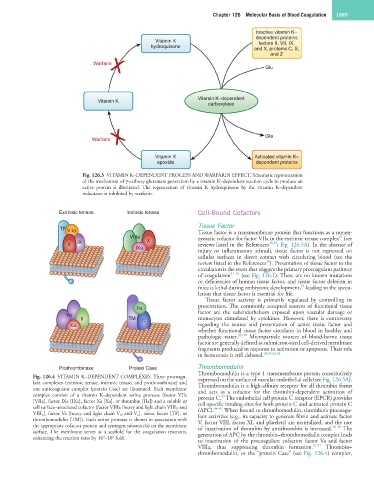
                            Fig. 126.3  VITAMIN K–DEPENDENT PROCESS AND WARFARIN EFFECT. Schematic representation
                            of the mechanism of γ-carboxy glutamate generation by a vitamin K–dependent reaction cycle to produce an
                            active  protein  is  illustrated.  The  regeneration  of  vitamin  K  hydroquinone  by  the  vitamin  K–dependent
                            reductases is inhibited by warfarin.


                    Extrinsic tenase      Intrinsic tenase        Cell-Bound Cofactors
                                                                  Tissue Factor
                     TF  VIIa                                     Tissue factor is a transmembrane protein that functions as a nonen-
                                           VIIIa                  zymatic cofactor for factor VIIa in the extrinsic tenase complex  (see
                                                                                                                27
                       X  IX                     X                reviews listed in the References 28,29 ; Fig. 126.5A). In the absence of
                                             IXa
                                                                  injury  or  inflammatory  stimuli,  tissue  factor  is  not  expressed  on
                                                                  cellular  surfaces  in  direct  contact  with  circulating  blood  (see  the
                                                                                        30
                                                                  review listed in the References ). Presentation of tissue factor to the
                                                                  circulation is the event that triggers the primary procoagulant pathway
                                                                  of coagulation 31–33  (see Fig. 126.1). There are no known mutations
                                                                  or deficiencies of human tissue factor, and tissue factor deletion in
                                                                                                   34
                                                                  mice is lethal during embryonic development,  leading to the specu-
                                                                  lation that tissue factor is essential for life.
                                                                    Tissue  factor  activity  is  primarily  regulated  by  controlling  its
                                              IIa                 presentation. The  commonly  accepted  sources  of  functional  tissue
                       Va                                         factor  are  the  subendothelium  exposed  upon  vascular  damage  or
                           II              TM  C                  monocytes  stimulated  by  cytokines.  However,  there  is  controversy
                        Xa                                        regarding  the  source  and  presentation  of  active  tissue  factor  and
                                                                  whether functional tissue factor circulates in blood in healthy and
                                                                  pathologic  states. 35–40   Microparticle  sources  of  blood-borne  tissue
                                                                  factor are generally defined as submicron-sized cell-derived membrane
                                                                  fragments produced in response to activation or apoptosis. Their role
                                                                  in hemostasis is still debated. 28,35,41,42
                    Prothrombinase         Protein Case           Thrombomodulin
                                                                  Thrombomodulin is a type 1 transmembrane protein constitutively
            Fig. 126.4  VITAMIN K–DEPENDENT COMPLEXES. Three procoagu-  expressed on the surface of vascular endothelial cells (see Fig. 126.5A).
            lant complexes (extrinsic tenase, intrinsic tenase, and prothrombinase) and   Thrombomodulin is a high-affinity receptor for all thrombin forms
            one  anticoagulant  complex  (protein  Case)  are  illustrated.  Each  membrane   and  acts  as  a  cofactor  for  the  thrombin-dependent  activation  of
            complex  consists  of  a  vitamin  K–dependent  serine  protease  (factor  VIIa   protein C.  The endothelial cell protein C receptor (EPCR) provides
                                                                         43
            [VIIa], factor IXa [IXa], factor Xa [Xa], or thrombin [IIa]) and a soluble or   cell-specific binding sites for both protein C and activated protein C
            cell surface–associated cofactor (factor VIIIa [heavy and light chain VIII H  and   (APC). 44–47  When bound to thrombomodulin, thrombin’s procoagu-
            VIII L ], factor Va [heavy and light chain V H  and V L ], tissue factor [TF], or   lant activities (e.g., its capacity to generate fibrin and activate factor
            thrombomodulin [TM]). Each serine protease is shown in association with   V, factor VIII, factor XI, and platelets) are neutralized, and the rate
            the appropriate cofactor protein and zymogen substrate(s) on the membrane   of  inactivation  of  thrombin  by antithrombin  is  increased. 48–50  The
            surface. The  membrane  serves  as  a  scaffold  for  the  coagulation  reactants,   generation of APC by the thrombin–thrombomodulin complex leads
                                   4
                                      9
            enhancing the reaction rates by 10 –10 -fold.
                                                                  to  inactivation  of  the  procoagulant  cofactors  factor  Va  and  factor
                                                                  VIIIa,  thus  suppressing  thrombin  formation. 51,52   Thrombin–
                                                                  thrombomodulin,  or  the  “protein  Case”  (see  Fig. 126.4)  complex,

