


Page 2127 - Hematology_ Basic Principles and Practice ( PDFDrive )
P. 2127
1888   Part XII  Hemostasis and Thrombosis


                                                      R152 – I153
                 FACTOR VII

                 NH 2         Gla           EGF1   EGF2       Serine protease  COOH
                                                       S           S

                                                     R145 – A146 R180 – V181
                 FACTOR IX

                 NH 2         Gla           EGF1   EGF2       AP      Serine protease  COOH
                                                    S                   S

                                                              R194 – I195
                 FACTOR X

                 NH 2         Gla           EGF1   EGF2       AP      Serine protease  COOH
                                                    S                   S

                                                                            R271 – T272  R320 – I321
                 PROTHROMBIN
                 NH 2         Gla                  K1                 K2              Serine protease  COOH

                                                                                    S            S

                                                              R169 – L170
                 PROTEIN C
                 NH 2         Gla           EGF1   EGF2       AP      Serine protease  COOH

                                                    S                   S
                 PROTEIN S

                 NH 2         Gla          TSR     EGF1    EGF2    EGF3    EGF4       SHGB domain     COOH

                 PROTEIN Z

                 NH 2         Gla           EGF1   EGF2       Pseudo catalytic domain  COOH
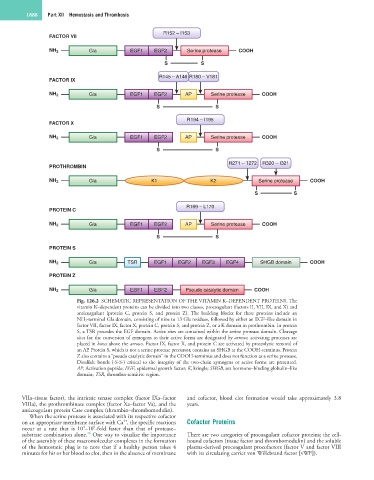
                          Fig. 126.2  SCHEMATIC REPRESENTATION OF THE VITAMIN K–DEPENDENT PROTEINS. The
                          vitamin K–dependent proteins can be divided into two classes, procoagulant (factors II, VII, IX, and X) and
                          anticoagulant  (protein  C,  protein  S,  and  protein  Z).  The  building  blocks  for  these  proteins  include  an
                          NH 2-terminal Gla domain, consisting of nine to 13 Gla residues, followed by either an EGF–like domain in
                          factor VII, factor IX, factor X, protein C, protein S, and protein Z, or a K domain in prothrombin. In protein
                          S, a TSR precedes the EGF domain. Active sites are contained within the serine protease domain. Cleavage
                          sites for the conversion of zymogens to their active forms are designated by arrows; activating proteases are
                          placed in boxes above the arrows. Factor IX, factor X, and protein C are activated by proteolytic removal of
                          an AP. Protein S, which is not a serine protease precursor, contains an SHGB at the COOH-terminus. Protein
                          Z also contains a “pseudo catalytic domain” in the COOH-terminus and does not function as a serine protease.
                          Disulfide  bonds  (-S-S-)  critical  to  the  integrity  of  the  two-chain  zymogens  or  active  forms  are  presented.
                          AP, Activation peptide; EGF, epidermal growth factor; K, kringle; SHGB, sex hormone–binding globulin–like
                          domain; TSR, thrombin-sensitive region.


        VIIa–tissue factor), the intrinsic tenase complex (factor IXa–factor   and  cofactor,  blood  clot  formation  would  take  approximately  3.8
        VIIIa), the prothrombinase complex (factor Xa–factor Va), and the   years.
        anticoagulant protein Case complex (thrombin–thrombomodulin).
           When the serine protease is associated with its respective cofactor
                                         2+
        on an appropriate membrane surface with Ca , the specific reactions   Cofactor Proteins
                                9
                            4
        occur  at  a  rate  that  is  10 –10 -fold  faster  than  that  of  protease–
                              26
        substrate combination alone.  One way to visualize the importance   There are two categories of procoagulant cofactor proteins; the cell-
        of the assembly of these macromolecular complexes in the formation   bound cofactors (tissue factor and thrombomodulin) and the soluble
        of  the  hemostatic  plug  is  to  note  that  if  a  healthy  person  takes  4   plasma-derived procoagulant procofactors (factor V and factor VIII
        minutes for his or her blood to clot, then in the absence of membrane   with its circulating carrier von Willebrand factor [vWF]).

