


Page 2126 - Hematology_ Basic Principles and Practice ( PDFDrive )
P. 2126
Chapter 126  Molecular Basis of Blood Coagulation  1887


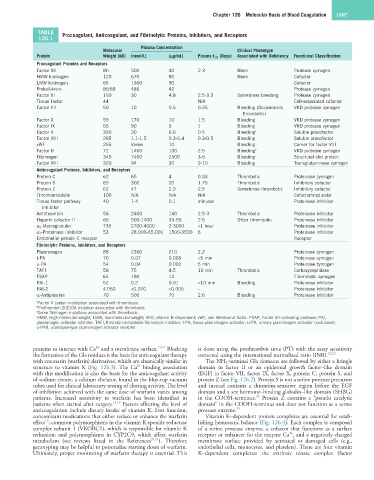
             TABLE   Procoagulant, Anticoagulant, and Fibrinolytic Proteins, Inhibitors, and Receptors
              126.1
                                               Plasma Concentration
                                   Molecular                                   Clinical Phenotype
             Protein               Weight (kD)  (nmol/L)  (µg/mL)  Plasma t 1/2  (Days)  Associated with Deficiency  Functional Classification
             Procoagulant Proteins and Receptors
             Factor XII            80       500         40        2-3          None              Protease zymogen
             HMW kininogen         120      670         80                     None              Cofactor
             LMW kininogen         66       1300        90                                       Cofactor
             Prekallikrein         85/88    486         42                                       Protease zymogen
             Factor XI             160      30          4.8       2.5-3.3      Sometimes bleeding  Protease zymogen
             Tissue factor         44                             N/A                            Cell-associated cofactor
             Factor VII            50       10          0.5       0.25         Bleeding (Occasionally   VKD protease zymogen
                                                                                thrombotic)
             Factor X              59       170         10        1.5          Bleeding          VKD protease zymogen
             Factor IX             55       90          5         1            Bleeding          VKD protease zymogen
             Factor V              330      20          6.6       0.5          Bleeding a        Soluble procofactor
             Factor VIII           285      1.1-1.5     0.3-0.4   0.3-0.5      Bleeding          Soluble procofactor
             vWF                   255      Varies      10                     Bleeding          Carrier for factor VIII
             Factor II             72       1400        100       2.5          Bleeding b        VKD protease zymogen
             Fibrinogen            340      7400        2500      3-5          Bleeding c        Structural clot protein
             Factor XIII           320      94          30        9-10         Bleeding          Transglutaminase zymogen
             Anticoagulant Proteins, Inhibitors, and Receptors
             Protein C             62       65          4         0.33         Thrombotic        Proteinase zymogen
             Protein S             69       300         20        1.75         Thrombotic        Inhibitory cofactor
             Protein Z             62       47          2.9       2.5          Sometimes thrombotic  Inhibitory cofactor
             Thrombomodulin        100      N/A         N/A       N/A                            Cofactor/modulator
             Tissue factor pathway   40     1-4         0.1       minutes                        Proteinase inhibitor
               inhibitor
             Antithrombin          58       2400        140       2.5-3        Thrombotic        Proteinase inhibitor
             Heparin cofactor II   66       500-1400    33-90     2.5          Often thrombotic  Proteinase inhibitor
             α 2 -Macroglobulin    735      2700-4000   2-3000    <1 hour                        Proteinase inhibitor
             α 1 -Proteinase inhibitor  53  28,000-65,000  1500-3500  6                          Proteinase inhibitor
             Endothelial protein C receptor                                                      Receptor
             Fibrinolytic Proteins, Inhibitors, and Receptors
             Plasminogen           88       2300        210       2.2                            Proteinase zymogen
             t-PA                  70       0.07        0.005     <5 min                         Proteinase zymogen
             u-PA                  54       0.04        0.002     5 min                          Proteinase zymogen
             TAFI                  58       75          4.5       10 min       Thrombotic        Carboxypeptidase
             FSAP                  64       190         12                                       Fibrinolytic zymogen
             PAI-1                 52       0.2         0.01      <10 min      Bleeding          Proteinase inhibitor
             PAI-2                 47/60    <0.070      <0.005    −                              Proteinase inhibitor
             α-Antiplasmin         70       500         70        2.6          Bleeding          Proteinase inhibitor
             a Factor V Leiden mutatation associated with thrombosis.
             b Prothrombin 20210A mutation associated with thrombosis.
             c Some fibrinogen mutations associated with thrombosis.
             HMW, High-molecular-weight; LMW, low-molecular-weight; VKD, vitamin K–dependent; vWF, von Willebrand factor. FSAP, Factor VII–activating protease; PAI,
             plasminogen activator inhibitor; TAFI, thrombin-activatable fibrinolysis inhibitor; t-PA, tissue plasminogen activator; u-PA, urinary plasminogen activator (urokinase);
             u-PAR, urokinase-type plasminogen activator receptor.


                                2+
            proteins to interact with Ca  and a membrane surface. 15,16  Blocking   is done using the prothrombin time (PT) with the assay sensitivity
            the formation of the Gla residues is the basis for anticoagulant therapy   corrected using the international normalized ratio (INR). 22,23
            with coumarin (warfarin) derivatives, which are chemically similar in   The NH 2 -terminal Gla domains are followed by either a kringle
                                              2+
            structure  to  vitamin  K  (Fig.  126.3). The  Ca   binding  association   domain  in  factor  II  or  an  epidermal  growth  factor–like  domain
            with this modification is also the basis for the anticoagulant activity   (EGF) in factor VII, factor IX, factor X, protein C, protein S, and
            of sodium citrate, a calcium chelator, found in the blue-top vacuum   protein Z (see Fig. 126.2). Protein S is not a serine protease precursor
            tubes used for clinical laboratory testing of clotting activity. The level   and  instead  contains  a  thrombin-sensitive  region  before  the  EGF
            of inhibition achieved with the same dose of warfarin varies among   domain and a sex hormone–binding globulin–like domain (SHBG)
                                                                                     24
            patients.  Increased  sensitivity  to  warfarin  has  been  identified  in   in  the  COOH-terminus.   Protein  Z  contains  a  “pseudo  catalytic
            patients when started after surgery. 17,18  Factors affecting the level of   domain” in the COOH-terminus and does not function as a serine
            anticoagulation include dietary intake of vitamin K; liver function;   protease enzyme. 25
            concomitant medications that either reduce or enhance the warfarin   Vitamin K–dependent protein complexes are essential for estab-
                19
            effect ; common polymorphisms in the vitamin K epoxide reductase   lishing hemostatic balance (Fig. 126.4). Each complex is composed
            complex subunit 1 (VKORC1), which is responsible for vitamin K   of a serine protease enzyme, a cofactor that functions as a surface
                                                                                                2+
            reduction;  and  polymorphisms  in  CYP2C9,  which  affect  warfarin   receptor or enhancer for the enzyme Ca , and a negatively charged
            metabolism  (see  reviews  listed  in  the  References 20,21 ).  Therefore   membrane  surface  provided  by  activated  or  damaged  cells  (e.g.,
            genotyping may be helpful to personalize starting doses of warfarin.   endothelial cells, monocytes, and platelets). There are four vitamin
            Ultimately, proper monitoring of warfarin therapy is essential. This   K–dependent  complexes:  the  extrinsic  tenase  complex  (factor

