


Page 2233 - Hematology_ Basic Principles and Practice ( PDFDrive )
P. 2233
1980   Part XII  Hemostasis and Thrombosis


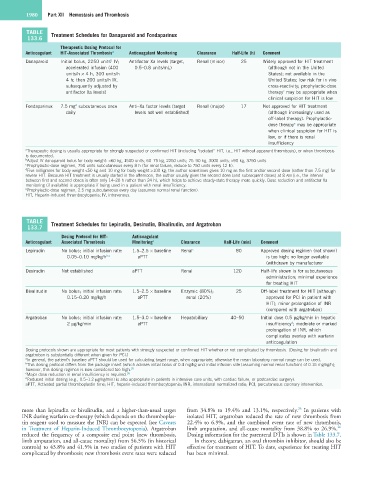
          TABLE   Treatment Schedules for Danaparoid and Fondaparinux
          133.6
                     Therapeutic Dosing Protocol for
         Anticoagulant  HIT-Associated Thrombosis a  Anticoagulant Monitoring  Clearance  Half-Life (h)  Comment
                                     b
         Danaparoid  Initial bolus, 2250 units  IV;   Antifactor Xa levels (target,   Renal (minor)  25  Widely approved for HIT treatment
                       accelerated infusion (400   0.5–0.8 units/mL)                     (although not in the United
                       units/h × 4 h, 300 units/h                                        States); not available in the
                       4 h; then 200 units/h IV,                                         United States; low risk for in vivo
                       subsequently adjusted by                                          cross-reactivity; prophylactic-dose
                       antifactor Xa levels)                                             therapy  may be appropriate when
                                                                                              c
                                                                                         clinical suspicion for HIT is low
         Fondaparinux  7.5 mg  subcutaneous once   Anti–Xa factor levels (target   Renal (major)  17  Not approved for HIT treatment
                          d
                       daily                 levels not well established)                (although increasingly used as
                                                                                         off-label therapy). Prophylactic-
                                                                                         dose therapy  may be appropriate
                                                                                                 e
                                                                                         when clinical suspicion for HIT is
                                                                                         low, or if there is renal
                                                                                         insufficiency
         a Therapeutic dosing is usually appropriate for strongly suspected or confirmed HIT (including “isolated” HIT, i.e., HIT without apparent thrombosis), or when thrombosis
         is documented.
         b Adjust IV danaparoid bolus for body weight: <60 kg, 1500 units; 60–75 kg, 2250 units; 75–90 kg, 3000 units; >90 kg, 3750 units.
         c Prophylactic-dose regimen, 750 units subcutaneous every 8 h (for renal failure, reduce to 750 units every 12 h).
         d Five milligrams for body weight <50 kg and 10 mg for body weight >100 kg; the author sometimes gives 10 mg as the first and/or second dose (rather than 7.5 mg) for
         severe HIT. Because HIT treatment is usually started in the afternoon, the author usually gives the second dose (and subsequent doses) at 8 AM (i.e., the interval
         between first and second doses is often only 14–20 h rather than 24 h), which helps to achieve steady-state therapy more quickly. Dose reduction and antifactor Xa
         monitoring (if available) is appropriate if being used in a patient with renal insufficiency.
         e Prophylactic-dose regimen, 2.5 mg subcutaneous every day (assumes normal renal function).
         HIT, Heparin-induced thrombocytopenia; IV, intravenous.


          TABLE   Treatment Schedules for Lepirudin, Desirudin, Bivalirudin, and Argatroban
          133.7
                     Dosing Protocol for HIT-  Anticoagulant
         Anticoagulant  Associated Thrombosis  Monitoring a  Clearance    Half-Life (min)  Comment
         Lepirudin   No bolus; initial infusion rate:   1.5–2.5 × baseline   Renal c  80  Approved dosing regimen (not shown)
                       0.05–0.10 mg/kg/h b,c  aPTT                                      is too high; no longer available
                                                                                        (withdrawn by manufacturer
         Desirudin   Not established        aPTT            Renal            120      Half-life shown is for subcutaneous
                                                                                        administration; minimal experience
                                                                                        for treating HIT
         Bivalirudin  No bolus; initial infusion rate:   1.5–2.5 × baseline   Enzymic (80%);   25  Off-label treatment for HIT (although
                       0.15–0.20 mg/kg/h      aPTT            renal (20%)               approved for PCI in patient with
                                                                                        HIT); minor prolongation of INR
                                                                                        (compared with argatroban)
         Argatroban  No bolus; initial infusion rate:   1.5–3.0 × baseline   Hepatobiliary  40–50  Initial dose 0.5 µg/kg/min in hepatic
                       2 µg/kg/min            aPTT                                      insufficiency ; moderate or marked
                                                                                                d
                                                                                        prolongation of INR, which
                                                                                        complicates overlap with warfarin
                                                                                        anticoagulation
         Dosing protocols shown are appropriate for most patients with strongly suspected or confirmed HIT whether or not complicated by thrombosis. (Dosing for bivalirudin and
         argatroban is substantially different when given for PCI.)
         a In general, the patient’s baseline aPTT should be used for calculating target range, when appropriate; otherwise the mean laboratory normal range can be used.
         b This dosing protocol differs from the package insert (which advises initial bolus of 0.4 mg/kg and initial infusion rate [assuming normal renal function] of 0.15 mg/kg/h);
         however, this dosing regimen is now considered too high. 26
         c Major dose reduction in renal insufficiency is required. 26
         d Reduced initial dosing (e.g., 0.5–1.2 µg/kg/min) is also appropriate in patients in intensive care units, with cardiac failure, or postcardiac surgery).
         aPTT, Activated partial thromboplastin time; HIT, heparin-induced thrombocytopenia; INR, international normalized ratio; PCI, percutaneous coronary intervention.


                                                                                                  26
        more  than  lepirudin  or  bivalirudin,  and  a  higher-than-usual  target   from  34.8%  to  19.4%  and  13.1%,  respectively.   In  patients  with
        INR during warfarin co-therapy (which depends on the thromboplas-  isolated HIT, argatroban reduced the rate of new thrombosis from
        tin reagent used to measure the INR) can be expected (see Caveats   22.4%  to  6.9%,  and  the  combined  event  rate  of  new  thrombosis,
                                                                                                               26
        in  Treatment  of  Heparin-Induced  Thrombocytopenia).  Argatroban   limb  amputation,  and  all-cause  mortality  from  38.8%  to  26.9%.
        reduced  the  frequency  of  a  composite  end  point  (new  thrombosis,   Dosing information for the parenteral DTIs is shown in Table 133.7.
        limb amputation, and all-cause mortality) from 56.5% (in historical   In theory, dabigatran, an oral thrombin inhibitor, should also be
        controls) to 43.8% and 41.5% in two studies of patients with HIT   effective for treatment of HIT. To date, experience for treating HIT
        complicated by thrombosis; new thrombosis event rates were reduced   has been minimal.

