


Page 2232 - Hematology_ Basic Principles and Practice ( PDFDrive )
P. 2232
Chapter 133  Heparin-Induced Thrombocytopenia  1979


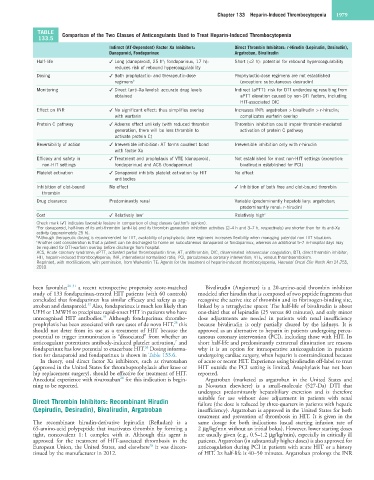
             TABLE   Comparison of the Two Classes of Anticoagulants Used to Treat Heparin-Induced Thrombocytopenia
              133.5
                                     Indirect (AT-Dependent) Factor Xa Inhibitors:   Direct Thrombin Inhibitors: r-Hirudin (Lepirudin, Desirudin),
                                     Danaparoid, Fondaparinux                 Argatroban, Bivalirudin
                                                      a
             Half-life               ✓ Long (danaparoid, 25 h ; fondaparinux, 17 h):   Short (<2 h): potential for rebound hypercoagulability
                                       reduces risk of rebound hypercoagulability
             Dosing                  ✓ Both prophylactic- and therapeutic-dose   Prophylactic-dose regimens are not established
                                       regimens b                               (exception: subcutaneous desirudin)
             Monitoring              ✓ Direct (anti-Xa levels): accurate drug levels   Indirect (aPTT): risk for DTI underdosing resulting from
                                       obtained                                 aPTT elevation caused by non-DTI factors, including
                                                                                HIT-associated DIC
             Effect on INR           ✓ No significant effect: thus simplifies overlap   Increases INR: argatroban > bivalirudin > r-hirudin;
                                       with warfarin                            complicates warfarin overlap
             Protein C pathway       ✓ Adverse effect unlikely (with reduced thrombin   Thrombin inhibition could impair thrombin-mediated
                                       generation, there will be less thrombin to   activation of protein C pathway
                                       activate protein C)
             Reversibility of action  ✓ Irreversible inhibition: AT forms covalent bond   Irreversible inhibition only with r-hirudin
                                       with factor Xa
             Efficacy and safety in   ✓ Treatment and prophylaxis of VTE (danaparoid,   Not established for most non-HIT settings (exception:
               non-HIT settings        fondaparinux) and ACS (fondaparinux)     bivalirudin established for PCI)
             Platelet activation     ✓ Danaparoid inhibits platelet activation by HIT   No effect
                                       antibodies
             Inhibition of clot-bound   No effect                             ✓ Inhibition of both free and clot-bound thrombin
               thrombin
             Drug clearance          Predominantly renal                      Variable (predominantly hepatobiliary: argatroban;
                                                                                predominantly renal: r-hirudin)
             Cost                    ✓ Relatively low c                       Relatively high c
             Check mark (✓) indicates favorable feature in comparison of drug classes (author’s opinion).
             a For danaparoid, half-lives of its anti-thrombin (anti-IIa) and its thrombin generation inhibition activities (2–4 h and 3–7 h, respectively) are shorter than for its anti-Xa
             activity (approximately 25 h).
             b Although therapeutic dosing is recommended for HIT, availability of prophylactic-dose regimens increases flexibility when managing potential non-HIT situations.
             c Another cost consideration is that a patient can be discharged to home on subcutaneous danaparoid or fondaparinux, whereas an additional 5–7 in-hospital days may
             be required for DTI-warfarin overlap before discharge from hospital.
             ACS, Acute coronary syndrome; aPTT, activated partial thromboplastin time; AT, antithrombin; DIC, disseminated intravascular coagulation; DTI, direct thrombin inhibitor;
             HIT, heparin-induced thrombocytopenia; INR, international normalized ratio; PCI, percutaneous coronary intervention; VTE, venous thromboembolism.
             Reprinted, with modifications, with permission, from Warkentin TE: Agents for the treatment of heparin-induced thrombocytopenia, Hematol Oncol Clin North Am 24:755,
             2010.


            been favorable; 28–31  a recent retrospective propensity score-matched   Bivalirudin  (Angiomax)  is  a  20-amino-acid  thrombin  inhibitor
            study of 133 fondaparinux-treated HIT patients (with 60 controls)   modeled after hirudin that is composed of two peptide fragments that
            concluded that fondaparinux has similar efficacy and safety as arg-  recognize the active site of thrombin and its fibrinogen-binding site,
                              32
            atroban and danaparoid.  Also, fondaparinux is much less likely than   linked by a tetraglycine spacer. The half-life of bivalirudin is about
            UFH or LMWH to precipitate rapid-onset HIT in patients who have   one-third that of lepirudin (25 versus 80 minutes), and only minor
                                   33
            unrecognized  HIT  antibodies.   Although  fondaparinux  thrombo-  dose  adjustments  are  needed  in  patients  with  renal  insufficiency
                                                          28
            prophylaxis has been associated with rare cases of de novo HIT,  this   because  bivalirudin  is  only  partially  cleared  by  the  kidneys.  It  is
            should  not  deter  from  its  use  as  a  treatment  of  HIT  because  the   approved as an alternative to heparin in patients undergoing percu-
            potential to trigger immunization is “dissociated” from whether an   taneous coronary intervention (PCI), including those with HIT. Its
                                                          7
            anticoagulant potentiates antibody-induced platelet activation,  and   short half-life and predominantly extrarenal elimination are reasons
                                                33
            fondaparinux has low potential to exacerbate HIT.  Dosing informa-  why  it  is  an  option  for  intraoperative  anticoagulation  in  patients
            tion for danaparoid and fondaparinux is shown in Table 133.6.  undergoing cardiac surgery, when heparin is contraindicated because
              In  theory,  oral  direct  factor  Xa  inhibitors,  such  as  rivaroxaban   of acute or recent HIT. Experience using bivalirudin off-label to treat
            (approved in the United States for thromboprophylaxis after knee or   HIT outside the PCI setting is limited. Anaphylaxis has not been
            hip replacement surgery), should be effective for treatment of HIT.   reported.
                                        20
            Anecdotal experience with rivaroxaban  for this indication is begin-  Argatroban  (marketed  as  argatroban  in  the  United  States  and
            ning to be reported.                                  as  Novastan  elsewhere)  is  a  small-molecule  (527-Da)  DTI  that
                                                                  undergoes  predominantly  hepatobiliary  excretion  and  is  therefore
            Direct Thrombin Inhibitors: Recombinant Hirudin       suitable  for  use  without  dose  adjustment  in  patients  with  renal
                                                                  failure (the dose is reduced by three-quarters in patients with hepatic
            (Lepirudin, Desirudin), Bivalirudin, Argatroban       insufficiency). Argatroban is approved in the United States for both
                                                                  treatment  and prevention  of  thrombosis  in  HIT. It is  given in the
            The  recombinant  hirudin-derivative  lepirudin  (Refludan)  is  a   same  dosage  for  both  indications  (usual  starting  infusion  rate  of
            65-amino-acid polypeptide that inactivates thrombin by forming a   2 µg/kg/min without an initial bolus). However, lower starting doses
            tight,  noncovalent  1 : 1  complex  with  it.  Although  this  agent  is   are usually given (e.g., 0.5–1.2 µg/kg/min), especially in critically ill
            approved  for  the  treatment  of  HIT-associated  thrombosis  in  the   patients. Argatroban (in substantially higher doses) is also approved for
                                                  26
            European Union, the United States, and elsewhere  it was discon-  anticoagulation during PCI in patients with acute HIT or a history
            tinued by the manufacturer in 2012.                   of HIT. Its half-life is 40–50 minutes. Argatroban prolongs the INR

