


Page 2231 - Hematology_ Basic Principles and Practice ( PDFDrive )
P. 2231
1978   Part XII  Hemostasis and Thrombosis


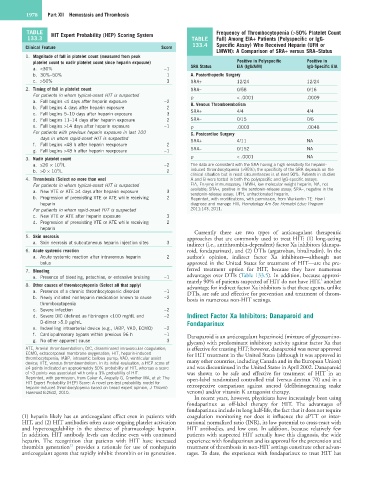
          TABLE   HIT Expert Probability (HEP) Scoring System           Frequency of Thrombocytopenia (>50% Platelet Count
          133.3                                                 TABLE   Fall) Among EIA+ Patients (Polyspecific or IgG-
                                                                133.4   Specific Assay) Who Received Heparin (UFH or
         Clinical Feature                             Score
                                                                        LMWH): A Comparison of SRA+ versus SRA–Status
         1.  Magnitude of fall in platelet count (measured from peak
            platelet count to nadir platelet count since heparin exposure)     Positive in Polyspecific   Positive in
             a.  <30%                                  −1      SRA Status      EIA (IgG/A/M)         IgG-Specific EIA
             b.  30%–50%                                1      A. Postorthopedic Surgery
             c.  >50%                                   3      SRA+            12/24                 12/24
         2.  Timing of fall in platelet count                  SRA–            0/58                  0/16
            For patients in whom typical-onset HIT is suspected  p             < .0001               .0009
             a.  Fall begins <4 days after heparin exposure  −2  B. Venous Thromboembolism
             b.  Fall begins 4 days after heparin exposure  2  SRA+
             c.  Fall begins 5–10 days after heparin exposure  3               4/4                   4/4
             d.  Fall begins 11–14 days after heparin exposure  2  SRA–        0/15                  0/6
             e.  Fall begins >14 days after heparin exposure  −1  p            .0003                 .0048
            For patients with previous heparin exposure in last 100   C. Postcardiac Surgery
              days in whom rapid-onset HIT is suspected        SRA+            4/11                  NA
             f.  Fall begins <48 h after heparin reexposure  2
             g.  Fall begins >48 h after heparin reexposure  −1  SRA–          0/152                 NA
         3.  Nadir platelet count                              p               < .0001               NA
             a.  ≤20 × 10 /L                           −2      The data are consistent with the SRA having a high sensitivity for heparin-
                     9
                    9
             b.  >0 × 10 /L                             2      induced thrombocytopenia (>95%); the specificity of the SRA depends on the
                                                               clinical situation but in most circumstances is at least 90%. Patients in studies
         4.  Thrombosis (Select no more than one)              A and B were tested in both the polyspecific and IgG-specific assays.
            For patients in whom typical-onset HIT is suspected  EIA, Enzyme immunoassay; LMWH, low-molecular-weight heparin; NA, not
             a.  New VTE or ATE ≥4 days after heparin exposure  3  available; SRA+, positive in the serotonin-release assay; SRA–, negative in the
                                                               serotonin-release assay; UFH, unfractionated heparin.
             b.  Progression of preexisting VTE or ATE while receiving   2  Reprinted, with modifications, with permission, from Warkentin TE: How I
              heparin                                          diagnose and manage HIT, Hematology Am Soc Hematol Educ Program
            For patients in whom rapid-onset HIT is suspected  2011:143, 2011.
             c.  New VTE or ATE after heparin exposure  3
             d.  Progression of preexisting VTE or ATE while receiving   2
              heparin
                                                                 Currently  there  are  two  types  of  anticoagulant  therapeutic
         5.  Skin necrosis                                    approaches  that  are  commonly  used  to  treat  HIT:  (1)  long-acting
             a.  Skin necrosis at subcutaneous heparin injection sites  3  indirect (i.e., antithrombin-dependent) factor Xa inhibitors (danapa-
         6.  Acute systemic reaction                          roid, fondaparinux), and (2) DTIs (argatroban, bivalirudin). In the
             a.  Acute systemic reaction after intravenous heparin   2  author’s  opinion,  indirect  factor  Xa  inhibitors—although  not
              bolus                                           approved in the United States for treatment of HIT—are the pre-
         7.  Bleeding                                         ferred  treatment  option  for  HIT,  because  they  have  numerous
             a.  Presence of bleeding, petechiae, or extensive bruising  −1  advantages over DTIs (Table 133.5). In addition, because approxi-
                                                                                                          5
         8.  Other causes of thrombocytopenia (Select all that apply)  mately 90% of patients suspected of HIT do not have HIT,  another
                                                              advantage for indirect factor Xa inhibitors is that these agents, unlike
             a.  Presence of a chronic thrombocytopenic disorder  −1  DTIs, are safe and effective for prevention and treatment of throm-
             b.  Newly initiated nonheparin medication known to cause   −2  bosis in numerous non-HIT settings.
              thrombocytopenia
             c.  Severe infection                      −2
             d.  Severe DIC (defined as fibrinogen <100 mg/dL and   −2  Indirect Factor Xa Inhibitors: Danaparoid and
              D-dimer >5.0 µg/mL                              Fondaparinux
             e.  Indwelling intraarterial device (e.g., IABP, VAD, ECMO)  −2
             f.  Cardiopulmonary bypass within previous 96 h  −1  Danaparoid is an anticoagulant heparinoid (mixture of glycosamino-
             g.  No other apparent cause                3     glycans) with predominant inhibitory activity against factor Xa that
         ATE, Arterial thromboembolism; DIC, disseminated intravascular coagulation;   is effective for treating HIT; however, danaparoid was never approved
         ECMO, extracorporeal membrane oxygenation; HIT, heparin-induced   for HIT treatment in the United States (although it was approved in
         thrombocytopenia; IABP, intraaortic balloon pump; VAD, ventricular assist   many other countries, including Canada and in the European Union)
         device; VTE, venous thromboembolism. In its initial evaluation, a HEP score of
         ≥4 points indicated an approximately 50% probability of HIT, whereas a score   and was discontinued in the United States in April 2002. Danaparoid
         of ≤3 points was associated with only a 3% probability of HIT.  was  shown  to  be  safe  and  effective  for  treatment  of  HIT  in  an
         Reprinted, with permission, from Cuker A, Arepally G, Crowther MA, et al: The   open-label randomized controlled trial (versus dextran 70) and in a
         HIT Expert Probability (HEP) Score: A novel pre-test probability model for   retrospective  comparison  against  ancrod  (defibrinogenating  snake
         heparin-induced thrombocytopenia based on broad expert opinion, J Thromb
         Haemost 8:2642, 2010.                                venom) and/or vitamin K antagonist therapy.
                                                                 In recent years, however, physicians have increasingly been using
                                                              fondaparinux  as  off-label  therapy  for  HIT.  The  advantages  of
                                                              fondaparinux include its long half-life, the fact that it does not require
        (1) heparin likely has an anticoagulant effect even in patients with   coagulation  monitoring  nor  does  it  influence  the  aPTT  or  inter-
        HIT, and (2) HIT antibodies often cause ongoing platelet activation   national normalized ratio (INR), its low potential to cross-react with
        and  hypercoagulability  in  the  absence  of  pharmacologic  heparin.   HIT  antibodies,  and  low  cost.  In  addition,  because  relatively  few
        In addition, HIT antibody levels can decline even with continued   patients with suspected HIT actually have this diagnosis, the wide
        heparin.  The  recognition  that  patients  with  HIT  have  increased   experience with fondaparinux and its approval for the prevention and
                        12
        thrombin  generation   provides  a  rationale  for  use  of  nonheparin   treatment of thrombosis in non-HIT settings constitute other advan-
        anticoagulant agents that rapidly inhibit thrombin or its generation.  tages. To date, the experience with fondaparinux to treat HIT has

