


Page 2241 - Hematology_ Basic Principles and Practice ( PDFDrive )
P. 2241
1988   Part XII  Hemostasis and Thrombosis


                                                              more sensitive assays, such as those for prothrombin fragment 1+2,
                                                              thrombin-antithrombin  complexes  and  plasmin-antiplasmin  com-
                                                              plexes, often reveal low-grade activation of coagulation and fibrino-
                                                              lytic pathways. Evidence of renal involvement may include hematuria,
                                                              proteinuria, granular or red cell casts, and mild azotemia, but anuria
                                                              and renal failure are uncommon presenting features. Severe deficiency
                                                              (<5%–10%)  of  ADAMTS13  in  the  appropriate  clinical  setting  is
                                                              considered  diagnostic  of  TTP,  though  TTP  cannot  be  entirely
                                                              excluded by a normal or only moderately decreased level (see box on
                                                              ADAMTS13 in the Management of Thrombotic Thrombocytopenic
                                                              Purpura).  Levels  should  be  measured  before  initiation  of  plasma
                                                              exchange to accurately assess baseline activity.
                                                                 The  prototypic  vascular  lesions  of  TTP  are  characterized  by
                                                              platelet-rich  thrombi  within  or  beneath  damaged  endothelium.
                                                              Involved microvascular endothelial cells are swollen and in some cases
                                                              detached. The subendothelium contains hyaline material that is rela-
                                                              tively poor in fibrin and consists largely of vWF and platelet remnants.
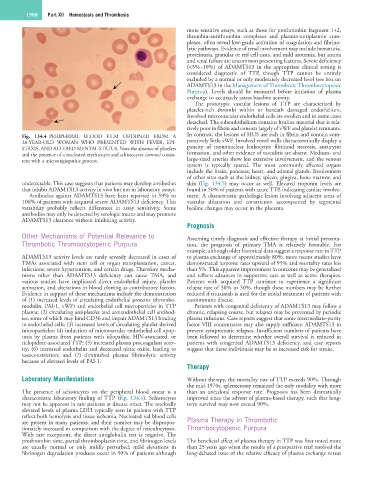
        Fig.  134.4  PERIPHERAL  BLOOD  FILM  OBTAINED  FROM  A   In contrast, the lesions of HUS are rich in fibrin and contain com-
        28-YEAR-OLD  WOMAN  WHO  PRESENTED  WITH  FEVER,  EPI-  paratively little vWF. Involved vessel walls characteristically display a
        STAXIS, AND ALTERED MENTAL STATUS. Note the absence of platelets   paucity  of  mononuclear  leukocytes;  fibrinoid  necrosis,  aneurysm
        and the presence of a nucleated erythrocyte and schistocytes (arrows) consis-  formation, and other evidence of vasculitis are absent. Medium- and
        tent with a microangiopathic process.                 large-sized arteries show less extensive involvement, and the venous
                                                              system  is  typically  spared.  The  most  commonly  affected  organs
                                                              include the brain, pancreas, heart, and adrenal glands. Involvement
                                                              of other sites such as the kidney, spleen, gingiva, bone marrow, and
        undetectable. This case suggests that patients may develop antibodies   skin  (Fig.  134.5)  may  occur  as  well.  Elevated  troponin  levels  are
        that inhibit ADAMTS13 activity in vivo but not in laboratory assays.  found in 50% of patients with acute TTP, indicating cardiac involve-
           Antibodies against ADAMTS13 have been reported in 59% to   ment. A characteristic pathologic lesion involving adjacent areas of
        100% of patients with acquired severe ADAMTS13 deficiency. This   vascular  dilatation  and  constriction  accompanied  by  segmental
        variability  probably  reflects  differences  in  assay  sensitivity.  Some   hyaline changes may occur in the placenta.
        antibodies may only be detected by serologic means and may promote
        ADAMTS13 clearance without inhibiting activity.
                                                              Prognosis
        Other Mechanisms of Potential Relevance to            Assuming timely diagnosis and effective therapy at initial presenta-
        Thrombotic Thrombocytopenic Purpura                   tion,  the  prognosis  of  primary  TMA  is  relatively  favorable.  For
                                                              example, although older historical data suggest a response rate in TTP
        ADAMTS13 activity levels are rarely severely decreased in cases of   to plasma exchange of approximately 80%, more recent studies have
        TMAs  associated  with  stem  cell  or  organ  transplantation,  cancer,   demonstrated response rates upward of 95% and mortality rates less
        infections, severe hypertension, and certain drugs. Therefore mecha-  than 5%. This apparent improvement in outcome may be generalized
        nisms  other  than  ADAMTS13  deficiency  can  cause  TMA,  and   and reflects advances in supportive care as well as active therapies.
        various  studies  have  implicated  direct  endothelial  injury,  platelet   Patients  with  acquired  TTP  continue  to  experience  a  significant
        activation, and alterations in blood clotting as contributory factors.   relapse rate of 30% to 50%, though these numbers may be further
        Evidence in support of these mechanisms include the demonstration   reduced if rituximab is used for the initial treatment of patients with
        of (1) increased levels of circulating endothelial proteins (thrombo-  autoimmune disease.
        modulin, PAI-1, vWF) and endothelial cell microparticles in TTP   Patients with congenital deficiency of ADAMTS13 may follow a
        plasma; (2) circulating antiplatelet and antiendothelial cell antibod-  chronic, relapsing course, but relapses may be prevented by periodic
        ies, some of which may bind CD36 and impair ADAMTS13 binding   plasma infusions. Case reports suggest that some intermediate-purity
        to endothelial cells; (3) increased levels of circulating platelet-derived   factor VIII concentrates may also supply sufficient ADAMTS13 to
        microparticles; (4) induction of microvascular endothelial cell apop-  prevent symptomatic relapses. Insufficient numbers of patients have
        tosis  by  plasma  from  patients  with  idiopathic,  HIV-associated,  or   been  followed  to  determine  whether  overall  survival  is  reduced  in
        ticlopidine-associated TTP; (5) increased plasma procoagulant activ-  patients  with  congenital  ADAMTS13  deficiency,  and  case  reports
        ity; (6) increased endothelin and decreased nitric oxide, leading to   suggest that these individuals may be at increased risk for stroke.
        vasoconstriction;  and  (7)  diminished  plasma  fibrinolytic  activity
        because of elevated levels of PAI-1.
                                                              Therapy
        Laboratory Manifestations                             Without therapy, the mortality rate of TTP exceeds 90%. Through
                                                              the mid-1970s, splenectomy remained the only modality with more
        The  presence  of  schistocytes  on  the  peripheral  blood  smear  is  a   than  an  anecdotal  response  rate.  Prognosis  has  been  dramatically
        characteristic  laboratory  finding  of TTP  (Fig.  134.4).  Schistocytes   improved since the advent of plasma-based therapy, such that long-
        may not be apparent in rare patients at disease onset. The markedly   term survival may now exceed 90%.
        elevated levels of plasma LDH typically seen in patients with TTP
        reflect both hemolysis and tissue ischemia. Nucleated red blood cells
        are present in many patients, and their number may be dispropor-  Plasma Therapy in Thrombotic
        tionately increased in comparison with the degree of reticulocytosis.   Thrombocytopenic Purpura
        With  rare  exceptions,  the  direct  antiglobulin  test  is  negative. The
        prothrombin time, partial thromboplastin time, and fibrinogen levels   The beneficial effect of plasma therapy in TTP was first noted more
        are  usually  normal  or  only  mildly  perturbed;  mild  elevations  in   than 25 years ago when the results of a prospective trial resolved the
        fibrinogen degradation products occur in 50% of patients although   long-debated issue of the relative efficacy of plasma exchange versus

