


Page 2240 - Hematology_ Basic Principles and Practice ( PDFDrive )
P. 2240
Chapter 134  Thrombotic Thrombocytopenic Purpura and the Hemolytic Uremic Syndromes  1987


                                                        Q448E
                                                        Q449X
                                                        Q456H
                                                        P457L
                                                        P475S       P671L                            R1206X
                      179M              S203P           R507Q       T673F                            C1213G
                                                                    A690T
                      V88L   D217H                      C508Y       R692C         A900V              C1213Y
                      V88M ∗  G227R                     G525D       Q723K         S903L    W1016X    I1217T
                      A95P   L232Q                      R528G       A732V         C908Y    C1024G    R1219W
                      H96D   C265S/S266C  Y304C         G550R                     C908S    C1024R    C1239V
                      R102C  R268P        C311Y                                   R910X    A1033T    W1245X
                      R102H  H234Q        R312C   G385E       A596V               Q929X    R1034X    K1256F
                      S119F  H234R        C322G   W390C       A606P               C951G    R1060W    K1256S
                      I143T  D235H        T323R   W390X       P618A
                      S150P  D235Y        F324L   R398H       R625H                            W1081X
                      I178T  G236C        R328G   R398C       A631V                            C1084Y
                      R193Q  A250V        C347S   R409W       Y658C                            R1095Q
                            ∗
                      R193W   S263C       R349C   Q436H       P671L     C754R                  R1095W
                R7W   T196I  S263F        P353L   E444G       I673F     C758R         H960D    R1096X     Q1302X
                                          C365X ∗                                     C977F    Q1105X     R1336W
                   Q44X                                                      E812X    C977W    R1123C     D1362V


                          Metalloprotease  Disint.  TSP  Cys  Spacer  TSP  TSP  TSP  TSP  TSP  TSP  TSP  CUB1 CUB2
                                                     1                2   3    4    5    6   7    8

                82dupT                825_832 del8bp
                       106−1 G C      987 11 C T      1584 5 G A                      2861          3769ins T
                                      987 69 C T      1584 106 C G          2455 delG   55 C T
                                                      1584 236 T C          2549 delAT  2930_2935
                  291_319 del29bp                                                     del6bp
                  330 1 G A                                 1783−1784 T T del
                  414 1 G A                   1244−2 T G    1786+1 G A
                  686 1>A 686 1 T G           1245−32 C G   1787−26 G A                      3190 delCT
                  718−724 del G C             1309_? G A    1885 delT                        3220 deIT ACC
                  768_774 del17bp                                                            3254_3255 del
                                                                          2259 delA
                                                                          2279 G A                    4077 32 T C
                                                                          2279 delG                   4119 del G
                                                                          2376 del26                  4143 dupA
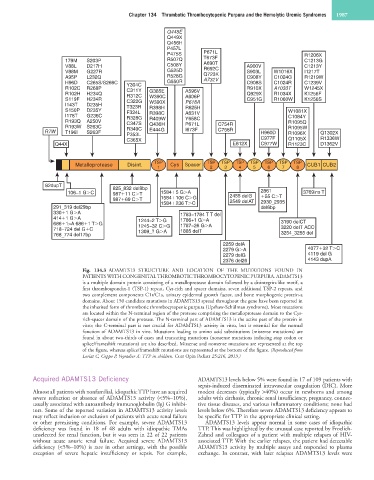
                            Fig.  134.3  ADAMTS13  STRUCTURE  AND  LOCATION  OF  THE  MUTATIONS  FOUND  IN
                            PATIENTS WITH CONGENITAL THROMBOTIC THROMBOCYTOPENIC PURPURA. ADAMTS13
                            is a multiple domain protein consisting of a metalloprotease domain followed by a disintegrin-like motif, a
                            first thrombospondin-1 (TSP-1) repeat, Cys-rich and spacer domains, seven additional TSP-2 repeats, and
                            two complement components C1r/C1s, urinary epidermal growth factor, and bone morphogenic protein-a
                            domains. About 150 candidate mutations in ADAMTS13 spread throughout the gene have been reported in
                            the inherited form of thrombotic thrombocytopenic purpura (Upshaw-Schülman syndrome). Most mutations
                            are located within the N-terminal region of the protease comprising the metalloprotease domain to the Cys-
                            rich-spacer domain of the protease. The N-terminal part of ADAMTS13 is the active part of the protein in
                            vitro; the C-terminal part is not crucial for ADAMTS13 activity in vitro, but is essential for the normal
                            function of ADAMTS13 in vivo. Mutations leading to amino acid substitutions (missense mutations) are
                            found in about two-thirds of cases and truncating mutations (nonsense mutations inducing stop codon or
                            splice/frameshift mutations) are also described. Missense and nonsense mutations are represented at the top
                            of the figure, whereas splice/frameshift mutations are represented at the bottom of the figure. (Reproduced from
                            Loriat C, Coppo P, Veyradier A: TTP in children. Curr Opin Pediatr 25:216, 2013.)


            Acquired ADAMTS13 Deficiency                          ADAMTS13 levels below 5% were found in 17 of 109 patients with
                                                                  sepsis-induced disseminated intravascular coagulation (DIC). More
            Almost all patients with nonfamilial, idiopathic TTP have an acquired   modest  decreases  (typically  >40%)  occur  in  newborns  and  among
            severe  reduction  or  absence  of  ADAMTS13  activity  (<5%–10%),   adults with cirrhosis, chronic renal insufficiency, pregnancy, connec-
            usually associated with autoantibody immunoglobulin (Ig) G inhibi-  tive tissue diseases, and various inflammatory conditions; none had
            tors. Some of the reported variation in ADAMTS13 activity levels   levels below 6%. Therefore severe ADAMTS13 deficiency appears to
            may reflect inclusion or exclusion of patients with acute renal failure   be specific for TTP in the appropriate clinical setting.
            or  other  preexisting  conditions.  For  example,  severe  ADAMTS13   ADAMTS13  levels  appear  normal  in  some  cases  of  idiopathic
            deficiency  was  found  in  18  of  48  adults  with  idiopathic  TMAs   TTP. This was highlighted by the unusual case reported by Froelich-
            unselected for renal function, but it was seen in 22 of 22 patients   Zahnd and colleagues of a patient with multiple relapses of HIV-
            without  acute  anuric  renal  failure.  Acquired  severe  ADAMTS13   associated TTP. With the earlier relapses, the patient had detectable
            deficiency  (<5%–10%)  is  rare  in  other  settings,  with  the  possible   ADAMTS13  activity  by  multiple  assays  and  responded  to  plasma
            exception  of  severe  hepatic  insufficiency  or  sepsis.  For  example,   exchange.  In  contrast,  with  later  relapses  ADAMTS13  levels  were

