


Page 2239 - Hematology_ Basic Principles and Practice ( PDFDrive )
P. 2239
1986   Part XII  Hemostasis and Thrombosis


                                                     Thrombocytopenia + MAHA

                                          History & laboratory tests  • ADAMTS13 activity
                                                                • Stools for shiga toxins, Urine pneumococcal Ag
                    • Non TTP/HUS diagnosis:                    • Autoimmune serology (ANA, APLA)
                      STEC, T-activation, Vasculitis, Cancer,
                      Stem-cell transplant, Renal transplant,   • DIC panel, Coombs test, Vitamin B 12
                      Drug-induced TMA, DIC, Hypertension,  Co-morbidity  • Blood cultures & HIV studies as indicated
                      HELLP, CAPS, Vascular devices, HIV,       • Imaging studies, BM, tissue biopsy as indicated
                      Cobalamin-C deficiency
                                                        Plasma exchange


                               No severe ADAMTS13 deficiency/AKI      Severe ADAMTS13 deficiency
                                              • Complement factors                • Inhibitor assay
                                                             C3, C4, CFH, CFI, CFB
                                              • MCP expression                    • Anti-ADAMTS13 serology
                                              • Anti CFH                          • Serial ADAMTS13
                                              • Genetic testing                   • ADAMTS13 genetics
                                                            Complement, DGKε,
                                                            Thrombomodulin

                      Not TTP/aHUS     aHUS:                    Acquired TTP:         Hereditary TTP:
                      • Specific       • Eculizumab             • Plasma exchange     • Plasma therapy
                        management     • Rituximab (anti–CFH)   • Steroid/Rituximab   • rADAMTS13*
                                       • Transplantation        • Block GPIb-vWF*

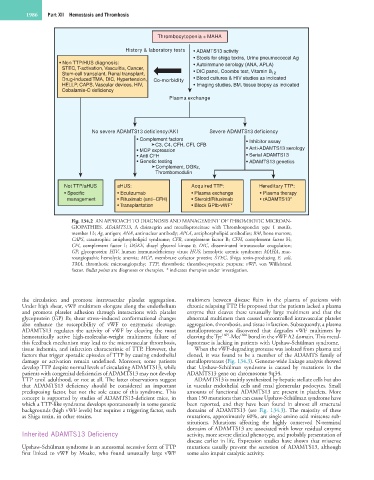
                        Fig. 134.2  AN APPROACH TO DIAGNOSIS AND MANAGEMENT OF THROMBOTIC MICROAN-
                        GIOPATHIES.  ADAMTS13,  A  disintegrin  and  metalloproteinase  with  Thrombospondin  type  1  motifs,
                        member 13; Ag, antigen; ANA, antinuclear antibody; APLA, antiphospholipid antibodies; BM, bone marrow;
                        CAPS, catastrophic antiphospholipid syndrome; CFB, complement factor B; CFH, complement factor H;
                        CFI,  complement  factor  I;  DGKE,  diacyl  glycerol  kinase  ε;  DIC,  disseminated  intravascular  coagulation;
                        GP, glycoprotein; HIV, human immunodeficiency virus; HUS, hemolytic uremic syndrome; MAHA, mac-
                        roangiopathic hemolytic anemia; MCP, membrane cofactor protein; STEC, Shiga toxin-producing E. coli,
                        TMA,  thrombotic  microangiopathy;  TTP,  thrombotic  thrombocytopenic  purpura;  vWF,  von  Willebrand
                        factor. Bullet points are diagnoses or therapies. * indicates therapies under investigation.


        the  circulation  and  promote  intravascular  platelet  aggregation.   multimers  between  disease  flairs  in  the  plasma  of  patients  with
        Under high shear, vWF multimers elongate along the endothelium   chronic relapsing TTP. He proposed that the patients lacked a plasma
        and  promote  platelet  adhesion  through  interactions  with  platelet   enzyme  that  cleaves  these  unusually  large  multimers  and  that  the
        glycoprotein (GP) Ib; shear stress–induced conformational changes   abnormal multimers then caused uncontrolled intravascular platelet
        also  enhance  the  susceptibility  of  vWF  to  enzymatic  cleavage.   aggregation, thrombosis, and tissue infarction. Subsequently, a plasma
        ADAMTS13  regulates  the  activity  of  vWF  by  cleaving  the  most   metalloprotease  was  discovered  that  degrades  vWF  multimers  by
        hemostatically  active  high-molecular-weight  multimers;  failure  of   cleaving the Tyr 1605 -Met 1606  bond in the vWF A2 domain. This metal-
        this feedback mechanism may lead to the microvascular thrombosis,   loprotease is lacking in patients with Upshaw-Schülman syndrome.
        tissue ischemia, and infarction characteristic of TTP. However, the   When the vWF-degrading protease was isolated from plasma and
        factors that trigger sporadic episodes of TTP by causing endothelial   cloned,  it  was  found  to  be  a  member  of  the  ADAMTS  family  of
        damage  or  activation  remain  undefined.  Moreover,  some  patients   metalloproteases (Fig. 134.3). Genome-wide linkage analysis showed
        develop TTP despite normal levels of circulating ADAMTS13, while   that  Upshaw-Schülman  syndrome  is  caused  by  mutations  in  the
        patients with congenital deficiencies of ADAMTS13 may not develop   ADAMTS13 gene on chromosome 9q34.
        TTP until adulthood, or not at all. The latter observations suggest   ADAMTS13 is mainly synthesized by hepatic stellate cells but also
        that  ADAMTS13  deficiency  should  be  considered  an  important   in vascular endothelial cells and renal glomerular podocytes. Small
        predisposing factor, but not the sole cause of this syndrome. This   amounts  of  functional  ADAMTS13  are  present  in  platelets.  More
        concept is supported by studies of ADAMTS13-deficient mice, in   than 150 mutations that can cause Upshaw-Schülman syndrome have
        which a TTP-like syndrome develops spontaneously in some genetic   been  reported,  and  they  have  been  found  in  almost  all  structural
        backgrounds (high vWF levels) but requires a triggering factor, such   domains  of  ADAMTS13  (see  Fig.  134.3).  The  majority  of  these
        as Shiga toxin, in other strains.                     mutations, approximately 60%, are single amino acid missense sub-
                                                              stitutions.  Mutations  affecting  the  highly  conserved  N-terminal
                                                              domains of ADAMTS13 are associated with lower residual enzyme
        Inherited ADAMTS13 Deficiency                         activity, more severe clinical phenotype, and probably presentation of
                                                              disease earlier in life. Expression studies have shown that missense
        Upshaw-Schülman syndrome is an autosomal recessive form of TTP   mutations  usually  prevent  the  secretion  of  ADAMTS13,  although
        first  linked  to  vWF  by  Moake,  who  found  unusually  large  vWF   some also impair catalytic activity.

