


Page 2255 - Hematology_ Basic Principles and Practice ( PDFDrive )
P. 2255
2002   Part XII  Hemostasis and Thrombosis


        undergoes a series of posttranslational modifications, including N-   or aggregated forms of the protein in heterologous cells with high
        and O-linked glycosylation mainly in the B domain (Fig. 135.2) and   levels of FVIII expression, their relevance in native FVIII-producing
        sulfation of tyrosine residues. Furthermore, when the nascent protein   cells (i.e., vascular endothelium and liver sinusoidal endothelial cells)
        transits the endoplasmic reticulum (ER), it interacts with ER chap-  is unknown. Indeed, under conditions of high-level FVIII expression,
        erones, including calreticulin and immunoglobulin binding protein   cells can activate a classic unfolded protein response and can succumb
        (BiP). Although these interactions limit the transport of malfolded   to apoptotic cell death.
                                                                 The other detail of FVIII trafficking that has attracted attention
                                                              is its transit between the ER and Golgi en route to secretion. Efficient
            1           7          14       22    23 26       transit through the ER–Golgi boundary appears to require an interac-
          5′                                           3′     tion with glycans within the B domain of the protein. Absence of
                                                              these glycans or lack of specific transport proteins responsible for this
                                                              trafficking event can significantly reduce the levels of secreted FVIII.


                                                              The Factor VIII Protein Structure

                                                              The DNA sequence of the F8 gene predicts a translated single-chain
                                                              polypeptide with a molecular weight of 260 kDa consisting of 2351
                                          F8A       F8B       amino  acid  residues,  including  a  19-residue  signal  peptide.  Upon
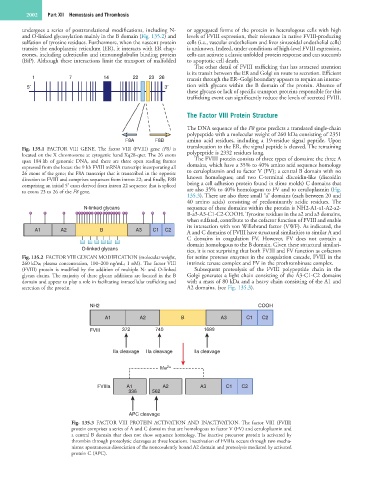
        Fig.  135.1  FACTOR  VIII  GENE. The  factor  VIII  (FVIII)  gene  (F8)  is   translocation to the ER, the signal peptide is cleaved. The remaining
        located on the X chromosome at cytogenic band Xq28-qter. The 26 exons   polypeptide is 2332 residues long.
        span  184 kb  of  genomic  DNA,  and  there  are  three  open  reading  frames   The FVIII protein consists of three types of domains: the three A
        expressed from the locus: the 9 kb FVIII mRNA transcript incorporating all   domains, which have a 35% to 40% amino acid sequence homology
        26 exons of the gene; the F8A transcript that is transcribed in the opposite   to ceruloplasmin and to factor V (FV); a central B domain with no
        direction to FVIII and comprises sequences from intron 22; and finally, F8B   known  homologues;  and  two  C-terminal  discoidin-like  (discoidin
        comprising an initial 5′ exon derived from intron 22 sequence that is spliced   being a cell adhesion protein found in slime molds) C domains that
        to exons 23 to 26 of the F8 gene.                     are also 35% to 40% homologous to FV and to ceruloplasmin (Fig.
                                                              135.3). There are also three small “a” domains (each between 20 and
                                                              40  amino  acids)  consisting  of  predominantly  acidic  residues.  The
                            N-linked glycans                  sequence of these domains within the protein is NH2-A1-a1-A2-a2-
                                                              B-a3-A3-C1-C2-COOH. Tyrosine residues in the a2 and a3 domains,
                                                              when sulfated, contribute to the cofactor function of FVIII and enable
                                                              its interaction with von Willebrand factor (VWF). As indicated, the
            A1       A2           B          A3    C1  C2     A and C domains of FVIII have structural similarities to similar A and
                                                              C  domains  in  coagulation  FV.  However,  FV  does  not  contain  a
                                                              domain homologous to the B domain. Given these structural similari-
                            O-linked glycans                  ties, it is not surprising that both FVIII and FV function as cofactors
        Fig. 135.2  FACTOR VIII GLYCAN MODIFICATION (molecular weight,   for serine protease enzymes in the coagulation cascade, FVIII in the
        260 kDa; plasma concentration, 100–200 ng/mL; 1 nM). The factor VIII   intrinsic tenase complex and FV in the prothrombinase complex.
        (FVIII)  protein  is  modified  by  the  addition  of  multiple  N-  and  O-linked   Subsequent  proteolysis  of  the  FVIII  polypeptide  chain  in  the
        glycan chains. The majority of these glycan additions are located in the B   Golgi generates a light chain consisting of the A3-C1-C2 domains
        domain and appear to play a role in facilitating intracellular trafficking and   with a mass of 80 kDa and a heavy chain consisting of the A1 and
        secretion of the protein.                             A2 domains. (see Fig. 135.3).


                              NH2                                                    COOH
                                   A1          A2           B            A3       C1   C2

                              FVIII      372        740             1689


                                      IIa cleavage  IIa cleavage  IIa cleavage

                                                     Me 2+


                                 FVIIIa   A1          A2           A3      C1   C2
                                           336     562


                                           APC cleavage
                        Fig.  135.3  FACTOR  VIII  PROTEIN  ACTIVATION  AND  INACTIVATION. The  factor  VIII  (FVIII)
                        protein comprises a series of A and C domains that are homologous to factor V (FV) and ceruloplasmin and
                        a central B domain that does not show sequence homology. The inactive precursor protein is activated by
                        thrombin through proteolytic cleavages at three locations. Inactivation of FVIIIa occurs through two mecha-
                        nisms: spontaneous dissociation of the noncovalently bound A2 domain and proteolysis mediated by activated
                        protein C (APC).

