


Page 2256 - Hematology_ Basic Principles and Practice ( PDFDrive )
P. 2256
Chapter 135  Hemophilia A and B  2003


              Circulating FVIII exists as a heterodimer of the NH 2-terminus
            heavy chain and the COOH-terminus light chain. The two FVIII
            chains  are  bound  to  one  another  at  the  A1  and  A3  domains  by
            noncovalent  bonds  that  are  divalent  metal  ion  dependent.  The   Enzyme        Substrate     FXa
                                                                                                   FX
                                                                         FIXa
            involved ion is likely copper, which has been found in association
            with FVIII.
                                                                                  Cofactor FVIIIa
            Storage, Secretion, and Circulation of Factor VIII                Gla             Gla

                                                                           Ca 2+                 Ca 2+
            After synthesis, FVIII is secreted into the circulation, where it forms
            a tight noncovalent complex with its multimeric partner VWF (kDa
            ≈0.2–0.5 nM).  Whereas  the  plasma  concentration  of  FVIII  is
            100–200 ng/mL  (≈1 nM),  the  concentration  of  VWF  is  approxi-  Procoagulant phospholipid surface
            mately 10 µg/mL (50 nM); thus the molar ratio of FVIII to VWF
            in the FVIII-VWF complex is about 1 : 50. The majority of VWF in
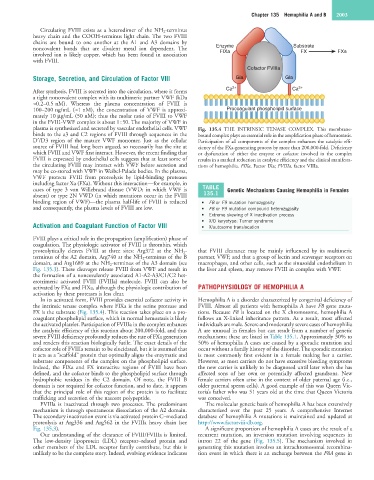
            plasma is synthesized and secreted by vascular endothelial cells. VWF   Fig.  135.4  THE  INTRINSIC  TENASE  COMPLEX.  This  membrane-
            binds to the a3 and C2 regions of FVIII through sequences in the   bound complex plays an essential role in the amplification phase of hemostasis.
            D′/D3  region  of  the  mature  VWF  monomer.  Just  as  the  cellular   Participation of all components of the complex enhances the catalytic effi-
            source of FVIII had long been argued, so necessarily has the site at   ciency of the FXa-generating process by more than 200,000-fold. Deficiency
            which FVIII and VWF first interact. However, the recent finding that   or  dysfunction  of  either  the  enzyme  or  cofactor  involved  in  the  complex
            FVIII is expressed by endothelial cells suggests that at least some of   results in a marked reduction in catalytic efficiency and the clinical manifesta-
            the circulating FVIII may interact with VWF before secretion and   tions of hemophilia. FIXa, Factor IXa; FVIIIa, factor VIIIa.
            may be co-stored with VWF in Weibel-Palade bodies. In the plasma,
            VWF  protects  FVIII  from  proteolysis  by  lipid-binding  proteases
            including factor Xa (FXa). Without this interaction—for example, in
            cases  of  type  3  von Willebrand  disease  (VWD;  in  which VWF  is   TABLE   Genetic Mechanisms Causing Hemophilia in Females
            absent) or type 2N VWD (in which mutations occur in the FVIII   135.1
            binding region of VWF)—the plasma half-life of FVIII is reduced   •  F8 or F9 mutation homozygosity
            and consequently, the plasma levels of FVIII are low.  •  F8 or F9 mutation compound heterozygosity
                                                                   •  Extreme skewing of X inactivation process
                                                                   •  X/O karyotype: Turner syndrome
            Activation and Coagulant Function of Factor VIII       •  X/autosome translocation

            FVIII plays a critical role in the propagation (amplification) phase of
            coagulation. The physiologic activator of FVIII is thrombin, which
            proteolytically  cleaves  FVIII  at  three  sites:  Arg372  at  the  NH 2 -  that  FVIII  clearance  may  be  mainly  influenced  by  its  multimeric
            terminus of the A2 domain, Arg740 at the NH 2 -terminus of the B   partner, VWF, and that a group of lectin and scavenger receptors on
            domain, and Arg1689 at the NH 2 -terminus of the A3 domain (see   macrophages, and other cells, such as the sinusoidal endothelium in
            Fig. 135.3). These cleavages release FVIII from VWF and result in   the liver and spleen, may remove FVIII in complex with VWF.
            the formation of a noncovalently associated A1-A2-A3/C1/C2 het-
            erotrimeric  activated  FVIII  (FVIIIa)  molecule.  FVIII  can  also  be
            activated by FXa and FIXa, although the physiologic contribution of   PATHOPHYSIOLOGY OF HEMOPHILIA A
            activation by these proteases is less clear.
              In its activated form, FVIII provides essential cofactor activity in   Hemophilia A is a disorder characterized by congenital deficiency of
            the intrinsic tenase complex where FIXa is the serine protease and   FVIII. Almost all patients with hemophilia A have F8 gene muta-
            FX is the substrate (Fig. 135.4). This reaction takes place on a pro-  tions. Because F8 is located on the X chromosome, hemophilia A
            coagulant phospholipid surface, which in normal hemostasis is likely   follows an X-linked inheritance pattern. As a result, most affected
            the activated platelet. Participation of FVIIIa in the complex enhances   individuals are male. Severe and moderately severe cases of hemophilia
            the catalytic efficiency of this reaction about 200,000-fold, and thus   A are unusual in females but can result from a number of genetic
            severe FVIII deficiency profoundly reduces the rate of FXa generation   mechanisms; these are listed in Table 135.1. Approximately 30% to
            and renders this reaction biologically futile. The exact details of the   50% of hemophilia A cases are caused by a sporadic mutation and
            cofactor role of FVIIIa remain to be elucidated, but it is assumed that   occur without a family history of the disorder. The sporadic mutation
            it acts as a “scaffold” protein that optimally aligns the enzymatic and   is  most  commonly  first  evident  in  a  female  making  her  a  carrier.
            substrate components of the complex on the phospholipid surface.   However, as most carriers do not have excessive bleeding symptoms
            Indeed,  the  FIXa  and  FX  interactive  regions  of  FVIII  have  been   the new carrier is unlikely to be diagnosed until later when she has
            defined, and the cofactor binds to the phospholipid surface through   affected  sons  of  her  own  or  potentially  affected  grandsons.  New
            hydrophobic  residues  in  the  C2  domain.  Of  note,  the  FVIII  B   female carriers often arise in the context of older paternal age (i.e.,
            domain is not required for cofactor function, and to date, it appears   older paternal sperm cells). A good example of this was Queen Vic-
            that  the  principal  role  of  this  region  of  the  protein  is  to  facilitate   toria’s father who was 51 years old at the time that Queen Victoria
            trafficking and secretion of the nascent polypeptide.  was conceived.
              FVIIIa  is  inactivated  through  two  processes. The  predominant   The molecular genetic basis of hemophilia A has been extensively
            mechanism is through spontaneous dissociation of the A2 domain.   characterized  over  the  past  25  years.  A  comprehensive  Internet
            The secondary inactivation event is via activated protein C–mediated   database of hemophilia A mutations is maintained and updated at
            proteolysis  at  Arg336  and  Arg562  in  the  FVIIIa  heavy  chain  (see    http://www.factorviii-db.org.
            Fig. 135.3).                                            A significant proportion of hemophilia A cases are the result of a
              Our understanding of the clearance of FVIII/FVIIIa is limited.   recurrent  mutation,  an  inversion  mutation  involving  sequences  in
            The  low-density  lipoprotein  (LDL)  receptor–related  protein  and   intron  22  of  the  gene  (Fig.  135.5).  The  mechanism  involved  in
            other members of the LDL receptor family contribute, but this is   generating this mutation involves an intrachromosomal recombina-
            unlikely to be the complete story. Indeed, evolving evidence indicates   tion event in which there is an exchange between the F8A gene in

