


Page 2257 - Hematology_ Basic Principles and Practice ( PDFDrive )
P. 2257
2004   Part XII  Hemostasis and Thrombosis


             Factor VIII exons 1-22
                                                               5′                                             3′
            F8A                              F8A F8A
              22     14      7        1                             1    2 3   4      5   6        7   8
                                                                  Molecular pathology of hemophilia B
         tel                                           cen        • No predominant recurring mutation
                                                                  • Majority of mutations are missense variants
                                                     F8B          • Some mild phenotypes are due to founder mutations
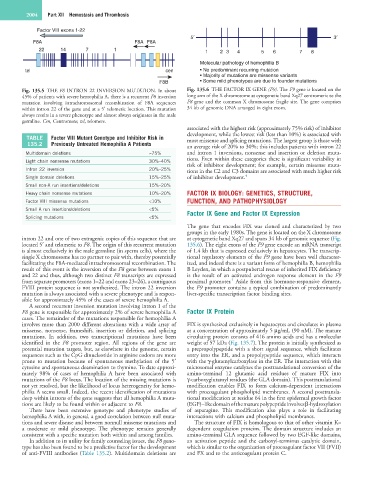
        Fig. 135.5  THE F8 INTRON 22 INVERSION MUTATION. In about   Fig. 135.6  THE FACTOR IX GENE (F9). The F9 gene is located on the
        45% of patients with severe hemophilia A, there is a recurrent F8 inversion   long arm of the X chromosome at cytogenetic band Xq27 centromeric to the
        mutation  involving  intrachromosomal  recombination  of  F8A  sequences   F8 gene and the common X chromosome fragile site. The gene comprises
        within intron 22 of the gene and at a 5′ telomeric location. This mutation   34 kb of genomic DNA arranged in eight exons.
        always results in a severe phenotype and almost always originates in the male
        germline. Cen, Centromere; tel, telomere.
                                                              associated with the highest risk (approximately 75% risk) of inhibitor
                                                              development, while the lowest risk (less than 10%) is associated with
          TABLE   Factor VIII Mutant Genotype and Inhibitor Risk in   most missense and splicing mutations. The largest group is those with
          135.2   Previously Untreated Hemophilia A Patients  an average risk of 20% to 30%; this includes patients with intron 22
         Multidomain deletions                    ≈75%        and intron 1 inversions, nonsense and insertion or deletion muta-
         Light chain nonsense mutations           30%–40%     tions. Even within these categories there is significant variability in
                                                              risk of inhibitor development; for example, certain missense muta-
         Intron 22 inversion                      20%–25%     tions in the C2 and C3 domains are associated with much higher risk
         Single domain deletions                  15%–25%     of inhibitor development. 4
         Small non-A run insertions/deletions     15%–20%
         Heavy chain nonsense mutations           10%–20%     FACTOR IX BIOLOGY: GENETICS, STRUCTURE,
         Factor VIII missense mutations           <10%        FUNCTION, AND PATHOPHYSIOLOGY
         Small A run insertions/deletions         <5%         Factor IX Gene and Factor IX Expression
         Splicing mutations                       <5%
                                                              The  gene  that  encodes  FIX  was  cloned  and  characterized  by  two
                                                              groups in the early 1980s. The gene is located on the X chromosome
        intron 22 and one of two extragenic copies of this sequence that are   at cytogenetic band Xq27 and spans 34 kb of genomic sequence (Fig.
        located 5′ and telomeric to F8. The origin of this recurrent mutation   135.6). The eight exons of the F9 gene encode an mRNA transcript
        is almost exclusively in the male germline (in sperm cells), where the   of 1.4 kb that is expressed exclusively in hepatocytes. The transcrip-
        single X chromosome has no partner to pair with, thereby potentially   tional regulatory elements of the F9 gene have been well character-
        facilitating the F8A-mediated intrachromosomal recombination. The   ized, and indeed there is a variant form of hemophilia B, hemophilia
        result of this event is the inversion of the F8 gene between exons 1   B Leyden, in which a postpubertal rescue of inherited FIX deficiency
        and 22 and thus, although two distinct F8 transcripts are expressed   is  the  result  of  an  activated  androgen  response  element  in  the  F9
                                                                             5
        from separate promoters (exons 1–22 and exons 23–26), a contiguous   proximal  promoter.   Aside  from  this  hormone-responsive  element,
        FVIII protein sequence is not synthesized. The intron 22 inversion   the F9 promoter contains a typical combination of predominantly
        mutation is always associated with a severe phenotype and is respon-  liver-specific transcription factor binding sites.
        sible for approximately 45% of the cases of severe hemophilia A.
           A second recurrent inversion mutation involving intron 1 of the
        F8 gene is responsible for approximately 2% of severe hemophilia A   Factor IX Protein
        cases. The remainder of the mutations responsible for hemophilia A
        involves more than 2000 different alterations with a wide array of   FIX is synthesized exclusively in hepatocytes and circulates in plasma
        missense,  nonsense,  frameshift,  insertion  or  deletion,  and  splicing   at a concentration of approximately 5 µg/mL (90 nM). The mature
        mutations.  In  addition,  two  transcriptional  mutations  have  been   circulating protein consists of 416 amino acids and has a molecular
        identified  in  the  F8  promoter  region.  All  regions  of  the  gene  are   weight of 57 kDa (Fig. 135.7). The protein is initially synthesized as
        potential mutation targets, but, as elsewhere in the genome, certain   a prepropolypeptide with a short signal sequence, which facilitates
        sequences such as the CpG dinucleotide in arginine codons are more   entry into the ER, and a propolypeptide sequence, which interacts
        prone  to  mutation  because  of  spontaneous  methylation  of  the  5′   with the γ-glutamylcarboxylase in the ER. The interaction with this
        cytosine and spontaneous deamination to thymine. To date approxi-  microsomal enzyme catalyzes the posttranslational conversion of the
        mately  98%  of  cases  of  hemophilia  A  have  been  associated  with   amino-terminal  12  glutamic  acid  residues  of  mature  FIX  into
        mutations of the F8 locus. The location of the missing mutations is   γ-carboxyglutamyl residues (the GLA domain). This posttranslational
        not yet resolved, but the likelihood of locus heterogeneity for hemo-  modification  enables  FIX  to  form  calcium-dependent  interactions
        philia A seems small. Indeed, the recent identification of mutations   with procoagulant phospholipid membranes. A second posttransla-
        deep within introns of the gene suggests that all hemophilia A muta-  tional modification at residue 64 in the first epidermal growth factor
        tions are likely to be found within or adjacent to F8.  (EGF)–like domain of the mature polypeptide involves β-hydroxylation
           There  have  been  extensive  genotype  and  phenotype  studies  of   of  asparagine.  This  modification  also  plays  a  role  in  facilitating
        hemophilia A with, in general, a good correlation between null muta-  interactions with calcium and phospholipid membranes.
        tions and severe disease and between nonnull missense mutations and   The structure of FIX is homologous to that of other vitamin K–
        a  moderate  or  mild  phenotype.  The  phenotype  remains  generally   dependent coagulation proteins. The domain structure includes an
        consistent with a specific mutation both within and among families.  amino-terminal GLA sequence followed by two EGF-like domains,
           In addition to its utility for family counseling issues, the F8 geno-  an  activation  peptide  and  the  carboxyl-terminus  catalytic  domain,
        type has also been found to be a predictive factor for the development   which is similar to the organization of procoagulant factor VII (FVII)
        of anti-FVIII antibodies (Table 135.2). Multidomain deletions are   and FX and to the anticoagulant protein C.

