


Page 2310 - Hematology_ Basic Principles and Practice ( PDFDrive )
P. 2310
2052   Part XII  Hemostasis and Thrombosis


                                                                                                       P
                          P          P                   P                     P
                                                     P                              P
                              P                               P              P


                                                         FVIII bound                      P
                VWF                FVIII                to N-terminus             Platelets
             multimers                                                                       P
                                                            of VWF
                                                                                          Resting   Activated


              P           P           P

                    P                      P
                                                                      P      P
                                                               P    P     P    P
                                                                  P    P    P
               With injury, VWF adheres to vessel              With shear, VWF multimers uncoil, platelets adhere and
                    subendothelial matrix.                                   become activated.


                  Activated platelets expose phosphatidyl      Bleeding ceases by platelet-fibrin plug sealing vascular
                 serine and bind FVIII to facilitate clotting.  injury and is followed by thrombolysis and tissue repair.
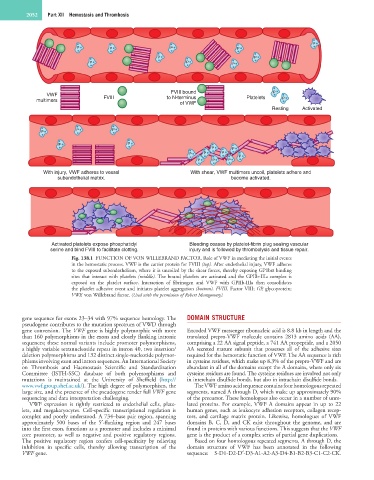
                        Fig. 138.1  FUNCTION OF VON WILLEBRAND FACTOR. Role of VWF in mediating the initial events
                        in the hemostatic process. VWF is the carrier protein for FVIII (top). After endothelial injury, VWF adheres
                        to the exposed subendothelium, where it is uncoiled by the shear forces, thereby exposing GP1bα binding
                        sites that interact with platelets (middle). The bound platelets are activated and the GPIIb-IIIa complex is
                        exposed  on  the  platelet  surface.  Interaction  of  fibrinogen  and  VWF  with  GPIIb-IIIa  then  consolidates
                        the platelet adhesive event and initiates platelet aggregation (bottom). FVIII, Factor VIII; GP, glycoprotein;
                        VWF, von Willebrand factor. (Used with the permission of Robert Montgomery).


        gene sequence for exons 23–34 with 97% sequence homology. The   DOMAIN STRUCTURE
        pseudogene contributes to the mutation spectrum of VWD through
        gene conversion. The VWF gene is highly polymorphic with more   Encoded VWF messenger ribonucleic acid is 8.8 kb in length and the
        than 160 polymorphisms in the exons and closely flanking intronic   translated  prepro-VWF  molecule  contains  2813  amino  acids  (AA),
        sequences; these normal variants include promoter polymorphisms,   comprising a 22 AA signal peptide, a 741 AA propeptide, and a 2050
        a highly variable tetranucleotide repeat in intron 40, two insertion/  AA  secreted  mature  subunit  that  possesses  all  of  the  adhesive  sites
        deletion polymorphisms and 132 distinct single-nucleotide polymor-  required for the hemostatic function of VWF. The AA sequence is rich
        phisms involving exon and intron sequences. An International Society   in cysteine residues, which make up 8.3% of the prepro-VWF and are
        on  Thrombosis  and  Haemostasis  Scientific  and  Standardization   abundant in all of the domains except the A domains, where only six
        Committee  (ISTH-SSC)  database  of  both  polymorphisms  and     cysteine residues are found. The cysteine residues are involved not only
        mutations  is  maintained  at  the  University  of  Sheffield  (http://   in interchain disulfide bonds, but also in intrachain disulfide bonds.
        www.vwf.group.shef.ac.uk/). The high degree of polymorphism, the   The VWF amino acid sequence contains four homologous repeated
        large size, and the presence of the pseudogene render full VWF gene   segments, named A through D, which make up approximately 90%
        sequencing and data interpretation challenging.       of the precursor. These homologues also occur in a number of unre-
           VWF  expression  is  tightly  restricted  to  endothelial  cells,  plate-  lated proteins. For example, VWF A domains appear in up to 22
        lets,  and  megakaryocytes.  Cell-specific  transcriptional  regulation  is   human genes, such as leukocyte adhesion receptors, collagen recep-
        complex and poorly understood. A 734–base pair region, spanning   tors,  and  cartilage  matrix  protein.  Likewise,  homologues  of  VWF
        approximately  500  bases  of  the  5′-flanking  region  and  247  bases   domains  B,  C,  D, and  CK  exist  throughout  the  genome, and are
        into the first exon, functions as a promoter and includes a minimal   found in proteins with various functions. This suggests that the VWF
        core  promoter,  as  well  as  negative  and  positive  regulatory  regions.   gene is the product of a complex series of partial gene duplications.
        The  positive  regulatory  region  confers  cell-specificity  by  relieving   Based on four homologous repeated segments, A through D, the
        inhibition  in  specific  cells,  thereby  allowing  transcription  of  the    domain  structure  of  VWF  has  been  annotated  in  the  following
        VWF gene.                                             sequence:  S-D1-D2-D′-D3-A1-A2-A3-D4-B1-B2-B3-C1-C2-CK.

