


Page 2311 - Hematology_ Basic Principles and Practice ( PDFDrive )
P. 2311
Chapter 138  Structure, Biology, and Genetics of von Willebrand Factor  2053


                                  5          10             28               45             52


                                      Multimerization                                       Dimerization
                                                                                B1–3
                          NH 2                                                                   COOH
                                D1     D2    D’     D3    A1   A2   A3    D4         C1   C2  CK

                           Pre   Pro (741 AA)                Mature subunit (2050 AA)
                         (22 AA)
                         1    23           763                                                     2813


                                                                              B1–3
                              NH 2                                                          COOH
                                  D’     D3       A1    A2    A3       D4           C1   C2  CK


                                   FVIII         Gplb       Collagen
                          A                    Collagen                              αllbβ3

                                   GP1b  Collagen
                              FVIII                                   GPIIb-IIIa


                              D’D3  A1 A2 A3    D4    C1    C2     C3    C4    C5    C6  CK


                          Multimerization                                           Dimerization

                          B         ADAMTS13
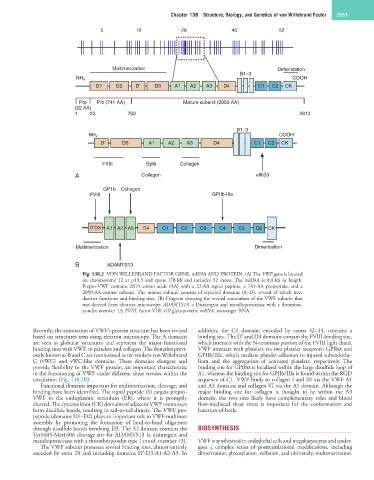
                            Fig. 138.2  VON WILLEBRAND FACTOR GENE, mRNA AND PROTEIN. (A) The VWF gene is located
                            on  chromosome  12  at  p13.3  and  spans  178 kb  and  includes  52  exons. The  mRNA  is  8.8 kb  in  length.
                            Prepro-VWF  contains  2813  amino  acids  (AA)  with  a  22-AA  signal  peptide,  a  741-AA  propeptide,  and  a
                            2050-AA mature subunit. The mature subunit consists of repeated domains (A–D), several of which have
                            distinct functions and binding sites. (B) Diagram showing the revised annotation of the VWF subunit that
                            was derived from electron microscopy. ADAMTS13, a Disintegrin and metalloproteinase with a thrombos-
                            pondin member 13; FVIII, factor VIII; GP, glycoprotein, mRNA, messenger RNA.


            Recently, the annotation of VWF’s protein structure has been revised   addition,  the  C1  domain,  encoded  by  exons  42–44,  contains  a
            based on structures seen using electron microscopy. The A domains   binding site. The D′ and D3 domains contain the FVIII-binding site,
            are  seen  as  globular  structures  and  represent  the  major  functional   which interacts with the N-terminus portion of the FVIII light chain.
            binding sites with VWF, to platelets and collagen. The domains previ-  VWF interacts with platelets via two platelet receptors; GPIbα and
            ously known as B and C are reannotated as six-tandem von Willebrand   GPIIb/IIIa, which mediate platelet adhesion to injured subendothe-
            C  (vWC)  and  vWC-like  domains.  These  domains  elongate  and   lium  and  the  aggregation  of  activated  platelets,  respectively.  The
            provide flexibility to the VWF protein, an important characteristic   binding site for GPIbα is localized within the large disulfide loop of
            to the functioning of VWF under different shear stresses within the   A1, whereas the binding site for GPIIb/IIIa is found within the RGD
            circulation (Fig. 138.2B).                            sequence of C1. VWF binds to collagen I and III via the VWF A1
              Functional domains important for multimerization, cleavage, and   and A3 domains and collagen VI via the A1 domain. Although the
            binding have been identified. The signal peptide (S) targets prepro-  major  binding  site  for  collagen  is  thought  to  be  within  the  A3
            VWF  to  the  endoplasmic  reticulum  (ER),  where  it  is  promptly   domain,  the  two  sites  likely  have  complementary  roles  and  blood
            cleaved. The cysteine knot (CK) domains of adjacent VWF monomers   flow-mediated  shear  stress  is  important  for  the  conformation  and
            form disulfide bonds, resulting in tail-to-tail dimers. The VWF pro-  function of both.
            peptide (domains D1–D2) plays an important role in VWF multimer
            assembly  by  promoting  the  formation  of  head-to-head  oligomers
            through disulfide bonds involving D3. The A2 domain contains the   BIOSYNTHESIS
            Tyr1605-Met1606 cleavage site for ADAMTS13 (a disintegrin and
            metalloproteinase with a thrombospondin type 1 motif, member 13).  VWF is synthesized in endothelial cells and megakaryocytes and under-
              The VWF subunit possesses several binding sites, almost entirely   goes  a  complex  series  of  posttranslational  modifications,  including
            encoded by exon 28 and including domains D′-D3-A1-A2-A3. In   dimerization, glycosylation, sulfation, and ultimately, multimerization.

