


Page 2313 - Hematology_ Basic Principles and Practice ( PDFDrive )
P. 2313
Chapter 138  Structure, Biology, and Genetics of von Willebrand Factor  2055


                                                                  asialoglycoprotein receptor in both cell types and sialic-acid-binding-
                                                                  immunoglobulin-like-lectin 5 in macrophages. C-type lactic domain
                                                                  family  4  member  M  on  endothelial  cells  has  also  been  shown  to
                                                                  mediate  VWF  clearance  in  a  glycan-dependent  manner.  Further
                                                                  studies are needed to decipher the relative contribution of each of
                                                                  these mechanisms as determinants of VWF levels.
                                                                    The VWF propeptide remains associated with VWF multimers
                                                                  stored in WPBs and is secreted in a 1 : 1 molar ratio with the mature
                                                                  VWF subunit. After secretion, the propeptide (VWFpp) dissociates
                                                                  from VWF and circulates at a concentration of approximately 1 µg/
                                                                  mL and with a half-life of 2–3 hours. In contrast, VWF circulates at
                                                                  a plasma concentration of approximately 10 µg/mL and has a half-life
                                                                  of approximately 12–20 hours. The ratio between VWFpp and mature
                                                                  VWF (vWFpp/VWF : Ag) can be used to estimate the relative half-life
                                                                  of mature VWF; elevated ratios indicate enhanced clearance.
                                                                    Changes in VWF glycosylation or point mutations can be associ-
                                                                  ated with increased clearance. Blood group O subjects (see the fol-
                                                                  lowing  section  on  ABO  Blood  Groups)  exhibit  increased  VWF
                                                                  clearance compared with the other blood types and have consistently
                                                                  elevated  vWFpp/VWF : Ag  ratios  and  shorter  VWF  survival  after
                                                                  DDAVP administration. Several point mutations may lead to acceler-
                                                                  ated VWF clearance and are associated with either a type 1 or type
                                                                  2A VWD phenotype. The vast majority of these are localized to the
                                                                  D3 domain (e.g., R1205H and C1130F), but point mutations in the
                                                                  A1 (I1416N), CK (C2617), and D4 domains (S2179F) have also
                                                                  been implicated.
                                                                    VWF  mutations  associated  with  accelerated  clearance  are  not
                                                                  necessarily associated with increased susceptibility to proteolysis by
                NHP    T1    2A     2B    2M    2N     T3         ADAMTS13 and vice versa. For example, the VWD Vicenza muta-
                                                                  tion,  R1205,  is  the  prototypical  clearance  mutation.  Patients  with
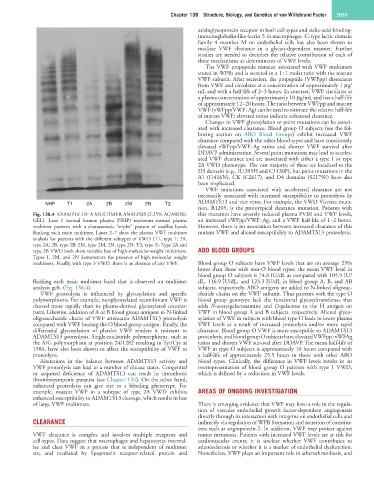
            Fig. 138.4  EXAMPLE OF A MULTIMER ANALYSIS (2.25% AGAROSE   this mutation have severely reduced plasma FVIII and VWF levels,
            GEL).  Lane  1  normal  human  plasma  (NHP)  represents  normal  plasma   an increased vWFpp/VWF : Ag, and a VWF half-life of 1–2 hours.
            multimer  patterns  with  a  characteristic  “triplet”  pattern  of  satellite  bands   However, there is no association between increased clearance of this
            flanking each main multimer. Lanes 2–7 show the plasma VWF multimer   mutant VWF and altered susceptibility to ADAMTS13 proteolysis.
            analysis for patients with the different subtypes of VWD (T1, type 1; 2A,
            type 2A; 2B, type 2B; 2M, type 2M; 2N, type 2N; T3, type 3). Type 2A and
            type 2B VWD both show variable loss of high-molecular-weight multimers.   ABO BLOOD GROUPS
            Types 1, 2M, and 2N demonstrate the presence of high molecular weight
            multimers. Finally, with type 3 VWD, there is an absence of any VWF.   Blood group O subjects have VWF levels that are on average 25%
                                                                  lower than those with non-O blood types: the mean VWF level in
                                                                  blood group O subjects is 74.8 IU/dL as compared with 105.9 IU/
            flanking  each  main  multimer  band  that  is  observed  on  multimer   dL, 116.9 IU/dL, and 123.3 IU/dL in blood group A, B, and AB
            analysis gels. (Fig. 138.4).                          subjects, respectively. ABO antigens are added to N-linked oligosac-
              VWF  proteolysis  is  influenced  by  glycosylation  and  specific   charide chains on the VWF subunit. Thus patients with the type O
            polymorphisms. For example, nonglycosylated recombinant VWF is   blood  group  genotype  lack  the  functional  glycosyltransferase  that
            cleaved more rapidly than its plasma-derived glycosylated counter-  adds  N-acetylgalactosamine  and  D-galactose  to  the  H  antigen  on
            parts. Likewise, addition of A or B blood group antigens to N-linked   VWF in blood group A and B subjects, respectively. Altered glyco-
            oligosaccharide chains of VWF attenuates ADAMTS13 proteolysis   sylation of VWF in subjects with blood type O leads to lower plasma
            compared with VWF bearing the O blood group antigen. Finally, the   VWF  levels  as  a  result  of  increased  proteolysis  and/or  more  rapid
            differential  glycosylation  of  platelet  VWF  renders  it  resistant  to   clearance. Blood group O VWF is more susceptible to ADAMTS13
            ADAMTS13 proteolysis. Single-nucleotide polymorphisms, such as   proteolysis, and blood group O subjects have elevated VWFpp : vWFAg
            the A/G polymorphism at position 24/1282 resulting in Tyr/Cys at   ratios and shorter VWF survival after DDAVP. The mean half-life of
            1584, have also been shown to affect the susceptibility of VWF to   VWF in type O subjects is approximately 10 hours compared with
            proteolysis.                                          a  half-life  of  approximately  25.5  hours  in  those  with  other  ABO
              Alterations  in  the  balance  between  ADAMTS13  activity  and   blood  types.  Clinically,  the  difference  in VWF  levels  results  in  an
            VWF proteolysis can lead to a number of disease states. Congenital   overrepresentation  of  blood  group  O  patients  with  type  1  VWD,
            or  acquired  deficiency  of  ADAMTS13  can  result  in  thrombotic   which is defined by a reduction in VWF levels.
            thrombocytopenic purpura (see Chapter 134). On the other hand,
            enhanced  proteolysis  can  give  rise  to  a  bleeding  phenotype.  For
            example,  mutant  VWF  in  a  subtype  of  type  2A  VWD  exhibits   AREAS OF ONGOING INVESTIGATION
            enhanced susceptibility to ADAMTS13 cleavage, which results in loss
            of large VWF multimers.                               There is emerging evidence that VWF may have a role in the regula-
                                                                  tion  of  vascular  endothelial  growth  factor-dependent  angiogenesis
                                                                  directly through its interaction with integrins on endothelial cells and
            CLEARANCE                                             indirectly via regulation of WPB formation and secretion of constitu-
                                                                  ents such as angiopoietin-2. In addition, VWF may protect against
            VWF  clearance  is  complex  and  involves  multiple  receptors  and   tumor metastasis. Patients with increased VWF levels are at risk for
            cell-types. Data suggest that macrophages and hepatocytes internal-  cardiovascular  events;  it  is  unclear  whether  VWF  contributes  to
            ize  and  clear  VWF  in  a  process  that  is  independent  of  multimer   atherosclerosis or whether it is a marker of endothelial dysfunction.
            size  and  mediated  by  lipoprotein  receptor-related  protein  and   Nonetheless, VWF plays an important role in atherothrombosis, and

