


Page 2314 - Hematology_ Basic Principles and Practice ( PDFDrive )
P. 2314
2056   Part XII  Hemostasis and Thrombosis


        drugs targeting VWF attenuate arterial thrombosis in animal models.   secretion or clearance, which also lead to a VWD phenotype. A third
        Their utility in humans is unknown.                   level of classification denoted by roman numerals (e.g., VWD type
                                                              2A IIA) indicates specific phenotypes and is a remnant of an older
                                                              classification system that is mainly used in the research setting.
        VON WILLEBRAND DISEASE

        VWD is caused by deficient or defective plasma VWF and represents   von Willebrand Disease Type 1
        the most common inherited bleeding disorder. Bleeding symptoms
        reflect  the  defect  in  primary  hemostasis:  mucocutaneous  bleeding,   Type 1 VWD, a quantitative deficiency of VWF, represents approxi-
        especially  epistaxis  and  menorrhagia.  When  FVIII  levels  are  suffi-  mately 70% of VWD cases. The VWF is functionally normal without
        ciently  low,  the  bleeding  phenotype  overlaps  with  that  of  mild  to   a specific abnormality in ligand binding sites or a significant decrease
        moderate hemophilia; patients may experience joint or muscle bleeds.   in HMW multimers. Functional assays of VWF, such as VWF : RCo,
        The current VWD classification recognizes three subtypes. Type 1   are decreased in proportion to the decrease in VWF : Ag concentra-
        VWD  is  characterized  by  quantitative  deficiency  of  VWF,  type  2   tion, and the ratio of functional activity as compared with VWF : Ag
        VWD  is  characterized  by  qualitative  defects,  and  type  3 VWD  is   is normal (i.e., VWF : RCo/VWF : Ag ratio is >0.6).
        characterized by an almost complete absence of VWF.      Point mutations, most frequently missense mutations, have been
                                                              identified in approximately 65% of individuals with type 1 VWD
                                                              and occur throughout the VWF gene. Fully penetrant, dominantly
        Epidemiology                                          inherited  missense  mutations  are  more  often  identified  when
                                                              VWF : Ag and VWF : RCo levels are less than 25 IU/dL. In contrast,
        VWD is the most common inherited bleeding disorder. However,   incompletely  penetrant,  dominantly  inherited  missense  mutations,
        because  VWF  levels  are  variable  in  the  population  and  symptom   such as p.Tyr1584Cys and p.Arg924Gln, are identified in approxi-
        severity ranges from infrequent, mild bleeding to frequent or severe   mately 50% of individuals whose VWF : Ag and VWF : RCo levels
        bleeds, the reported prevalence depends on the diagnostic criteria and   are  above  25 IU/dL. The  extent  to  which  incompletely  penetrant
        the study population. In two large epidemiologic studies, the preva-  VWF mutations contribute to the bleeding phenotype in individuals
        lence of VWD was approximately 1% in healthy school-age children   with VWF levels of approximately 50 IU/dL is not clear, and genetic
        based  on  low VWF  activity,  and  a  personal  and  family  history  of   analyses in such cases are difficult to interpret.
        bleeding  symptoms.  The  prevalence  of  VWD  in  individuals  who   Missense mutations may affect VWF levels by reducing secretion
        present  to  a  primary  care  physician  with  bleeding  symptoms  is   and/or  increasing  clearance. The  most  frequently  reported  genetic
        approximately 0.1%, whereas in patients whose bleeding symptoms   mutation is a missense mutation that results in the substitution of
        are sufficiently severe to warrant referral to specialized centers, the   tyrosine with cysteine at codon 1584 (Y1584C), which is found in
        prevalence is 20–113 per million.                     10% to 20% of type 1 VWD patients. Intracellular retention is a
                                                              common mechanism for type 1 VWD pathogenicity and can result
                                                              from  missense  mutations  in  various  VWF  domains.  Haploinsuffi-
        Classification and Pathophysiology                    ciency  from  a  heterozygous  null  allele  results  in  reduced  VWF
                                                              expression in a small proportion of cases. A common heterozygous
        The  2006  ISTH  VWD  classification  relies  on  the  VWF  protein   in-frame large deletion of exons 4–5 was reported in a cohort of type
        phenotype, which in turn often reflects the underlying pathophysiol-  1 VWD patients in the United Kingdom, and this and similar partial
        ogy  and  has  implications  for  treatment. Type  1 VWD  is  a  partial   gene  deletions  may  contribute  to  the  spectrum  of  mutations  in  a
        quantitative deficiency; type 2 (with four subtypes: 2A, 2B, 2M, and   minority of cases. A well-described pathophysiologic mechanism for
        2N) is a qualitative defect; and type 3 is a virtual deficiency of VWF   VWD type 1 is increased VWF clearance, referred to as type 1C (C
        (Table 138.1). The diagnosis and categorization of VWD into a type   for increased clearance), although this designation is not included in
        can be achieved with widely available laboratory testing. However,   the ISTH classification. Patients typically have very low VWF levels,
        the differentiation among type 2 subtypes may require referral to a   an increased vWFpp/VWF : Ag ratio, and a marked but short-lived
        specialized laboratory. The current classification does not incorporate   response to DDAVP. Of note, the half-life of VWF/FVIII concen-
        genotypic data: the diagnosis of VWD is not limited to individuals   trates  is  normal  in  these  individuals.  Missense  mutations  mainly
        with mutations within the VWF gene. VWF mutations may not be   occur  in  the  D3  domain  and  reduce  the  half-life  of  VWF  up  to
        identified in VWD patients because of the complexity of the VWF   15-fold. R1205H, which is known as the “Vicenza” variant, is the
        gene or because of mutations in other genes, such as those affecting   most common, most severe, and best characterized of these muta-
                                                              tions. Because of the transient response to DDAVP, the utility of this
                                                              medication for treatment of major bleeds is questioned in this sub-
                                                              group of patients.
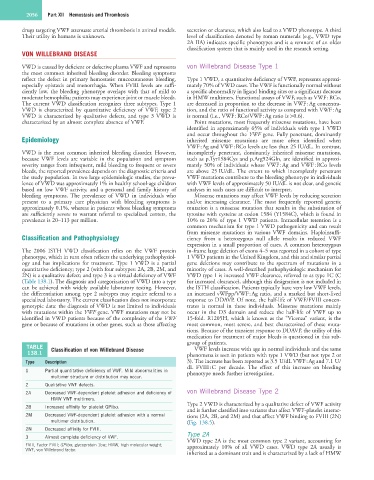
          TABLE   Classification of von Willebrand Disease       VWF levels increase with age in normal individuals and the same
          138.1                                               phenomena is seen in patients with type 1 VWD (but not type 2 or
         Type   Description                                   3). The increase has been reported as 3.5 U/dL VWF : Ag and 7.1 U/
                                                              dL  FVIII : C  per  decade.  The  effect  of  this  increase  on  bleeding
         1      Partial quantitative deficiency of VWF. Mild abnormalities in   phenotype needs further investigation.
                  multimer structure or distribution may occur.
         2      Qualitative VWF defects.
         2A     Decreased VWF-dependent platelet adhesion and deficiency of   von Willebrand Disease Type 2
                  HMW VWF multimers.
                                                              Type 2 VWD is characterized by a qualitative defect of VWF activity
         2B     Increased affinity for platelet GPIbα.
                                                              and is further classified into variants that affect VWF-platelet interac-
         2M     Decreased VWF-dependent platelet adhesion with a normal   tions (2A, 2B, and 2M) and that affect VWF binding to FVIII (2N)
                  multimer distribution.                      (Fig. 138.5).
         2N     Decreased affinity for FVIII.
         3      Almost complete deficiency of VWF.            Type 2A
                                                              VWD type 2A is the most common type 2 variant, accounting for
         FVIII, Factor FVIII; GPIbα, glycoprotein 1bα; HMW, high molecular weight;   approximately  10%  of  all  VWD  cases.  VWD  type  2A  usually  is
         VWF, von Willebrand factor.
                                                              inherited as a dominant trait and is characterized by a lack of HMW

