


Page 2312 - Hematology_ Basic Principles and Practice ( PDFDrive )
P. 2312
2054   Part XII  Hemostasis and Thrombosis


        The fully processed protein is then either released into the circulation
        or is stored in specialized organelles: the Weibel-Palade bodies (WPBs)
        of endothelial cells or the α-granules of platelets.
           Dimerization of pro-VWF monomers occurs in the ER through
        the formation of disulfide bonds between CK domain monomers in
        a  tail-to-tail  fashion.  The  location  of  these  intersubunit  disulfide
        bonds has been localized to a subset of cysteine residues (Cys2771,
        Cys2773, and/or Cys2811). In addition, the signal peptide is cleaved
        and most of the intrachain disulphide bonds are formed in the ER.
        Only pro-VWF dimers are then transported to the Golgi apparatus,
        where they make up the basic building blocks for further multimer-
        ization. Here, the propeptide (D1–D2) is cleaved by a propeptide
        processing protease, likely furin, between amino acids 763–764. The
        propeptide  continues  to  be  essential  for  VWF  multimerization
        because under acidic conditions, it serves as an endogenous chaperone
        that  promotes  additional  disulfide  bond  formation  between  D3
        domains  of  adjacent  dimers  in  a  head-to-head  orientation.  The
        intersubunit disulfide bonds are likely mediated by the alignment of   A
        the cysteine pairs C1099 and C1142. The VWF subunit is approxi-
        mately 250 kDa, whereas resulting disulfide-linked multimers can be
        more than 20,000 kDa.
           The mature VWF subunit is heavily glycosylated with carbohy-
        drate  making  up  approximately  20%  of  the  mass  of  the  mature
        subunit.  Although  the  function  of  these  oligosaccharide  chains  is
        largely  unknown,  they  appear  to  protect  VWF  from  proteolytic
        degradation, maintain the multimeric structure of VWF, affect VWF
        interaction with platelets and collagen, and influence plasma clear-
        ance  of  VWF.  In  the  ER,  12  N-linked  high-mannose-containing
        oligosaccharide chains are added to each VWF subunit, and these
        appear to be necessary for VWF subunit dimerization. In addition,
        the propeptide has three additional potential N-glycosylation sites.
        Posttranslational modification continues in the Golgi with the addi-
        tion of 10 O-linked oligosaccharides to the peptide chain, and the
        sulfation of certain N-linked oligosaccharides, such as Asn384 and
        Asn468. Glycan expression is determined by the cell-type. Within
        the postGolgi compartment of endothelial cells, the previously added
        N-linked  glycans  undergo  further  processing  with  the  addition  of
        ABO groups, as determined by the ABO genotype. Preliminary data   B
        suggest that there is less N-linked glycosylation in platelets and ABO
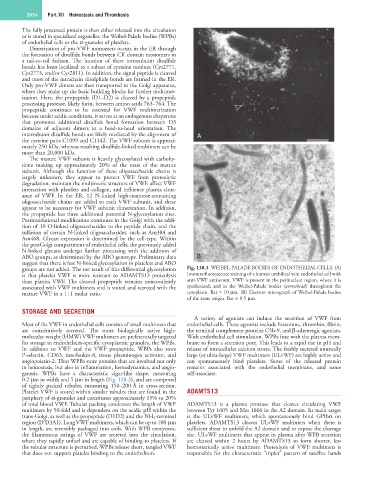
        groups are not added. The net result of this differential glycosylation   Fig. 138.3  WEIBEL-PALADE BODIES OF ENDOTHELIAL CELLS. (A)
        is  that  platelet  VWF  is  more  resistant  to  ADAMTS13  proteolysis   Immunofluorescence staining of a human umbilical vein endothelial cell with
        than  plasma  VWF. The  cleaved  propeptide  remains  noncovalently   anti-VWF antiserum. VWF is present in the perinuclear region, where it is
        associated with VWF multimers and is stored and secreted with the   synthesized,  and  in  the  Weibel-Palade  bodies  (arrowhead)  throughout  the
        mature VWF in a 1 : 1 molar ratio.                    cytoplasm. Bar = 10 µm. (B) Electron micrograph of Weibel-Palade bodies
                                                              of the same origin. Bar = 0.5 µm.

        STORAGE AND SECRETION
                                                                 A  variety  of  agonists  can  induce  the  secretion  of  VWF  from
        Most of the VWF in endothelial cells consists of small multimers that   endothelial cells. These agonists include histamine, thrombin, fibrin,
        are  constitutively  secreted.  The  more  biologically  active  high-  the terminal complement proteins C5b-9, and β-adrenergic agonists.
        molecular-weight (HMW) VWF multimers are preferentially targeted   With endothelial cell stimulation, WPBs fuse with the plasma mem-
        for storage in endothelium-specific cytoplasmic granules, the WPBs.   brane to form a secretion pore. This leads to a rapid rise in pH and
        In  addition  to  VWF  and  the  VWF  propeptide,  WBPs  also  store   release of intracellular calcium stores. The freshly secreted unusually
        P-selectin,  CD63,  interleukin-8,  tissue  plasminogen  activator,  and   large (or ultra-large) VWF multimers (ULvWF) are highly active and
        angiopoietin-2. Thus WPBs store proteins that are involved not only   can  spontaneously  bind  platelets.  Some  of  the  released  protein
        in hemostasis, but also in inflammation, hemodynamics, and angio-  remains  associated  with  the  endothelial  membrane,  and  some
        genesis.  WPBs  have  a  characteristic  cigar-like  shape,  measuring   self-associate.
        0.2 µm in width and 5 µm in length (Fig. 138.3), and are composed
        of  tightly  packed  tubules,  measuring  150–200 Å  in  cross-section.
        Platelet VWF is stored within similar tubules that are found in the   ADAMTS13
        periphery of α-granules and constitutes approximately 15% to 20%
        of total blood VWF. Tubular packing condenses the length of VWF   ADAMTS13  is  a  plasma  protease  that  cleaves  circulating  VWF
        multimers by 50-fold and is dependent on the acidic pH within the   between Tyr 1605 and Met 1606 in the A2 domain. Its main target
        trans-Golgi, as well as the propeptide (D1D2) and the NH 2-terminal   is  the  ULvWF  multimers,  which  spontaneously  bind  GPIbα  on
        region (D′D3A1). Long VWF multimers, which can be up to 100 µm   platelets.  ADAMTS13  cleaves  ULvWF  multimers  when  there  is
        in length, are reversibly packaged into coils. With WPB exocytosis,   sufficient shear to unfold the A2 domain and to expose the cleavage
        the  filamentous  strings  of  VWF  are  secreted  into  the  circulation,   site. ULvWF multimers that appear in plasma after WPB secretion
        where they rapidly unfurl and are capable of binding to platelets. If   are  cleaved  within  2  hours  by  ADAMTS13  to  form  shorter,  less
        the tubular structure is perturbed, WPBs release short, tangled VWF   hemostatically  active  multimers.  Proteolysis  of  VWF  multimers  is
        that does not support platelet binding to the endothelium.  responsible for the characteristic “triplet” pattern of satellite bands

