


Page 2315 - Hematology_ Basic Principles and Practice ( PDFDrive )
P. 2315
Chapter 138  Structure, Biology, and Genetics of von Willebrand Factor  2057


                                                               Gp1b
                                                   FVIII     Collagen  Collagen               Dimerization
                                         Multimerization

                             5′ UT    D1      D2   D’    D3    A1   A2   A3    D4     B C1 C2


                         Exon No. 12  3–10  11–17 18–20 20–28  28  28  28–32 35–39 40–4244–48  49–52

                                                  Type 2N     Types Type 2A                      Type 2A
                                                            2B and 2M

                                     Propeptide                   Mature VWF monomer
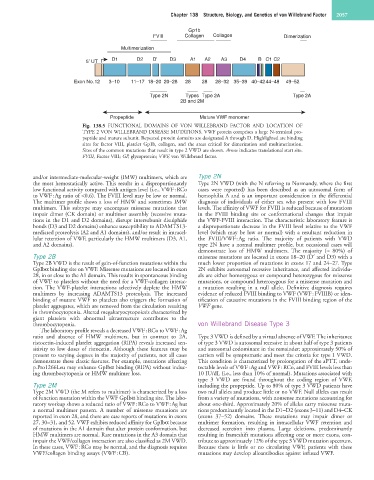
                            Fig.  138.5  FUNCTIONAL  DOMAINS  OF  VON  WILLEBRAND  FACTOR  AND  LOCATION  OF
                            TYPE 2 VON WILLEBRAND DISEASE MUTATIONS. VWF protein comprises a large N-terminal pro-
                            peptide and mature subunit. Repeated protein domains are designated A through D. Highlighted are binding
                            sites  for  factor VIII,  platelet  Gp1b,  collagen,  and  the  areas  critical  for  dimerization  and  multimerization.
                            Sites of the common mutations that result in type 2 VWD are shown. Arrow indicates translational start site.
                            FVIII, Factor VIII; GP, glycoprotein; VWF, von Willebrand factor.


            and/or intermediate-molecular-weight (IMW) multimers, which are   Type 2N
            the most hemostatically active. This results in a disproportionately   Type 2N VWD (with the N referring to Normandy, where the first
            low functional activity compared with antigen level (i.e., VWF : RCo   cases  were  reported)  has  been  described  as  an  autosomal  form  of
            to VWF : Ag ratio of <0.6). The FVIII level may be low or normal.   hemophilia A and is an important consideration in the differential
            The multimer profile shows a loss of HMW and sometimes IMW   diagnosis  of  individuals  of  either  sex  who  present  with  low  FVIII
            multimers. This  subtype  may  encompass  missense  mutations  that   levels. The affinity of VWF for FVIII is reduced because of mutations
            impair dimer (CK domain) or multimer assembly (recessive muta-  in  the  FVIII  binding  site  or  conformational  changes  that  impair
            tions in the D1 and D2 domains), disrupt intersubunit disulphide   the VWF-FVIII interaction. The characteristic laboratory feature is
            bonds (D3 and D2 domains) enhance susceptibility to ADAMTS13-  a disproportionate decrease in the FVIII level relative to the VWF
            mediated proteolysis (A2 and A1 domains), and/or result in intracel-  level (which may be low or normal) with a resultant reduction in
            lular retention of VWF, particularly the HMW multimers (D3, A1,   the  FVIII/VWF : Ag  ratio.  The  majority  of  patients  with  VWD
            and A2 domains).                                      type 2N have a normal multimer profile, but occasional cases will
                                                                  demonstrate  loss  of  HMW  multimers.  The  majority  (≈  80%)  of
            Type 2B                                               missense mutations are located in exons 18–20 (D′ and D3) with a
            Type 2B VWD is the result of gain-of-function mutations within the   much lower proportion of mutations in exons 17 and 24–27. Type
            GpIbα binding site on VWF. Missense mutations are located in exon   2N exhibits autosomal recessive inheritance, and affected individu-
            28, in or close to the A1 domain. This results in spontaneous binding   als are either homozygous or compound heterozygous for missense
            of VWF to platelets without the need for a VWF-collagen interac-  mutations, or compound heterozygous for a missense mutation and
            tion. The VWF-platelet  interactions  selectively  deplete  the  HMW   a  mutation  resulting  in  a  null  allele.  Definitive  diagnosis  requires
            multimers  by  increasing  ADAMTS13  proteolysis.  The  increased   evidence of reduced FVIII binding to VWF (VWF : FVIIIB) or iden-
            binding of mutant VWF to platelets also triggers the formation of   tification of causative mutations in the FVIII binding region of the
            platelet aggregates, which are removed from the circulation resulting   VWF gene.
            in thrombocytopenia. Altered megakaryocytopoiesis characterized by
            giant  platelets  with  abnormal  ultrastructure  contributes  to  the
            thrombocytopenia.                                     von Willebrand Disease Type 3
              The laboratory profile reveals a decreased VWF : RCo to VWF : Ag
            ratio  and  absence  of  HMW  multimers,  but  in  contrast  to  2A,   Type 3 VWD is defined by a virtual absence of VWF. The inheritance
            ristocetin-induced platelet aggregation (RIPA) reveals increased sen-  of type 3 VWD is autosomal recessive in about half of type 3 patients
            sitivity  to  low  doses  of  ristocetin.  Although  these  features  may  be   and autosomal codominant in the remainder: approximately 50% of
            present to varying degrees in the majority of patients, not all cases   carriers will be symptomatic and meet the criteria for type 1 VWD.
            demonstrate these classic features. For example, mutations affecting   This condition is characterized by prolongation of the aPTT, unde-
            p.Pro1266Leu may enhance GpIbα binding (RIPA) without induc-  tectable levels of VWF : Ag and VWF : RCo, and FVIII levels less than
            ing thrombocytopenia or HMW multimer loss.            10 IU/dL (i.e., less than 10% of normal). Mutations associated with
                                                                  type  3  VWD  are  found  throughout  the  coding  region  of  VWF,
            Type 2M                                               including the propeptide. Up to 80% of type 3 VWD patients have
            Type 2M VWD (the M refers to multimer) is characterized by a loss   two null alleles and produce little or no VWF. Null alleles can result
            of function mutation within the VWF GpIbα binding site. The labo-  from a variety of mutations, with nonsense mutations accounting for
            ratory workup shows a reduced ratio of VWF : RCo to VWF : Ag but   about one-third. Approximately 20% of alleles carry missense muta-
            a  normal  multimer  pattern.  A  number  of  missense  mutations  are   tions predominantly located in the D1–D2 (exons 3–11) and D4–CK
            reported in exon 28, and there are case reports of mutations in exons   (exons  37–52)  domains.  These  mutations  may  impair  dimer  or
            27, 30–31, and 52. VWF exhibits reduced affinity for GpIbα because   multimer  formation,  resulting  in  intracellular  VWF  retention  and
            of mutations in the A1 domain that alter protein conformation, but   decreased  secretion  into  plasma.  Large  deletions,  predominantly
            HMW multimers are normal. Rare mutations in the A3 domain that   resulting in frameshift mutations affecting one or more exons, con-
            impair the VWF/collagen interaction are also classified as 2M VWD.   tribute to approximately 12% of the type 3 VWD mutation spectrum.
            In these cases, VWF : RCo may be normal, and the diagnosis requires   Because  there  is  little  or  no  circulating  VWF,  patients  with  these
            VWF/collagen binding assays (VWF : CB).               mutations may develop alloantibodies against infused VWF.

