


Page 2323 - Hematology_ Basic Principles and Practice ( PDFDrive )
P. 2323
Chapter 139  Disseminated Intravascular Coagulation  2065


                 Endothelial                                      polyphosphates, and glycosaminoglycans, are potential activators of
                 cells                                            the contact pathway. Studies in patients with suspected DIC have
                                                                  identified  elevated  levels  of  markers  of  activation  of  the  contact
                      Cytokines               Inflammatory cells  system. In patients with meningococcal septicemia, there was a nega-
                                                                  tive correlation between plasma factor XII levels and factor XIIa–C1
                                                                  inhibitor complexes. Although this finding implies consumption of
                                                                  factor XII, and subsequent downstream activation of factor XI, an
                                                Tissue factor     alternative explanation is that there is a negative acute phase effect
                                                expression
                                                                  with reduced synthesis of factor XII, in conjunction with thrombin-
                                                                  mediated activation of factor XI.
                                     Impairment of                  However,  blockade  of  the  contact  system  with  a  factor  XIIa–
                                      physiologic                 directed  antibody  failed  to  prevent  DIC  in  a  balloon  model  of
                                     anticoagulant                Escherichia coli sepsis, but diminished development of lethal hypoten-
                                      mechanisms
                                                                  sion. These findings provide reasonable support for the current view
                                                                  that the contact pathway does not contribute to DIC, but may play
                                                                  important roles in proinflammatory mechanisms related to vascular
                            Inhibition of                         permeability,  vascular  proliferation  (kininogen  induces  smooth
                                                                                                             11
                            fibrinolysis                          muscle cell proliferation), and enhancement of fibrinolysis.
                            due to high
                           levels of PAI-1
                                                                  Cytokines and Other Amplification Pathways
                                                                  Activation of blood coagulation requires several cofactors. For devel-
                            MICROVASCULAR THROMBOSIS AND          opment of DIC, the surfaces of cell remnants or intact cells, inflam-
                             MODULATION OF INFLAMMATION           matory  mediators,  and  coagulation  proteins  are  required.  The
                                                                  stimulus for activation depends on the underlying disease and may
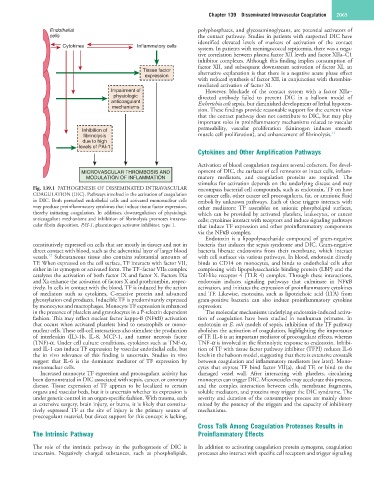
            Fig. 139.1  PATHOGENESIS OF DISSEMINATED INTRAVASCULAR   encompass bacterial cell compounds, such as endotoxin, TF on host
            COAGULATION (DIC). Pathways involved in the activation of coagulation   or cancer cells, other cancer cell procoagulants, fat, or amniotic fluid
            in  DIC.  Both  perturbed  endothelial  cells  and  activated  mononuclear  cells   emboli by unknown pathways. Each of these triggers interacts with
            may produce proinflammatory cytokines that induce tissue factor expression,   other  mediators:  TF  assembles  on  anionic  phospholipid  surfaces,
            thereby  initiating  coagulation.  In  addition,  downregulation  of  physiologic   which can be provided by activated platelets, leukocytes, or cancer
            anticoagulant mechanisms and inhibition of fibrinolysis promotes intravas-  cells; cytokines interact with receptors and induce signaling pathways
            cular fibrin deposition. PAI-1, plasminogen activator inhibitor, type 1.   that induce TF expression and other proinflammatory components
                                                                  via the NFκB complex.
                                                                    Endotoxin  is  a  lipopolysaccharide  compound  of  gram-negative
            constitutively expressed on cells that are mostly in tissues and not in   bacteria that induces the sepsis syndrome and DIC. Gram-negative
            direct contact with blood, such as the adventitial layer of larger blood   bacteria  liberate  endotoxins  from  their  membrane,  which  interact
                 12
            vessels.   Subcutaneous  tissue  also  contains  substantial  amounts  of   with cell surfaces via various pathways. In blood, endotoxin directly
            TF. When expressed on the cell surface, TF interacts with factor VII,   binds to CD14 on monocytes, and binds to endothelial cells after
            either in its zymogen or activated form. The TF–factor VIIa complex   complexing with lipopolysaccharide binding protein (LBP) and the
            catalyzes the activation of both factor IX and factor X. Factors IXa   Toll-like receptor 4 (TLR 4) complex. Through these interactions,
            and Xa enhance the activation of factors X and prothrombin, respec-  endotoxin  induces  signaling  pathways  that  culminate  in  NFκB
            tively. In cells in contact with the blood, TF is induced by the action   activation, and initiates the expression of proinflammatory cytokines
            of  mediators  such  as  cytokines,  C-reactive  protein  and  advanced   and TF.  Likewise,  exotoxins, such  as  lipoteichoic acid  (LTA)  from
            glycosylation end products. Inducible TF is predominantly expressed   gram-positive  bacteria  can  also  induce  proinflammatory  cytokine
            by monocytes and macrophages. Monocyte TF expression is enhanced   expression.
            in the presence of platelets and granulocytes in a P-selectin dependent   The molecular mechanisms underlying endotoxin-induced activa-
            fashion. This may reflect nuclear factor kappa-B (NFκB) activation   tion  of  coagulation  have  been  studied  in  nonhuman  primates.  In
            that occurs when activated platelets bind to neutrophils or mono-  endotoxin or E. coli models of sepsis, inhibition of the TF pathway
            nuclear cells. These cell-cell interactions also stimulate the production   abolishes the activation of coagulation, highlighting the importance
            of  interleukin  (IL)-1b,  IL-8,  MCP-1,  and  tumor  necrosis  factor   of TF. IL-6 is an important mediator of procoagulant effects, whereas
            (TNF)-α. Under cell culture conditions, cytokines such as TNF-α,   TNF-α is involved in the fibrinolytic response to endotoxin. Inhibi-
            and IL-1 can induce TF expression by vascular endothelial cells, but   tion of TF with tissue factor pathway inhibitor (TFPI) reduces IL-6
            the  in  vivo  relevance  of  this  finding  is  uncertain.  Studies  in  vivo   levels in the baboon model, suggesting that there is extensive crosstalk
            suggest  that  IL-6  is  the  dominant  mediator  of  TF  expression  by   between coagulation and inflammatory mediators (see later). Mono-
            mononuclear cells.                                    cytes  that  express TF  bind  factor  VII(a),  shed TF,  or  bind  to  the
              Increased monocyte TF expression and procoagulant activity has   damaged  vessel  wall.  After  interacting  with  platelets,  circulating
            been demonstrated in DIC associated with sepsis, cancer, or coronary   monocytes can trigger DIC. Microvesicles may accelerate this process,
            disease. Tissue  expression  of TF  appears  to  be  localized  to  certain   and  the  complex  interaction  between  cells,  membrane  fragments,
            organs and vascular beds, but it is uncertain whether its expression is   soluble mediators, and proteins may trigger the DIC syndrome. The
            under genetic control in an organ-specific fashion. With trauma, such   severity and duration of the consumptive process are mainly deter-
            as extensive surgery, brain injury, or burns, it is likely that constitu-  mined by the potency of the triggers and the capacity of inhibitory
            tively  expressed TF  at  the  site  of  injury  is  the  primary  source  of   mechanisms.
            procoagulant material, but direct support for this concept is lacking.
                                                                  Cross Talk Among Coagulation Proteases Results in
            The Intrinsic Pathway                                 Proinflammatory Effects
            The  role  of  the  intrinsic  pathway  in  the  pathogenesis  of  DIC  is   In addition to activating coagulation protein zymogens, coagulation
            uncertain.  Negatively  charged  substances,  such  as  phospholipids,   proteases also interact with specific cell receptors and trigger signaling

