


Page 2319 - Hematology_ Basic Principles and Practice ( PDFDrive )
P. 2319
Chapter 138  Structure, Biology, and Genetics of von Willebrand Factor  2061


                          Evaluations following        Personal and FHx to assess severity of bleeding phenotype
                              initial diagnosis                Screening for HBV, HCV, and HIV if Hx
                                                                  of exposure to blood products
                                                                     Baseline iron studies
                                                             Musculoskeletal examination for type 3 VWD
                                                         Gynecological evaluation for women with menorrhagia
                                                           Perform a desmopressin challenge for all type 1,
                                                                    subset of type 2 patients


                             Regular visits at  Review of bleeding events and plan for  Review of complications
                               a specialized  on demand and prophylactic treatment       of bleeding:
                           center (≤ annually)                                        Consider repeat iron
                                                                                         studies and
                                                                                       reassessment by
                                                                                         physiotherapy


                         Treatment: Education  Desmopressin       For desmopressin    Consider parenteral
                         for patients regarding  responsive:  unresponsive/contraindicated,  iron therapy
                              local measures  For minor/moderate  severe bleeds or invasive  If stigmata of chronic
                           (pressure, ice, etc.)  bleeds or invasive  procedure with high risk of  changes secondary to
                                and indirect  procedure with minimal  bleeding use VWF/FVIII  bleeding: consider
                                  therapies  risk of bleeding, use  concentrate to target a peak  long-term prophylaxis
                            (tranexamic acid)  desmopressin 0.3  VWF:RCo and FVIII level of
                                            µg/kg (max 20 µg)  >100 IU/dL and trough >50
                                            IV/SC. May require  IU/dL. Repeat doses until
                                             repeated doses   hemostasis achieved. Monitor
                                            FLUID RESTRICT       for supratherapeutic
                                                                   doses of  FVIII
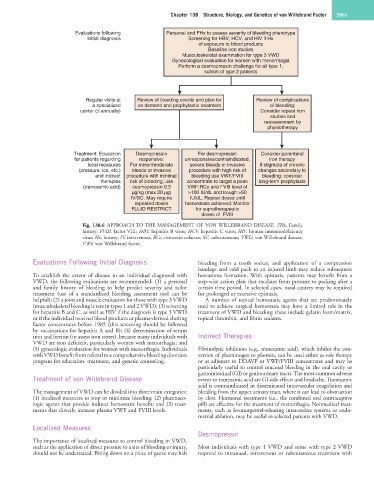
                            Fig. 138.6  APPROACH TO THE MANAGEMENT OF VON WILLEBRAND DISEASE. FHx, Family
                            history; FVIII, factor VIII; HBV, hepatitis B virus; HCV, hepatitis C virus; HIV, human immunodeficiency
                            virus; Hx, history; IV, intravenous; RCo, ristocetin cofactor; SC, subcutaneous; VWD, von Willebrand disease;
                            VWF, von Willebrand factor.


            Evaluations Following Initial Diagnosis               bleeding  from  a  tooth  socket,  and  application  of  a  compression
                                                                  bandage and cold pack to an injured limb may reduce subsequent
            To  establish  the  extent  of  disease  in  an  individual  diagnosed  with   hematoma  formation. With  epistaxis,  patients  may  benefit  from  a
            VWD, the following evaluations are recommended: (1) a personal   step-wise action plan that escalates from pressure to packing after a
            and  family  history  of  bleeding  to  help  predict  severity  and  tailor   certain time period. In selected cases, nasal cautery may be required
            treatment  (use  of  a  standardized  bleeding  assessment  tool  can  be   for prolonged or excessive epistaxis.
            helpful); (2) a joint and muscle evaluation for those with type 3 VWD   A  number  of  topical  hemostatic  agents  that  are  predominately
            (musculoskeletal bleeding is rare in types 1 and 2 VWD); (3) screening   used to achieve surgical hemostasis may have a limited role in the
            for hepatitis B and C, as well as HIV if the diagnosis is type 3 VWD   treatment of VWD and bleeding; these include gelatin foam/matrix,
            or if the individual received blood products or plasma-derived clotting   topical thrombin, and fibrin sealants.
            factor concentrates before 1985 (this screening should be followed
            by vaccinations for hepatitis A and B); (4) determination of serum
            iron and ferritin (to assess iron stores), because many individuals with   Indirect Therapies
            VWD are iron deficient, particularly women with menorrhagia; and
            (5) gynecologic evaluation for women with menorrhagia. Individuals   Fibrinolytic inhibitors (e.g., tranexamic acid), which inhibit the con-
            with VWD benefit from referral to a comprehensive bleeding disorders   version of plasminogen to plasmin, can be used either as sole therapy
            program for education, treatment, and genetic counseling.  or as adjuncts to DDAVP or VWF/FVIII concentrates and may be
                                                                  particularly useful to control mucosal bleeding in the oral cavity or
                                                                  gastrointestinal (GI) or genitourinary tracts. The most common adverse
            Treatment of von Willebrand Disease                   events to tranexamic acid are GI side-effects and headache. Tranexamic
                                                                  acid is contraindicated in disseminated intravascular coagulation and
            The management of VWD can be divided into three main categories:   bleeding from the upper urinary tract, where it can lead to obstruction
            (1) localized measures to stop or minimize bleeding; (2) pharmaco-  by clots. Hormonal treatments (i.e., the combined oral contraceptive
            logic agents that provide indirect hemostatic benefit; and (3) treat-  pill) are effective for the treatment of menorrhagia. Nonmedical treat-
            ments that directly increase plasma VWF and FVIII levels.  ments, such as levonorgestrel-releasing intrauterine systems or endo-
                                                                  metrial ablation, may be useful in selected patients with VWD.
            Localized Measures
                                                                  Desmopressin
            The importance of localized measures to control bleeding in VWD,
            such as the application of direct pressure to a site of bleeding or injury,   Most individuals with type 1 VWD and some with type 2 VWD
            should not be understated. Biting down on a piece of gauze may halt   respond to intranasal, intravenous or subcutaneous treatment with

