


Page 2385 - Hematology_ Basic Principles and Practice ( PDFDrive )
P. 2385
Chapter 144  Atherothrombosis  2127


              An intriguing recent development in understanding the cellular   for  monocytes.  Animal  studies  suggest  that  platelets  may  facilitate
            composition of plaque comes from so-called lineage marker studies   monocyte recruitment, acting as a bridge between the endothelium
                                                                                                 21
            that show that a surprisingly large percentage of foam cells expressing   and circulating monocytes (see Fig. 144.5).  Sophisticated single-cell
            macrophage markers were actually derived from a smooth muscle cell   imaging studies in mice showed that monocytes continue to traffic
                 20
            lineage.   These  studies  suggest  that  local  cues  in  plaque  might   through the “shoulders” of even advanced stage lesions.
            interact with intimal or adventitial smooth muscle cells to redirect   Plaque generally grows in an eccentric pattern within the intima
            their genetic programs towards a macrophage-like phenotype. It is   and in certain instances can create significant obstruction to blood
            possible that such cells do not possess the full migratory capacity of   flow  (Fig.  144.6,  left).  In  such  cases,  as  oxygen  demand  increases,
            macrophages  and  this  could  contribute  to  foam  cell  trapping  in   tissue  ischemia  results,  leading  to  angina  and/or  lower  extremity
            plaque.                                               claudication.  Recent  in  vivo  studies  using  advanced  imaging  tech-
                                                                  niques, such as intravascular ultrasound, however, demonstrate that
            LESION EVOLUTION: REMODELING AND THE                  in most cases the vessel wall remodels as plaque grows (see Fig. 144.6,
                                                                  right) so that the arterial lumen is mostly preserved and the bulk of
            VULNERABLE PLAQUE                                     the atheromatous mass is ablumenal. These studies show that tradi-
                                                                  tional two-dimensional angiographic techniques vastly underestimate
            In  humans,  plaque  develops  and  evolves  very  slowly  over  many   plaque burden. Of note, such studies, along with careful histopatho-
            decades, explaining in part why animal models in which advanced   logic examinations, have led to the concept that the “quality” of the
            lesions develop rapidly over weeks and months may not accurately   plaque may be more important than its quantity in predicting car-
            reflect the human condition. Accumulation of foam cells is only one   diovascular  outcomes.  Some  plaques,  particularly  those  with  thick
            component of the atherogenic process. Early on, signals from mac-  fibrous caps and cellular cores, seem to be stable (Fig. 144.7), whereas
            rophages  (Fig.  144.5)  and  the  injured  endothelium,  primarily   others, particularly those with thin fibrous caps, abundant leukocytes,
            platelet-derived growth factor (PDGF), stimulate adventitial smooth   and necrotic, lipid-rich cores, seem to be unstable and vulnerable to
                                                     2
            muscle cells to migrate into the intima and proliferate.  These cells   erosion and rupture (see Fig. 144.7). Rupture refers to the sudden
            contribute to the mass of the lesions, and secrete collagen and other   loss of integrity of the fibrous cap with release of plaque material into
            factors that change the nature of the intimal extracellular matrix, and   the lumen, often followed by acute occlusive thrombosis. Erosion is
            may  even  contribute  to  the  burden  of  foam  cells.  Lymphocytes   a  more  subtle  concept  referring  to  loss  of  endothelial  cells  at  the
            infiltrating from the circulation and mast cells from the adventitia   shoulder of the lesion or minimal leakage of plaque through a partially
            also contribute to the inflammatory milieu and matrix remodeling.   disrupted  cap.  Plaque  erosion  may  lead  to  subocclusive  thrombus
            Platelet antigens are also readily detectable in plaque, suggesting that   formation and/or intraplaque hemorrhage and thrombosis. Repeated
            platelets  enter  the  intima,  where  they  may  contribute  to  matrix   cycles  of  erosion  and  intraplaque  hemorrhage/thrombosis  may
            remodeling  and  the  inflammatory  state  by  secreting  PDGF,  trans-  account for the apparent stepwise growth of some lesions.
            forming  growth  factor-β,  and  other  growth  factors,  along  with   Understanding factors that contribute to plaque vulnerability is
                                                                                                 22
            platelet factor 4, which is a potent chemokine, also known as CXCL4,   an extremely important topic of research,  but one that is difficult


                                   Platelet

                                                          Chemokine
                                         Monocyte

                                                     Endothelium
                                                              Inflammatory
                                                                signals
                                                                                                Apoptotic
                                                                                  Foam cells
                                                                                                  cell
                         Neointima
                                               Foam cell
                                                                 T-cell
                                                                                              Proliferation
                                                                      Collagen               and migration


                                                 PDGF
                               Smooth muscle cell

                                        Adventitia
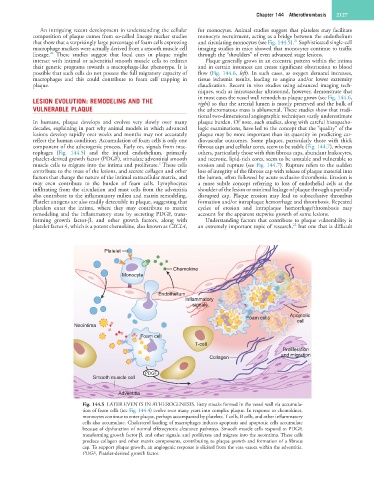
                            Fig. 144.5  LATER EVENTS IN ATHEROGENESIS. Fatty streaks formed in the vessel wall via accumula-
                            tion of foam cells (see Fig. 144.4) evolve over many years into complex plaque. In response to chemokines,
                            monocytes continue to enter plaque, perhaps accompanied by platelets. T cells, B cells, and other inflammatory
                            cells also accumulate. Cholesterol loading of macrophages induces apoptosis and apoptotic cells accumulate
                            because of dysfunction of normal efferocytotic clearance pathways. Smooth muscle cells respond to PDGF,
                            transforming growth factor β, and other signals, and proliferate and migrate into the neointima. These cells
                            produce collagen and other matrix components, contributing to plaque growth and formation of a fibrous
                            cap. To support plaque growth, an angiogenic response is elicited from the vasa vasora within the adventitia.
                            PDGF, Platelet-derived growth factor.

