


Page 2387 - Hematology_ Basic Principles and Practice ( PDFDrive )
P. 2387
Chapter 144  Atherothrombosis  2129


            to model in animals. Some key features that have emerged are the
            degree of angiogenesis within the plaque, balance of matrix-degrading
            enzymes and enzyme inhibitors, level of apoptosis of cells within the   Tissue factor
            plaque, deposition of calcium within the plaque, and level of systemic              Rupture
            and local inflammation.                                  OxLDL
              Plaque angiogenesis is a recently appreciated process that can be
            visualized by certain imaging modalities, such as ultrafast computed   Platelet
            tomography (CT) and magnetic resonance imaging (MRI), in real   Tissue factor
                                                                               +
                23
            time.  Based on analogy to tumor growth, it is not surprising that   Microparticle
            the growing plaque requires a blood supply and also that the neoves-
            sels within the plaque may, similar to their counterparts in cancer, be   Fibrin clot
            leaky  and  unstable. This  neovascular  instability  may  contribute  to
            plaque instability by facilitating entry of inflammatory cells, platelets,
            and  plasma  components,  such  as  fibrinogen  and  cell-derived  mic-
            roparticles (MPs). In animal models, treatment with antiangiogenic
            agents significantly slows plaque growth. In some disease states, such
            as diabetes, accelerated atherosclerosis may reflect a “microvascular”
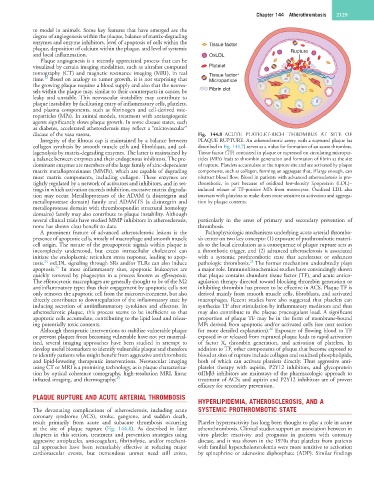
            disease of the vasa vasora.                           Fig.  144.8  ACUTE  PLATELET-RICH  THROMBUS  AT  SITE  OF
              Integrity of the fibrous cap is maintained by a balance between   PLAQUE RUPTURE. An atherosclerotic artery with a ruptured plaque (as
            collagen synthesis by smooth muscle cells and fibroblasts, and col-  described in Fig. 144.7) serves as a nidus for formation of an acute thrombus.
            lagenolysis by matrix-degrading enzymes. The latter is maintained by   Tissue factor (TF) contained in plaque or expressed on circulating micropar-
            a balance between enzymes and their endogenous inhibitors. The pre-  ticles (MPs) leads to thrombin generation and formation of fibrin at the site
            dominant enzymes are members of the large family of zinc-dependent   of rupture. Platelets accumulate at the rupture site and are activated by plaque
            matrix metalloproteinases (MMPs), which are capable of degrading   components, such as collagen, forming an aggregate that, if large enough, can
            most  matrix  components,  including  collagen.  These  enzymes  are   obstruct blood flow. Blood in patients with advanced atherosclerosis is pro-
            tightly regulated by a network of activators and inhibitors, and in set-  thrombotic,  in  part  because  of  oxidized  low-density  lipoprotein  (LDL)–
            tings in which activation exceeds inhibition, excessive matrix degrada-  induced  release  of TF-positive  MPs  from  monocytes.  Oxidized  LDL  also
            tion may occur. Metalloproteases of the ADAM (a disintegrin and   interacts with platelets to make them more sensitive to activation and aggrega-
            metalloprotease  domain)  family  and  ADAMTS  (a  disintegrin  and   tion by plaque contents.
            metalloprotease domain with thrombospondin structural homology
            domains) family may also contribute to plaque instability. Although
            several clinical trials have studied MMP inhibitors in atherosclerosis,   particularly  in  the  areas  of  primary  and  secondary  prevention  of
            none has shown clear benefit to date.                 thrombosis.
              A  prominent  feature  of  advanced  atherosclerotic  lesions  is  the   Pathophysiologic mechanisms underlying acute arterial thrombo-
            presence of apoptotic cells, mostly of macrophage and smooth muscle   sis center on two key concepts: (1) exposure of prothrombotic materi-
            cell origin. The nature of the proapoptotic signals within plaque is   als to the local circulation as a consequence of plaque rupture acts as
            incompletely  understood,  but  excess  intracellular  cholesterol  can   a thrombotic trigger, and (2) advanced atherosclerosis is associated
            initiate the endoplasmic reticulum stress response, leading to apop-  with  a  systemic  prothrombotic  state  that  accelerates  or  enhances
               24
                                                                                   25
            tosis.  oxLDL signaling through SRs and/or TLRs can also induce   pathologic thrombosis.  The former mechanism undoubtedly plays
                   25
            apoptosis.   In  most  inflammatory  sites,  apoptotic  leukocytes  are   a major role. Immunohistochemical studies have convincingly shown
            quickly removed by phagocytes in a process known as efferocytosis.   that plaque contains abundant tissue factor (TF), and acute antico-
            The efferocytotic macrophages are generally thought to be of the M2   agulation therapy directed toward blocking thrombin generation or
            antiinflammatory type; thus their engagement by apoptotic cells not   inhibiting thrombin has proven to be effective in ACS. Plaque TF is
            only removes the apoptotic cell from the microenvironment, but also   derived mainly from smooth muscle cells, fibroblasts, and activated
            directly contributes to downregulation of the inflammatory state by   macrophages. Recent studies have also suggested that platelets can
            inducing secretion of antiinflammatory cytokines and effectors. In   synthesize TF after stimulation by inflammatory mediators and thus
            atherosclerotic  plaque,  this  process  seems  to  be  inefficient  so  that   may also contribute to the plaque procoagulant load. A significant
            apoptotic cells accumulate, contributing to the lipid load and releas-  proportion of plaque TF may be in the form of membrane-bound
            ing potentially toxic contents.                       MPs derived from apoptotic and/or activated cells (see next section
                                                                                         26
              Although therapeutic interventions to stabilize vulnerable plaque   for more detailed explanation).  Exposure of flowing blood to TF
            or prevent plaques from becoming vulnerable have not yet material-  exposed in or released from ruptured plaque leads to rapid activation
            ized,  several  imaging  approaches  have  been  studied  in  attempt  to   of  factor  X,  thrombin  generation,  and  activation  of  platelets.  In
            develop useful biomarkers to identify vulnerable plaque and therefore   addition to TF, other components of plaque that become exposed to
            to identify patients who might benefit from aggressive antithrombotic   blood at sites of rupture include collagen and oxidized phospholipids,
            and  lipid-lowering  therapeutic  interventions.  Neovascular  imaging   both  of  which  can  activate  platelets  directly. Thus  aggressive  anti-
            using CT or MRI is a promising technology, as is plaque characteriza-  platelet  therapy  with  aspirin,  P2Y12  inhibitors,  and  glycoprotein
            tion by optical coherence tomography, high-resolution MRI, linear   αIIbβ3 inhibitors are mainstays of the pharmacologic approach to
            infrared imaging, and thermography. 23                treatment of ACS; and aspirin and P2Y12 inhibitors are of proven
                                                                  efficacy for secondary prevention.
            PLAQUE RUPTURE AND ACUTE ARTERIAL THROMBOSIS
                                                                  HYPERLIPIDEMIA, ATHEROSCLEROSIS, AND A
            The  devastating  complications  of  atherosclerosis,  including  acute   SYSTEMIC PROTHROMBOTIC STATE
            coronary  syndrome  (ACS),  stroke,  gangrene,  and  sudden  death,
            result  primarily  from  acute  and  subacute  thrombosis  occurring   Platelet hyperreactivity has long been thought to play a role in acute
            at  the  site  of  plaque  rupture  (Fig.  144.8).  As  described  in  later   atherothrombosis. Clinical studies support an association between in
            chapters  in  this  section,  treatment  and  prevention  strategies  using   vitro  platelet  reactivity  and  prognosis  in  patients  with  coronary
            aggressive  antiplatelet,  anticoagulant,  fibrinolytic,  and/or  mechani-  disease, and it was shown in the 1970s that platelets from patients
            cal  approaches  have  been  remarkably  effective  at  reducing  major   with familial hypercholesterolemia were more sensitive to activation
            cardiovascular  events,  but  tremendous  unmet  need  still  exists,   by  epinephrine  or  adenosine  diphosphate  (ADP).  Similar  findings

