


Page 2383 - Hematology_ Basic Principles and Practice ( PDFDrive )
P. 2383
Chapter 144  Atherothrombosis  2125


                                                  Chemokine
                                                   receptor
                                      Adhesion
                                      receptors
                                 LDL                                Chemokine   Foam cell
                                              Monocyte                         migrating out


                                                                                                  Plaque
                                                              Endothelium
                                                                            Macrophage


                                   LDL

                                                  ROS
                                                                                Inracellular
                                                                                lipid droplet  Foam cell
                            PLA2
                                                                            Scavenger receptors
                                                                            (CD36, SRA, TLR)
                                            OxLDL

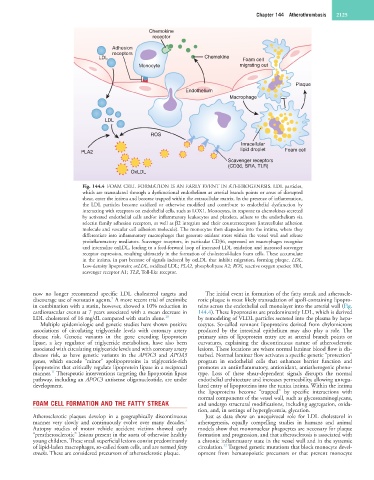
                            Fig. 144.4  FOAM CELL FORMATION IS AN EARLY EVENT IN ATHEROGENESIS. LDL particles,
                            which are transudated through a dysfunctional endothelium at arterial branch points or areas of disrupted
                            shear, enter the intima and become trapped within the extracellular matrix. In the presence of inflammation,
                            the  LDL  particles  become  oxidized  or  otherwise  modified  and  contribute  to  endothelial  dysfunction  by
                            interacting with receptors on endothelial cells, such as LOX1. Monocytes, in response to chemokines secreted
                            by activated endothelial cells and/or inflammatory leukocytes and platelets, adhere to the endothelium via
                            selectin family adhesion receptors, as well as β2 integrins and their counterreceptors (intercellular adhesion
                            molecule and vascular cell adhesion molecule). The monocytes then diapedese into the intima, where they
                            differentiate into inflammatory macrophages that generate oxidant stress within the vessel wall and release
                            proinflammatory mediators. Scavenger receptors, in particular CD36, expressed on macrophages recognize
                            and internalize oxLDL, leading to a feed-forward loop of increased LDL oxidation and increased scavenger
                            receptor expression, resulting ultimately in the formation of cholesterol-laden foam cells. These accumulate
                            in the intima, in part because of signals induced by oxLDL that inhibit migration, forming plaque. LDL,
                            Low-density lipoprotein; oxLDL, oxidized LDL; PLA2, phospholipase A2; ROS, reactive oxygen species; SRA,
                            scavenger receptor A1; TLR, Toll-like receptor.


            now  no  longer  recommend  specific  LDL  cholesterol  targets  and   The initial event in formation of the fatty streak and atheroscle-
                                      9
            discourage use of nonstatin agents.  A more recent trial of ezetimibe   rotic plaque is most likely transudation of apoB-containing lipopro-
            in combination with a statin, however, showed a 10% reduction in   teins across the endothelial cell monolayer into the arterial wall (Fig.
            cardiovascular events at 7 years associated with a mean decrease in   144.4). These lipoproteins are predominantly LDL, which is derived
            LDL cholesterol of 16 mg/dL compared with statin alone. 10  by remodeling of VLDL particles secreted into the plasma by hepa-
              Multiple epidemiologic and genetic studies have shown positive   tocytes. So-called remnant lipoproteins derived from chylomicrons
            associations  of  circulating  triglyceride  levels  with  coronary  artery   produced  by  the  intestinal  epithelium  may  also  play  a  role.  The
            disease  risk.  Genetic  variants  in  the  gene  encoding  lipoprotein   primary  sites  of  lipoprotein  entry  are  at  arterial  branch  points  or
            lipase,  a  key  regulator  of  triglyceride  metabolism,  have  also  been   curvatures,  explaining  the  discontinuous  nature  of  atherosclerotic
            associated with circulating triglyceride levels and with coronary artery   lesions. These locations are where normal laminar blood flow is dis-
            disease  risk,  as  have  genetic  variants  in  the  APOC3  and  APOA5   turbed. Normal laminar flow activates a specific genetic “protection”
            genes,  which  encode  “minor”  apolipoproteins  in  triglyceride-rich   program  in  endothelial  cells  that  enhances  barrier  function  and
            lipoproteins that critically regulate lipoprotein lipase in a reciprocal   promotes an antiinflammatory, antioxidant, antiatherogenic pheno-
                  11
            manner.  Therapeutic interventions targeting the lipoprotein lipase   type.  Loss  of  these  shear-dependent  signals  disrupts  the  normal
            pathway, including an APOC3 antisense oligonucleotide, are under   endothelial architecture and increases permeability, allowing unregu-
            development.                                          lated entry of lipoproteins into the tunica intima. Within the intima
                                                                  the  lipoproteins  become  “trapped”  by  specific  interactions  with
                                                                  normal components of the vessel wall, such as glycosoaminoglycans,
            FOAM CELL FORMATION AND THE FATTY STREAK              and undergo structural modifications, including aggregation, oxida-
                                                                  tion, and, in settings of hyperglycemia, glycation.
            Atherosclerotic  plaques  develop  in  a  geographically  discontinuous   Just  as  data  show  an  unequivocal  role  for  LDL  cholesterol  in
                                                              2
            manner  very  slowly  and  continuously  evolve  over  many  decades.    atherogenesis,  equally  compelling  studies  in  humans  and  animal
            Autopsy  studies  of  motor  vehicle  accident  victims  showed  early   models show that mononuclear phagocytes are necessary for plaque
            “preatherosclerotic” lesions present in the aorta of otherwise healthy   formation and progression, and that atherosclerosis is associated with
            young children. These small superficial lesions consist predominantly   a chronic inflammatory state in the vessel wall and in the systemic
                                                                          12
            of lipid-laden macrophages, so-called foam cells, and are termed fatty   circulation.  Targeted genetic mutations that block monocyte devel-
            streaks. These are considered precursors of atherosclerotic plaque.  opment  from  hematopoietic  precursors  or  that  prevent  monocyte

