


Page 2381 - Hematology_ Basic Principles and Practice ( PDFDrive )
P. 2381
Chapter 144  Atherothrombosis  2123


            otherwise normal, despite nearly absent LDL, suggesting that target-  and Drug Administration (FDA) in 2015 as second-line therapy for
                                                                                  5
            ing this enzyme could represent an effective strategy for cholesterol-  hypercholesterolemia.  In clinical trials these agents were well toler-
            lowering  therapeutics.  Indeed,  humanized  monoclonal  antibodies   ated  and  lowered  LDL  cholesterol  by  approximately  60%  and
            inhibiting PCSK9 function were quickly developed, moved through   decreased  cardiovascular  events  by  half,  but  it  must  be  noted  that
            clinical trials (OSLER and ODYSSEY) and approved by the US Food   long-term toxicity data are not yet available.
                                                                    Cells in the periphery have the capacity to eliminate excess cho-
                                                                  lesterol through a process known as reverse cholesterol transport (RCT).
                                                                  In this pathway, summarized in Fig. 144.3, postlysosomal trafficking
                                                                  of intracellular cholesterol to the plasma membrane, mediated in part
                                                                  by  actions  of  acyl-CoA  cholesterol  acyltransferase  (ACAT)  and
                                                                  Niemann-Pick type C (NPC) protein, allows the cell surface adenos-
                                                                  ine triphosphate (ATP)-binding cassette (ABC) proteins ABCA1 and
                                   Lumen                          ABCG1  to  transport  excess  cholesterol  to  apolipoprotein  (apo)
                                                                  A-containing  lipoproteins,  either  nascent  HDL  (in  the  case  of
                                                                  ABCA1) or mature HDL (in the case of ABCG1). HDL then “deliv-
                                                                  ers” the cholesterol back to the liver, where it is selectively taken up
                          Fatty plaque                Neo-intima  by  hepatocytes  through  a  protein  known  as  scavenger  receptor  B1
                                                                  (SRB1) and ultimately secreted into the bile and excreted in feces.
                                                                  The role of HDL in RCT probably accounts for its association with
                                                                  lowered risk for cardiovascular disease, but HDL particles also contain
                                                                  antiinflammatory and antioxidant proteins that may also contribute
                                                                  to lowering atherosclerosis risk.
                                                                    Pharmacologic  and  lifestyle  approaches  to  enhance  RCT  have
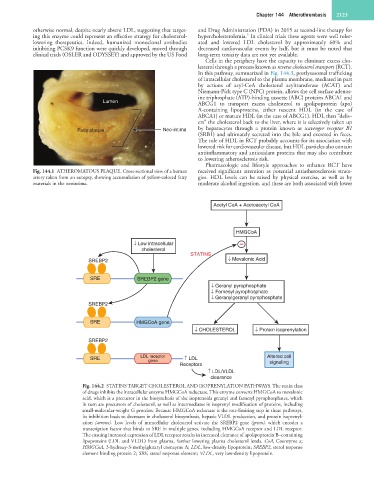
            Fig. 144.1  ATHEROMATOUS PLAQUE. Cross-sectional view of a human   received significant attention as potential antiatherosclerosis strate-
            artery taken from an autopsy, showing accumulation of yellow-colored fatty   gies.  HDL  levels  can  be  raised  by  physical  exercise,  as  well  as  by
            materials in the neointima.                           moderate alcohol ingestion, and these are both associated with lower


                                                                       Acetyl CoA + Acetoacetyl CoA


                                                                              HMGCoA
                                             ↓ Low intracellular
                                               cholesterol
                                                               STATINS
                              SREBP2                                        ↓ Mevalonic Acid


                               SRE            SREBP2 gene
                                                                      ↓ Geranyl pyrophosphate
                                                                      ↓ Farnesyl pyrophosphate
                                                                      ↓ Geranylgeranyl pyrophosphate
                              SREBP2


                               SRE            HMGCoA gene
                                                                 ↓ CHOLESTEROL      ↓ Protein isoprenylation
                              SREBP2

                               SRE             LDL receptor  ↑ LDL                      Altered cell
                                                 gene
                                                            Receptors                    signaling
                                                                     ↑ LDL/VLDL
                                                                      clearance
                            Fig. 144.2  STATINS TARGET CHOLESTEROL AND ISOPRENYLATION PATHWAYS. The statin class
                            of drugs inhibits the intracellular enzyme HMGCoA reductase. This enzyme converts HMGCoA to mevalonic
                            acid, which is a precursor in the biosynthesis of the isoprenoids geranyl and farnesyl pyrophosphates, which
                            in turn are precursors of cholesterol, as well as intermediates in isoprenyl modification of proteins, including
                            small-molecular-weight G proteins. Because HMGCoA reductase is the rate-limiting step in these pathways,
                            its inhibition leads to decreases in cholesterol biosynthesis, hepatic VLDL production, and protein isoprenyl-
                            ation  (arrows).  Low  levels  of  intracellular  cholesterol  activate  the  SREBP2  gene  (green),  which  encodes  a
                            transcription factor that binds to SRE in multiple genes, including HMGCoA receptor and LDL receptor.
                            The ensuing increased expression of LDL receptor results in increased clearance of apolipoprotein B–containing
                            lipoproteins (LDL and VLDL) from plasma, further lowering plasma cholesterol levels. CoA, Coenzyme a;
                            HMGCoA, 3-hydroxy-3-methylglutaryl coenzyme A; LDL, low-density lipoprotein; SREBP2, sterol response
                            element binding protein 2; SRE, sterol response element; VLDL, very low-density lipoprotein.

