


Page 2382 - Hematology_ Basic Principles and Practice ( PDFDrive )
P. 2382
2124   Part XII  Hemostasis and Thrombosis


                                                 miR33a

                                                       Cholesterol                       Hepatocyte
                       Macrophage


                                                            Nascent HDL


                                                            Mature HDL
                                                miR33a

                          Statins                                                        Peripheral cell

                                                                    CETP       +
                                                          TG

                             ABCA1      Cholesterol
                                                                       Statins
                             ABCG1      SRB-1
                              Apo B
                              Apo A     LDL receptor        LDL/VLDL


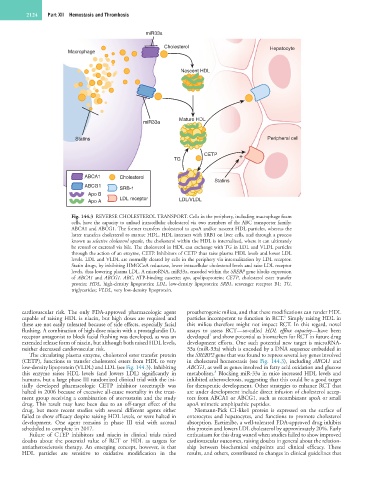
                        Fig. 144.3  REVERSE CHOLESTEROL TRANSPORT. Cells in the periphery, including macrophage foam
                        cells, have the capacity to unload intracellular cholesterol via two members of the ABC transporter family:
                        ABCA1 and ABCG1. The former transfers cholesterol to apoA and/or nascent HDL particles, whereas the
                        latter transfers cholesterol to mature HDL. HDL interacts with SRB1 on liver cells, and through a process
                        known as selective cholesterol uptake, the cholesterol within the HDL is internalized, where it can ultimately
                        be reused or excreted via bile. The cholesterol in HDL can exchange with TG in LDL and VLDL particles
                        through the action of an enzyme, CETP. Inhibitors of CETP thus raise plasma HDL levels and lower LDL
                        levels. LDL and VLDL are normally cleared by cells in the periphery via internalization by LDL receptor.
                        Statin drugs, by inhibiting HMGCoA reductase, lower intracellular cholesterol levels and raise LDL receptor
                        levels, thus lowering plasma LDL. A microRNA, miR33a, encoded within the SREBP gene blocks expression
                        of ABCA1 and ABCG1. ABC, ATP-binding cassette; apo, apolipoprotein; CETP, cholesterol ester transfer
                        protein;  HDL,  high-density  lipoprotein;  LDL,  low-density  lipoprotein;  SRB1,  scavenger  receptor  B1;  TG,
                        triglycerides; VLDL, very low-density lipoprotein.


        cardiovascular  risk.  The  only  FDA-approved  pharmacologic  agent   proatherogenic milieu, and that these modifications can render HDL
                                                                                              6
        capable of raising HDL is niacin, but high doses are required and   particles incompetent to function in RCT.  Simply raising HDL in
        these are not easily tolerated because of side effects, especially facial   this milieu therefore might not impact RCT. In this regard, novel
        flushing. A combination of high-dose niacin with a prostaglandin D 2    assays  to  assess  RCT—so-called  HDL  efflux  capacity—have  been
                                                                      7
        receptor antagonist to block facial flushing was developed, as was an   developed  and show potential as biomarkers for RCT in future drug
        extended release form of niacin, but although both raised HDL levels,   development efforts. One such potential new target is microRNA-
        neither decreased cardiovascular risk.                33a (miR-33a) which is encoded by a DNA sequence embedded in
           The circulating plasma enzyme, cholesterol ester transfer protein   the SREBP2 gene that was found to repress several key genes involved
        (CETP), functions to transfer cholesterol esters from HDL to very   in  cholesterol  homeostasis  (see  Fig.  144.3),  including  ABCA1  and
        low-density lipoprotein (VLDL) and LDL (see Fig. 144.3). Inhibiting   ABCG1, as well as genes involved in fatty acid oxidation and glucose
                                                                       8
        this  enzyme  raises  HDL  levels  (and  lowers  LDL)  significantly  in   metabolism.  Blocking miR-33a in mice increased HDL levels and
        humans, but a large phase III randomized clinical trial with the ini-  inhibited atherosclerosis, suggesting that this could be a good target
        tially  developed  pharmacologic  CETP  inhibitor  torcetrapib  was   for therapeutic development. Other strategies to enhance RCT that
        halted in 2006 because of excessive all-cause mortality in the treat-  are under development include direct infusion of cholesterol accep-
        ment group receiving a combination of atorvastatin and the study   tors from ABCA1 or ABCG1, such as recombinant apoA or small
        drug. This result may have been due to an off-target effect of the   apoA mimetic amphipathic peptides.
        drug,  but  more  recent  studies  with  several  different  agents  either   Niemann-Pick  C1-like1  protein  is  expressed  on  the  surface  of
        failed to show efficacy despite raising HDL levels, or were halted in   enterocytes and hepatocytes, and functions to promote cholesterol
        development.  One  agent  remains  in  phase  III  trial  with  accrual   absorption. Ezetimibe, a well-tolerated FDA-approved drug inhibits
        scheduled to complete in 2017.                        this protein and lowers LDL cholesterol by approximately 20%. Early
           Failure  of  CTEP  inhibitors  and  niacin  in  clinical  trials  raised   enthusiasm for this drug waned when studies failed to show improved
        doubts  about  the  potential  value  of  RCT  or  HDL  as  targets  for   cardiovascular outcomes, raising doubts in general about the relation-
        antiatherosclerosis  therapy.  An  emerging  concept,  however,  is  that   ship  between  biochemical  endpoints  and  clinical  efficacy.  These
        HDL  particles  are  sensitive  to  oxidative  modification  in  the   results, and others, contributed to changes in clinical guidelines that

