


Page 2440 - Hematology_ Basic Principles and Practice ( PDFDrive )
P. 2440
2178   Part XII  Hemostasis and Thrombosis


        protamine sulfate. Consequently, patients at high risk for bleeding may   half-life is about 17 hours. The drug is given subcutaneously once
        be more safely treated with continuous intravenous unfractionated   daily. Because fondaparinux is cleared unchanged via the kidneys, it
        heparin than with subcutaneous LMWH. In addition to the potential   is  contraindicated  in  patients  with  a  creatinine  clearance  less  than
        for  complete  reversal  with  protamine  sulfate,  the  short  half-life  of   30 mL/min,  and  it  should  be  used  with  caution  in  those  with  a
        intravenous heparin also is an advantage if major bleeding occurs.  creatinine clearance less than 50 mL/min.
                                                                 Fondaparinux produces a predictable anticoagulant response after
        Thrombocytopenia                                      administration  in  fixed  doses  because  it  does  not  bind  to  plasma
        The  risk  of  HIT  is  about  fivefold  lower  with  LMWH  than  with   proteins. The drug is given at a dose of 2.5 mg once daily for preven-
        heparin. LMWH binds less avidly to platelets and causes less PF4   tion of venous thromboembolism. For initial treatment of established
        release.  Furthermore,  with  lower  affinity  for  PF4  than  heparin,   venous thromboembolism, fondaparinux is given at a dose of 7.5 mg
        LMWH is less likely to induce the conformational changes in PF4   once daily. The dose can be reduced to 5 mg once daily for those
        that trigger the formation of HIT antibodies. LMWH should not be   weighing less than 50 kg and increased to 10 mg for those weighing
        used to treat patients with HIT, because most HIT antibodies exhibit   more than 100 kg. When given in these doses, fondaparinux is as
        cross-reactivity with LMWH, and there are case reports of thrombosis   effective as heparin or LMWH for initial treatment of patients with
        when patients with HIT were treated with LMWH.        deep vein thrombosis or pulmonary embolism and produces similar
                                                              rates of bleeding.
        Osteoporosis                                             Although  not  licensed  for  this  indication  in  the  United  States,
        The risk of osteoporosis is lower with long-term LMWH than with   fondaparinux has been used in place of heparin or LMWH in patients
        heparin. For extended treatment, therefore, LMWH is a better choice   with  acute  coronary  syndrome.  When  the  prophylactic  dose  of
        than heparin because of the lower risk of both osteoporosis and HIT.  fondaparinux (2.5 mg daily) was compared with treatment doses of
                                                              enoxaparin in patients with non–ST-segment elevation acute coro-
                                                              nary syndrome, there was no difference in the rate of cardiovascular
        Fondaparinux                                          death, myocardial infarction, or stroke at 9 days.  However, the rate
                                                                                                  17
                                                              of  major  bleeding  was  50%  lower  with  fondaparinux  than  with
        A  synthetic  analogue  of  the  antithrombin-binding  pentasaccharide   enoxaparin, a difference that likely reflects the fact that the dose of
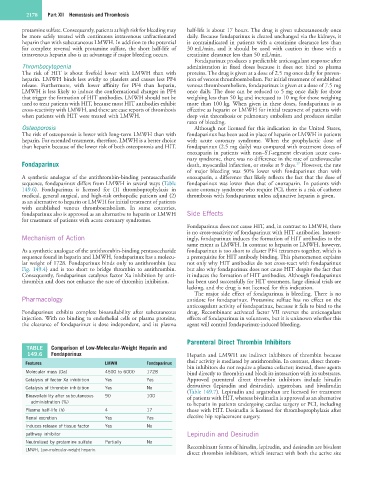
        sequence, fondaparinux differs from LMWH in several ways (Table   fondaparinux  was  lower  than  that  of  enoxaparin.  In  patients  with
        149.6).  Fondaparinux  is  licensed  for  (1)  thromboprophylaxis  in   acute coronary syndrome who require PCI, there is a risk of catheter
        medical, general surgical, and high-risk orthopedic patients and (2)   thrombosis with fondaparinux unless adjunctive heparin is given.
        as an alternative to heparin or LMWH for initial treatment of patients
        with  established  venous  thromboembolism.  In  some  countries,
        fondaparinux also is approved as an alternative to heparin or LMWH   Side Effects
        for treatment of patients with acute coronary syndromes.
                                                              Fondaparinux does not cause HIT, and, in contrast to LMWH, there
                                                              is no cross-reactivity of fondaparinux with HIT antibodies. Interest-
        Mechanism of Action                                   ingly, fondaparinux induces the formation of HIT antibodies to the
                                                              same extent as LMWH. In contrast to heparin or LMWH, however,
        As a synthetic analogue of the antithrombin-binding pentasaccharide   fondaparinux is too short to cluster PF4 tetramers together, which is
        sequence found in heparin and LMWH, fondaparinux has a molecu-  a prerequisite for HIT antibody binding. This phenomenon explains
        lar weight of 1728. Fondaparinux binds only to antithrombin (see   not only why HIT antibodies do not cross-react with fondaparinux
        Fig.  149.4)  and  is  too  short  to  bridge  thrombin  to  antithrombin.   but also why fondaparinux does not cause HIT despite the fact that
        Consequently, fondaparinux catalyzes factor Xa inhibition by anti-  it induces the formation of HIT antibodies. Although fondaparinux
        thrombin and does not enhance the rate of thrombin inhibition.  has been used successfully for HIT treatment, large clinical trials are
                                                              lacking, and the drug is not licensed for this indication.
                                                                 The major side effect of fondaparinux is bleeding. There is no
        Pharmacology                                          antidote  for  fondaparinux.  Protamine  sulfate  has  no  effect  on  the
                                                              anticoagulant activity of fondaparinux, because it fails to bind to the
        Fondaparinux  exhibits  complete  bioavailability  after  subcutaneous   drug.  Recombinant  activated  factor  VII  reverses  the  anticoagulant
        injection. With no binding to endothelial cells or plasma proteins,   effects of fondaparinux in volunteers, but it is unknown whether this
        the clearance of fondaparinux is dose independent, and its plasma   agent will control fondaparinux-induced bleeding.

                                                              Parenteral Direct Thrombin Inhibitors
          TABLE   Comparison of Low-Molecular-Weight Heparin and
          149.6   Fondaparinux                                Heparin  and  LMWH  are  indirect  inhibitors  of  thrombin  because
         Features                  LMWH          Fondaparinux  their activity is mediated by antithrombin. In contrast, direct throm-
                                                              bin inhibitors do not require a plasma cofactor; instead, these agents
         Molecular mass (Da)       4500 to 6000  1728         bind directly to thrombin and block its interaction with its substrates.
         Catalysis of factor Xa inhibition  Yes  Yes          Approved  parenteral  direct  thrombin  inhibitors  include  hirudin
         Catalysis of thrombin inhibition  Yes   No           derivatives  (lepirudin  and  desirudin),  argatroban,  and  bivalirudin
                                                              (Table 149.7). Lepirudin and argatroban are licensed for treatment
         Bioavailability after subcutaneous   90  100         of patients with HIT, whereas bivalirudin is approved as an alternative
           administration (%)                                 to heparin in patients undergoing cardiac surgery or PCI, including
         Plasma half-life (h)      4             17           those with HIT. Desirudin is licensed for thromboprophylaxis after
         Renal excretion           Yes           Yes          elective hip replacement surgery.
         Induces release of tissue factor  Yes   No
         pathway inhibitor                                    Lepirudin and Desirudin
         Neutralized by protamine sulfate  Partially  No
         LMWH, Low-molecular-weight heparin.                  Recombinant forms of hirudin, lepirudin, and desirudin are bivalent
                                                              direct thrombin inhibitors, which interact with both the active site

