


Page 2454 - Hematology_ Basic Principles and Practice ( PDFDrive )
P. 2454
2192   Part XII  Hemostasis and Thrombosis


           On  physical  examination,  the  location  and  characteristics  of   maternal  antibody  or  drug,  and  platelet  size.  A  classification  of
        bleeding  (e.g.,  procedural,  mucosal,  cutaneous,  intraventricular),   neonatal thrombocytopenia is provided in Table 150.3. Thrombocy-
                                                                                                       9
                                                                                                          12
        whether diffuse or localized, in addition to the general appearance of   topenia is defined as a platelet count less than 150 × 10 /L.  Platelet
                                                                                            9
        the baby as sick or well, will help to identify the underlying etiology   counts in the range of 100 to 150 × 10 /L are common in healthy
        of the hemorrhage. In ill-appearing newborns, disseminated intravas-  neonates; these mostly reflect transient thrombocytopenia and require
        cular coagulation (DIC) or liver disease may result in acquired factor   no further investigation unless there is a further decrease in the count.
                                                                                                           9
        deficiencies. These disorders tend to present with diffuse bleeding.   More  severe  thrombocytopenia  (platelet  count  <50  ×  10 /L)  in
        Well-appearing newborns are more likely to have localized bleeding   neonates rarely manifests with bleeding, particularly in the absence
        or ecchymoses because of thrombocytopenia from a transplacental   of  maternal  antiplatelet  antibodies.  The  estimated  prevalence  of
        antibody, vitamin K deficiency, or a rare inherited factor deficiency.  thrombocytopenia is in the range of 1% to 5% of all newborns. The
           Laboratory  evaluation  of  the  hemorrhage  in  newborns  should   prevalence of thrombocytopenia increases to 22% to 35% in neonates
        include sepsis evaluation and determination of the platelet count, PT,   admitted to the neonatal intensive care unit (NICU), with the rates
        aPTT,  thrombin  time,  and  fibrinogen  concentration.  If  the  test   increasing with decreasing gestational age. With severe thrombocyto-
        results are normal, bleeding neonates or infants should be assessed   penia, platelet transfusion may be necessary to treat or decrease the
        for FXIII and α 2AP activity. Deficiencies of FXIII, α 2AP, or PAI-1   risk of bleeding.
        are not detected with routine screening, and specific testing is needed   Causes of neonatal thrombocytopenia include decreased platelet
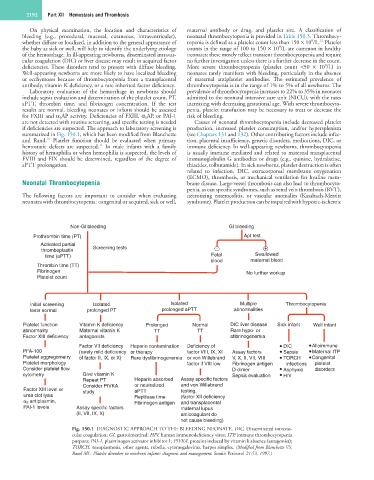
        if deficiencies are suspected. The approach to laboratory screening is   production,  increased  platelet  consumption,  and/or  hypersplenism
        summarized in Fig. 150.1, which has been modified from Blanchette   (see Chapters 131 and 132). Other contributing factors include infec-
                10
        and  Rand.   Platelet  function  should  be  evaluated  when  primary   tion, placental insufficiency, genetic disorders, medications, DIC, or
                                 11
        hemostatic  defects  are  suspected.   In  male  infants  with  a  family   immune deficiency. In well-appearing newborns, thrombocytopenia
        history of hemophilia or when hemophilia is suspected, the levels of   is usually immune mediated and related to maternal transplacental
        FVIII  and  FIX  should  be  determined,  regardless  of  the  degree  of   immunoglobulin G antibodies or drugs (e.g., quinine, hydralazine,
        aPTT prolongation.                                    thiazides, tolbutamide). In sick newborns, platelet destruction is often
                                                              related  to  infection,  DIC,  extracorporeal  membrane  oxygenation
                                                              (ECMO), thrombosis, or mechanical ventilation for hyaline mem-
        Neonatal Thrombocytopenia                             brane disease. Large-vessel thrombosis can also lead to thrombocyto-
                                                              penia, as can specific syndromes, such as renal vein thrombosis (RVT),
        The  following  factors  are  important  to  consider  when  evaluating   necrotizing  enterocolitis,  or  vascular  anomalies  (Kasabach-Merritt
        neonates with thrombocytopenia: congenital or acquired, sick or well,   syndrome). Platelet production can be impaired with hypoxic-ischemic


                        Non-GI bleeding                                     GI bleeding
            Prothrombin time (PT)                                                Apt test
              Activated partial
               thromboplastin   Screening tests                         -               +
                time (aPTT)                                           Fetal         Swallowed
                                                                      blood        maternal blood
             Thrombin time (TT)
             Fibrinogen                                                           No further workup
             Platelet count


           Initial screening   Isolated                  Isolated               Multiple       Thrombocytopenia
           tests normal      prolonged PT             prolonged aPTT          abnormalities

        Platelet function  Vitamin K deficiency  Prolonged      Normal      DIC liver disease  Sick infant  Well infant
        abnormality        Maternal vitamin K      TT             TT        Rare hypo- or
        Factor XIII deficiency  antagonists                                 afibrinogenemia
                           Factor VII deficiency  Heparin contamination  Deficiency of        DIC      Alloimmune
         PFA-100           (rarely mild deficiency or therapy  factor VIII, IX, XI  Assay factors  Sepsis  Maternal ITP
         Platelet aggregometry  of factor II, IX, or X)  Rare dysfibrinogenemia or von Willebrand  V, X, II, VII, VIII  TORCH  Congenital
         Platelet morphology                                  factor if VIII low  Fibrinogen antigen    infections    platelet
         Consider platelet flow                                              D-dimer          Asphyxia    disorders
         cytometry          Give vitamin K                                   Sepsis evaluation  HIV
                            Repeat PT        Heparin absorbed  Assay specific factors
                            Consider PIVKA   or neutralized  and von Willebrand
         Factor XIII level or  study         aPTT           testing.
         urea clot lysis                     Reptilase time  (factor XII deficiency
         α 2  antiplasmin,                   Fibrinogen antigen  and transplacental
         PAI-1 levels     Assay specific factors            maternal lupus
                          (II, VII, IX, X)                  anticoagulant do
                                                            not cause bleeding)
                         Fig. 150.1  DIAGNOSTIC APPROACH TO THE BLEEDING NEONATE. DIC, Disseminated intravas-
                         cular coagulation; GI, gastrointestinal; HIV, human immunodeficiency virus; ITP, immune thrombocytopenia
                         purpura; PAI-1, plasminogen activator inhibitor 1; PIVKA, proteins induced by vitamin k absence (antagonist);
                         TORCH, toxoplasmosis, other agents, rubella, cytomegalovirus, herpes simplex. (Modified from Blanchette VS,
                         Rand ML: Platelet disorders in newborn infants: diagnosis and management. Semin Perinatol 21:53, 1997.)

