


Page 254 - Hematology_ Basic Principles and Practice ( PDFDrive )
P. 254
206    Part III  Immunologic Basis of Hematology


                                                              naive B cells that have yet to encounter antigen recognized by their
                         Arterial
                                                              surface BCR/Ig complex. Recognition of an antigen by the BCR/Ig
              Macrophage                                      leads to B cell activation. A complex set of interactions between the
                                                              B cell, T cell, and APCs leads to the activation and proliferation of
                                                              B cells carrying an antigen-specific BCR. A fraction of these activated
                                                              proliferating B cells form GCs, which are surrounded by a mantle
                                                              zone of naive B cells, which together comprise a secondary follicle
                                                              (Fig. 19.5).
                                                                 Germinal centers are classically divided into two compartments,
                                     Dendritic                denoted as the dark and light zone based on their appearance under
                                     cell                     light microscopy (see Fig. 19.5, inset). Dark zones are located adjacent
                                                              to the T-cell areas, and contain a high density of proliferating B cells
                                                              termed centroblasts, which are large cells with a high nuclear:cytoplasmic
                                                              ratio, and do not express surface BCR/Ig. The light zone has a lower
                                                              cellular  density  secondary  to  the  presence  of  an  extensive  loose
                                                                                                               24
                                                              network of follicular DCs, and this imparts the “light” appearance.
             Venous            Lymphatic                      B cells in the light zone are termed centrocytes, which in contrast to
                                                              the centroblasts, are small B cells expressing surface BCR/Ig. Some
                                                              of these cell types, such as centrocytes and centroblasts, are discussed
                                                              in Chapter 73 in the context of lymphoid malignancies.
                                                                 Within the germinal center, the series of sequential shuttling and
                                                              reentry of B cells into the dark and light zones is termed the GC
                                                              reaction,  or  the  B-cell  selection  process. The  cyclic  reentry  model
                                                              proposes that centroblasts in the dark zone undergo cell division and
                                                              SHM  of  variable  light-chain  genes  mediated  by  AID.  Next,  they
                                                              reexpress BCR/sIg and exit the cell cycle, migrating into the light
                                                              zone  to  interact  with  antigen-presenting  follicular  DCs  and TFH
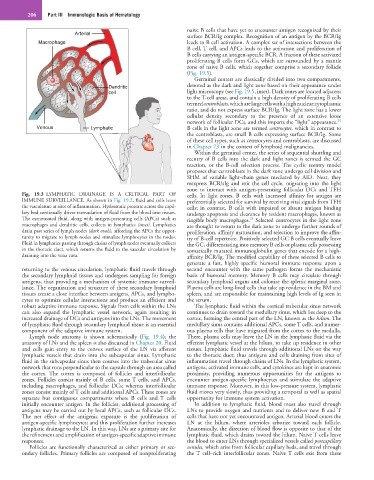
        Fig.  19.3  LYMPHATIC  DRAINAGE  IS  A  CRITICAL  PART  OF   cells. In light zones, B cells with increased affinity for antigen are
        IMMUNE SURVEILLANCE. As shown in Fig. 19.2, fluid and cells leave   preferentially selected for survival by receiving vital signals from TFH
        the vasculature at sites of inflammation. Hydrostatic pressure across the capil-  cells; in  contrast, B  cells  with  impaired  or  absent  antigen binding
        lary bed continually drives transudation of fluid from the blood into tissues.   undergo apoptosis and clearance by resident macrophages, known as
        The extravasated fluid, along with antigen-presenting cells (APCs) such as   tingible body macrophages.  Selected centrocytes in the light zone
                                                                                   25
        macrophages and dendritic cells, collects in lymphatics (inset). Lymphatics   are thought to return to the dark zone to undergo further rounds of
        drain past series of lymph nodes (dark ovals), affording the APCs the oppor-  proliferation, affinity maturation, and selection to improve the affin-
        tunity to migrate to lymph nodes and stimulate lymphocytes in the nodes.   ity of B-cell repertoire. Positively selected GC B cells eventually leave
        Fluid in lymphatics passing through chains of lymph nodes eventually collects   the GC, differentiating into memory B cells or plasma cells possessing
        in the thoracic duct, which returns the fluid to the vascular circulation by   somatically mutated immunoglobulin genes that encode for a high-
        draining into the vena cava.                          affinity BCR/Ig. The modified capability of these selected B cells to
                                                              generate  a  fast,  highly  specific  humoral  immune  response  upon  a
        returning to the venous circulation, lymphatic fluid travels through   second  encounter  with  the  same  pathogen  forms  the  mechanistic
        the secondary lymphoid tissues and undergoes sampling for foreign   basis  of  humoral  memory.  Memory  B  cells  may  circulate  through
        antigens, thus providing a mechanism of systemic immune surveil-  secondary lymphoid organs and colonize the splenic marginal zone.
        lance. The organization and structure of these secondary lymphoid   Plasma cells are long-lived cells that take up residence in the BM and
        tissues create a close interface between antigens, APCs, and lympho-  spleen, and are responsible for maintaining high levels of Ig seen in
        cytes to optimize cellular interactions and produce an efficient and   the serum.
        robust adaptive immune response. Signals from cells within the LNs   The lymphatic fluid within the cortical trabecular sinus network
        can  also  expand  the  lymphatic  vessel  network,  again  resulting  in   continues to drain toward the medullary sinus, which lies deep to the
        increased drainage of DCs and antigens into the LNs. The movement   cortex, forming the central part of the LN, known as the hilum. The
        of lymphatic fluid through secondary lymphoid tissue is an essential   medullary sinus contains additional APCs, some T cells, and numer-
        component of the adaptive immune system.              ous plasma cells that have migrated from the cortex to the medulla.
           Lymph  node  anatomy  is  shown  schematically  (Fig.  19.4);  the   There, plasma cells may leave the LN in the lymphatic fluid via the
        anatomy of LNs and the spleen is also discussed in Chapter 20. Fluid   efferent lymphatic vessel at the hilum, to take up residence in other
        and  cells  gain  entry  to  the  convex  surface  of  the  LN  via  afferent   tissues. Lymphatic fluid travels through additional LNs on the way
        lymphatic vessels that drain into the subcapsular sinus. Lymphatic   to the thoracic duct; thus antigens and cells draining from sites of
        fluid in the subcapsular sinus then courses into the trabecular sinus   inflammation travel through chains of LNs. In the lymphatic system,
        network that runs perpendicular to the capsule through an area called   antigens, activated immune cells, and cytokines are kept in anatomic
        the  cortex. The  cortex  is  composed  of  follicles  and  interfollicular   proximity,  providing  numerous  opportunities  for  the  antigens  to
        zones. Follicles consist mainly of B cells, some T cells, and APCs,   encounter  antigen-specific  lymphocytes  and  stimulate  the  adaptive
        including  macrophages,  and  follicular  DCs;  whereas  interfollicular   immune response. Moreover, in this low-pressure system, lymphatic
        zones consist mainly of T cells and additional APCs. These zones are   fluid moves very slowly, thus providing a temporal as well as spatial
        separate  but  contiguous  compartments  where  B  cells  and  T  cells   opportunity for immune system activation.
        initially encounter antigen. In the follicles, additional processing of   In  addition  to  lymphatic  fluid,  blood  must  also  travel  through
        antigens may be carried out by local APCs, such as follicular DCs.   LNs to provide oxygen and nutrients and to deliver new B and T
        The  net  effect  of  the  antigenic  exposure  is  the  proliferation  of   cells that have not yet encountered antigen. Arterial blood enters the
        antigen-specific lymphocytes; and this proliferation further increases   LN  at  the  hilum,  where  arterioles  arborize  toward  each  follicle.
        lymphatic drainage to the LN. In this way, LNs are a primary site for   Anatomically, the direction of blood flow is opposite to that of the
        the refinement and amplification of antigen-specific adaptive immune   lymphatic fluid, which drains toward the hilum. Naive T cells leave
        responses.                                            the blood to enter LNs through specialized vessels called postcapillary
           Follicles are functionally characterized as either primary or sec-  venules, which arise from follicular capillary beds, and travel through
        ondary follicles. Primary follicles are composed of nonproliferating   the T  cell–rich  interfollicular  zones.  Naive T  cells  exit  from  these

