


Page 2541 - Hematology_ Basic Principles and Practice ( PDFDrive )
P. 2541
2264   Part XIII  Consultative Hematology


                                                              degradation of the viral RNA by ribonuclease H activity of p66. The
                                       Virion                 reverse  transcriptase  then  acts  as  a  DNA  polymerase  forming  a
                                                              double-stranded DNA provirus. The reverse transcriptase of HIV has
                                                              a significant rate of base substitution errors, estimated as high as 1 in
                     Binding  CD4   Chemokine                 1700 to 1 in 2000 nucleoside bases, resulting in an average of 5 to
                  Penetration        receptor                 10 nucleoside mutations for each replication cycle. This explains the
                                                              high  degree  of  genomic  diversity  observed  between  HIV-1  viral
                                        RNA                   isolates.
                     Reverse                                     A linear form of the provirus is integrated into the host DNA by
                   transcription                              the viral integrase. In kinetic studies of HIV-1 infection, viral DNA
                                    Single-stranded DNA
                   Replication                                is present in the cytoplasm within 2 to 3 hours of infection, and viral
                                    Double-stranded DNA       nuclear DNA has been detected by 24 hours. The gene product of
                  Translocation                               VPR assists in transport of the viral pro-DNA into the nucleus for
                                                              subsequent  integration.  After  integration  of  the  viral  genome,  the
             Circularization              Circular viral DNA  HIV-1 infected cell may develop either a latent or persistent form of
                                                              infection.
                                                                 HIV-1  does  not  replicate  readily  in  resting  lymphocytes  and
             Integration  Host         Host                   macrophages. Cellular transactivation by, for example, nuclear factor
                         DNA           DNA  Provirus          kappa-B (NFκB) can enhance proviral transcription. HIV-1 proviral
             Transcription                                    transcription leads to the expression of regulatory proteins tat, rev,
                                            Viral RNAs
          Transport/translation          [regulatory proteins]  and  nef.  Tat  is  a  protein  essential  for  HIV  replication  and  in
                                         [structural proteins]  conjunction with the cellular proteins TAK (Tat associated kinase)
                                                              and Cyc T (cyclin T) promotes viral RNA elongation resulting in a
                                                              1000-fold increase in HIV-1 expression. Rev is a viral protein that is
                                              Viral RNA
              Processing                      [genomic]       also essential for replication by regulating nuclear export of unspliced
                                                              viral RNA. Nef and vpu proteins modulate the downregulation of
                                                              cellular CD4.
                                                                 The  structural  proteins  of  the  GAG,  POL,  and  ENV  genes  are
                      Assembly                                expressed  as  precursor  proteins  and  subsequently  cleaved  by  viral
                                                              protease  yielding  mature  viral  proteins. This  final  step  in  protein
                                                              processing is essential for the assembly of mature infectious virus. For
                      Budding
                                                              this reason, inhibition of the viral protease has proven a fruitful target
                                                              for HAART. The products of the ENV gene, GP120 and GP 41, are
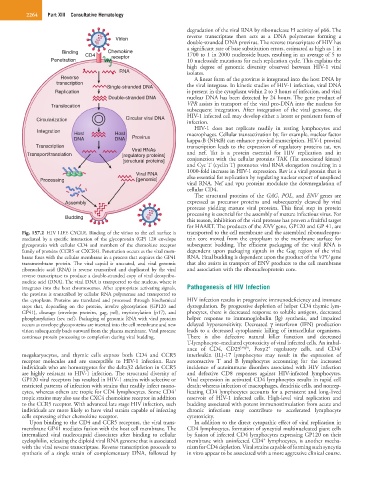
        Fig. 157.2  HIV LIFE CYCLE. Binding of the virion to the cell surface is   transported to the cell membrane and the assembled ribonucleopro-
        mediated  by  a  specific  interaction  of  the  glycoprotein  (GP)  120  envelope   tein core moved from the cytoplasm to the membrane surface for
        glycoprotein  with  cellular  CD4  and  members  of  the  chemokine  receptor   subsequent  budding. The  efficient  packaging  of  the  viral  RNA  is
        family of proteins (CCR5 or CXCR4). Penetration occurs as the viral mem-  dependent  upon  packaging  signals  in  the  Gag  region  of  the  viral
        brane fuses with the cellular membrane in a process that requires the GP41   RNA. Final budding is dependent upon the product of the VPU gene
        transmembrane  protein.  The  viral  capsid  is  uncoated,  and  viral  genomic   that also assists in transport of ENV products to the cell membrane
        ribonucleic  acid  (RNA)  is  reverse  transcribed  and  duplicated  by  the  viral   and association with the ribonucleoprotein core.
        reverse transcriptase to produce a double-stranded copy of viral deoxyribo-
        nucleic acid (DNA). The viral DNA is transported to the nucleus, where it
        integrates into the host chromosomes. After appropriate activating signals,   Pathogenesis of HIV Infection
        the provirus is transcribed by cellular RNA polymerase and transported to
        the  cytoplasm.  Proteins  are  translated  and  processed  through  biochemical   HIV infection results in progressive immunodeficiency and immune
        steps  that,  depending  on  the  protein,  involve  glycosylation  (GP120  and   dysregulation. By progressive depletion of helper CD4 thymic lym-
        GP41),  cleavage  (envelope  proteins,  gag,  pol),  myristoylation  (p17),  and   phocytes, there is decreased response to soluble antigens, decreased
        phosphorylation (rev, nef). Packaging of genomic RNA with viral proteins   helper  response  to  immunoglobulin  (Ig)  synthesis,  and  impaired
        occurs as envelope glycoproteins are inserted into the cell membrane and new   delayed  hypersensitivity.  Decreased  γ  interferon  (IFN)  production
        virion subsequently buds outward from the plasma membrane. Viral protease   leads  to  a  decreased  cytoplasmic  killing  of  intracellular  organisms.
        continues protein processing to completion during viral budding.   There  is  also  defective  natural  killer  function  and  decreased
                                                              T-lymphocyte–mediated cytotoxicity of viral infected cells. An imbal-
                                                                                         +
                                                              ance  of  CD4,  CD25 bright ,  Foxp2   regulatory  cells,  and  CD4/
        megakaryocytes,  and  thymic  cells  express  both  CD4  and  CCR5   interleukin  (IL)-17  lymphocytes  may  result  in  the  expression  of
        receptor  molecules  and  are  susceptible  to  HIV-1  infection.  Rare   autoreactive  T  and  B  lymphocytes  accounting  for  the  increased
        individuals who are homozygotes for the delta32 deletion in CCR5   incidence  of  autoimmune  disorders  associated  with  HIV  infection
        are highly resistant to HIV-1 infection. The structural diversity of   and  defective  CD8  responses  against  HIV-infected  lymphocytes.
        GP120 viral receptors has resulted in HIV-1 strains with selective or   Viral expression in activated CD4 lymphocytes results in rapid cell
        restricted patterns of infection with strains that readily infect mono-  death; whereas infection of macrophages, dendritic cells, and nonrep-
                                                          +
        cytes, whereas others are tropic for CD4 lymphocytes. Some CD4    licating CD4 lymphocytes accounts for a persistent and long-lived
        tropic strains may also use the CXC4 chemokine receptor in addition   reservoir  of  HIV-1  infected  cells.  High-level  viral  replication  and
        to the CCR5 receptor. With advanced late stage HIV infection, such   budding associated with potent immunostimulation from acute and
        individuals are more likely to have viral strains capable of infecting   chronic  infections  may  contribute  to  accelerated  lymphocyte
        cells expressing either chemokine receptor.           cytotoxicity.
           Upon binding to the CD4 and CCR5 receptors, the viral trans-  In addition to the direct cytopathic effect of viral replication in
        membrane GP41 mediates fusion with the host cell membrane. The   CD4 lymphocytes, formation of syncytial multinucleated giant cells
        internalized  viral  nucleocapsid  dissociates  after  binding  to  cellular   by fusion of infected CD4 lymphocytes expressing GP120 on their
                                                                                       +
        cyclophilin, releasing the diploid viral RNA genome that is associated   membrane with uninfected CD4  lymphocytes, is another mecha-
        with the viral reverse transcriptase. Reverse transcription proceeds to   nism for CD4 depletion. Viral strains capable of forming such syncytia
        synthesis  of  a  single  strain  of  complementary  DNA,  followed  by   in vitro appear to be associated with a more aggressive clinical course.

