


Page 2544 - Hematology_ Basic Principles and Practice ( PDFDrive )
P. 2544
Chapter 157  Hematologic Manifestations of HIV/AIDS  2267


            the  interval  immediately  following  the  start  of  therapy,  there  is  a   The  bone  marrow  in  patients  with  HIV  can  be  hypercellular,
                                            +
                                   +
            prompt  increase  in  both  CD4   and  CD8   cells  that  is  composed   normocellular, or hypocellular. In a majority of cases the normal bone
                                                           +
            predominantly  of  cells  of  a  memory  phenotype  (CD45RO   or   marrow  architecture  is  often  disturbed,  with  dysplastic  changes
                   +
                                                          +
                          –
                                                                                                 6
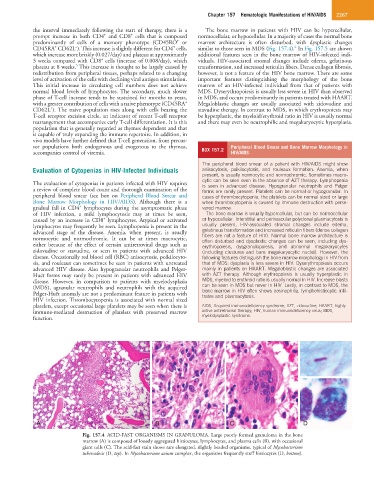
            CD45RA  CD62L ). This increase is slightly different for CD4  cells,   similar to those seen in MDS (Fig. 157.4).  In Fig. 157.5 are shown
            which increase more briskly (0.027/day) and plateau at approximately   additional features seen in the bone marrow of HIV-infected indi-
                                  +
            3 weeks compared with CD8  cells (increase of 0.008/day), which   viduals. HIV-associated stromal changes include edema, gelatinous
                          5
            plateau at 8 weeks.  This increase is thought to be largely caused by   transformation, and increased reticulin fibers. Dense collagen fibrosis,
            redistribution from peripheral tissues, perhaps related to a changing   however, is not a feature of the HIV bone marrow. There are some
            level of activation of the cells with declining viral antigen stimulation.   important  features  distinguishing  the  morphology  of  the  bone
            This  initial  increase  in  circulating  cell  numbers  does  not  achieve   marrow  of  an  HIV-infected  individual  from  that  of  patients  with
            normal  blood  levels  of  lymphocytes. The  secondary,  much  slower   MDS. Dyserythropoiesis is usually less severe in HIV than observed
            phase of T-cell increase tends to be sustained for months to years,   in MDS, and occurs predominantly in patients treated with HAART.
                                                              +
            with a greater contribution of cells with a naive phenotype (CD45RA    Megaloblastic  changes  are  usually  associated  with  zidovudine  and
                  +
            CD62L ). The  naive  population  rises  along  with  cells  bearing  the   stavudine therapy. In contrast to MDS, in which erythropoiesis may
            T-cell receptor excision circle, an indicator of recent T-cell receptor   be hyperplastic, the myeloid/erythroid ratio in HIV is usually normal
            rearrangement that accompanies early T-cell differentiation. It is this   and there may even be neutrophilic and megakaryocytic hyperplasia.
            population that is generally regarded as thymus dependent and that
            is capable of truly expanding the immune repertoire. In addition, in
            vivo models have further defined that T-cell generation, from precur-
            sor  populations  both  endogenous  and  exogenous  to  the  thymus,   BOX 157.2  Peripheral Blood Smear and Bone Marrow Morphology in
            accompanies control of viremia.                                  HIV/AIDS
                                                                   The  peripheral  blood  smear  of  a  patient  with  HIV/AIDS  might  show
            Evaluation of Cytopenias in HIV-Infected Individuals   anisocytosis,  poikilocytosis,  and  rouleaux  formation.  Anemia,  when
                                                                   present, is usually normocytic and normochromic. Sometimes macro-
                                                                   cytic can be seen even in the absence of AZT therapy. Lymphopenia
            The evaluation of cytopenias in patients infected with HIV requires   is  seen  in  advanced  disease.  Hypogranular  neutrophils  and  Pelger
            a review of complete blood count and thorough examination of the   forms are rarely present. Platelets can be normal or hypogranular. In
            peripheral  blood  smear  (see  box  on  Peripheral  Blood  Smear  and   cases of thrombocytopenia, the platelets can be normal sized or large
            Bone  Marrow  Morphology  in  HIV/AIDS).  Although  there  is  a   when thrombocytopenia is caused by immune destruction with perse-
                           +
            gradual fall in CD4   lymphocytes during  the  asymptomatic  phase   vered marrow.
            of  HIV  infection,  a  mild  lymphocytosis  may  at  times  be  seen,   The bone marrow is usually hypercellular, but can be normocellular
                                   +
            caused by an increase in CD8  lymphocytes. Atypical or activated   or hypocellular. Interstitial and perivascular polyclonal plasmacytosis is
            lymphocytes may frequently be seen. Lymphopenia is present in the   usually  present.  HIV-associated  stromal  changes  include  edema,
            advanced  stage  of  the  disease.  Anemia,  when  present,  is  usually   gelatinous transformation and increased reticulin fibers (dense collagen
                                                                   fibers are not a feature of HIV). Normal bone marrow architecture is
            normocytic  and  normochromic.  It  can  be  at  times  macrocytic,   often disturbed and dysplastic changes can be seen, including dys-
            either  because  of  the  effect  of  certain  antiretroviral  drugs  such  as   erythropoiesis,  dysgranulopoiesis,  and  abnormal  megakaryocytes
            zidovudine  or  stavudine,  or  seen  in  patients  with  advanced  HIV   (including  clustures  and  bare  megakaryocytic  nuclei).  However,  the
            disease. Occasionally red blood cell (RBC) anisocytosis, poikilocyto-  following features distinguish the bone marrow morphology in HIV from
            sis, and rouleaux can sometimes be seen in patients with untreated   that of MDS: dysplasia is less severe in HIV. Dyserythropoiesis occurs
            advanced  HIV  disease.  Also  hypogranular  neutrophils  and  Pelger-  mainly in patients on HAART. Megaloblastic changes are associated
            Huët forms may rarely be present in patients with advanced HIV   with  AZT  therapy.  Although  erythropoiesis  is  usually  hyperplastic  in
            disease.  However,  in  comparison  to  patients  with  myelodysplasia   MDS, myeloid to erythroid ratio is usually normal in HIV. Increase blasts
            (MDS),  agranular  neutrophils  and  neutrophils  with  the  acquired   can be seen in MDS but never in HIV. Lastly, in contrast to MDS, the
                                                                   bone marrow in HIV often shows eosinophilia, lymphohistiocytic infil-
            Pelger-Huët anomaly are not a predominant feature in patients with   trates and plasmacytosis.
            HIV  infection. Thrombocytopenia  is  associated  with  normal  sized
            platelets, except occasional large platelets may be seen when there is   AIDS, Acquired immunodeficiency syndrome; AZT, zidovudine; HAART, highly
            immune-mediated  destruction  of  platelets  with  preserved  marrow   active antiretroviral therapy; HIV, human immunodeficiency virus; MDS,
            function.                                              myelodysplastic syndrome.


             A                                      B                       C                       D     D
                            Fig. 157.4  ACID-FAST ORGANISMS IN GRANULOMA. Large poorly formed granuloma in the bone
                            marrow (A) is composed of loosely aggregated histiocytes, lymphocytes, and plasma cells (B), with occasional
                            giant cells (C). The acid-fast stain shows rare elongated, slightly beaded organisms, typical of Mycobacterium
                            tuberculosis (D, top). In Mycobacterium avium complex, the organisms frequently stuff histiocytes (D, bottom).

