


Page 2540 - Hematology_ Basic Principles and Practice ( PDFDrive )
P. 2540
Chapter 157  Hematologic Manifestations of HIV/AIDS  2263


             TABLE   Surveillance Case Definition for HIV Infection in                          gp 41
              157.1  Adults and Adolescents (Age >13 Years)              gp 120
             Stage      Laboratory Evidence  Clinical Evidence                                         Lipid membrane
             Stage1     Laboratory confirmation of   No AIDS-defining
                         HIV infection and CD4   +  condition (see Table   Viral RNA  p17
                         T lymphocyte count of   157.2)
                                        +
                         ≥500 cells/µL or CD4
                         T-lymphocyte                                               p9
                         percentage of ≥29% a                                                   p7
             Stage 2    Laboratory confirmation of   No AIDS-defining
                         HIV infection and CD4   +  condition (see Table                   p24
                         T lymphocyte count of   157.2)
                         200–499 cells/µL or
                            +
                         CD4  T-lymphocyte                           Reverse
                         percentage of 14–28% a                      transcriptase
             Stage 3    Laboratory confirmation of   Documentation of an
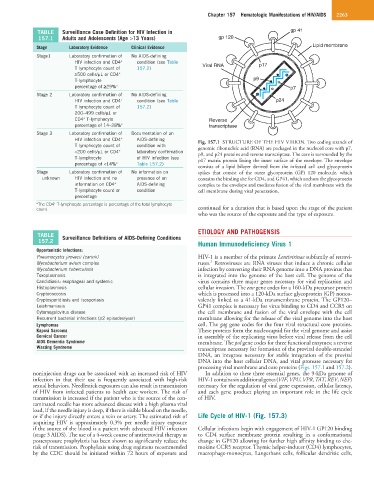
                         HIV infection and CD4   +  AIDS-defining   Fig. 157.1  STRUCTURE OF THE HIV VIRION. Two coding strands of
                         T lymphocyte count of   condition with   genomic ribonucleic acid (RNA) are packaged in the nucleoid core with p7,
                                        +
                         <200 cells/µL or CD4    laboratory confirmation   p9, and p24 proteins and reverse transcriptase. The core is surrounded by the
                         T-lymphocyte         of HIV infection (see   p17 matrix protein lining the inner surface of the envelope. The envelope
                         percentage of <14% a  Table 157.2)
                                                                  consists  of  a  lipid  bilayer  derived  from  the  infected  cell  and  glycoprotein
             Stage      Laboratory confirmation of   No information on   spikes  that  consist  of  the  outer  glycoprotein  (GP)  120  molecule,  which
               unknown   HIV infection and no   presence of an    contains the binding site for CD4, and GP41, which anchors the glycoprotein
                                      +
                         information on CD4    AIDS-defining      complex to the envelope and mediates fusion of the viral membrane with the
                         T-lymphocyte count or   condition        cell membrane during viral penetration.
                         percentage
             a The CD4  T-lymphocyte percentage is percentage of the total lymphocyte
                   +
             count.                                               continued for a duration that is based upon the stage of the patient
                                                                  who was the source of the exposure and the type of exposure.
                                                                  ETIOLOGY AND PATHOGENSIS
             TABLE   Surveillance Definitions of AIDS-Defining Conditions
              157.2
                                                                  Human Immunodeficiency Virus 1
             Opportunistic Infections:
             Pneumocystis jirovecii (carinii)                     HIV-1 is a member of the primate Lentivirinae subfamily of retrovi-
                                                                      3
             Mycobacterium avium complex                          ruses.  Retroviruses are RNA viruses that induce a chronic cellular
             Mycobacterium tuberculosis                           infection by converting their RNA genome into a DNA provirus that
             Toxoplasmosis                                        is integrated into the genome of the host cell. The genome of the
             Candidiasis: esophageal and systemic                 virus contains three major genes necessary for viral replication and
             Histoplasmosis                                       cellular invasion. The env gene codes for a 160-kDa precursor protein
             Cryptococcosis                                       which is processed into a 120-kDa surface glycoprotein (GP) nonco-
             Cryptosporidiosis and isosporiasis                   valently linked to a 41-kDa transmembrane protein. The GP120–
             Leishmaniasis                                        GP41 complex is necessary for virus binding to CD4 and CCR5 on
             Cytomegalovirus disease                              the  cell  membrane  and  fusion  of  the  viral  envelope  with  the  cell
             Recurrent bacterial infections (≥2 episodes/year)    membrane allowing for the release of the viral genome into the host
             Lymphomas                                            cell. The gag gene codes for the four viral structural core proteins.
             Kaposi Sarcoma                                       These proteins form the nucleocapsid for the viral genome and assist
             Cervical Cancer                                      in assembly of the replicating virus before viral release from the cell
             AIDS Dementia Syndrome                               membrane. The pol gene codes for three functional enzymes; a reverse
             Wasting Syndrome                                     transcriptase necessary for formation of the proviral double-stranded
                                                                  DNA,  an  integrase  necessary  for  stable  integration  of  the  proviral
                                                                  DNA into the host cellular DNA, and viral protease necessary for
                                                                  processing viral membrane and core proteins (Figs. 157.1 and 157.2).
            noninjection drugs can be associated with an increased risk of HIV   In addition to these three essential genes, the 9-kDa genome of
            infection  in  that  their  use  is  frequently  associated  with  high-risk   HIV-1 contains six additional genes (VIF, VPU, VPR, TAT, REV, NEF)
            sexual behaviors. Needlestick exposures can also result in transmission   necessary for the regulation of viral gene expression, cellular latency,
            of HIV from infected patients to health care workers. The risk of   and each gene product playing an important role in the life cycle
            transmission is increased if the patient who is the source of the con-  of HIV.
            taminated needle has more advanced disease with a high plasma viral
            load, if the needle injury is deep, if there is visible blood on the needle,
            or if the injury directly enters a vein or artery. The estimated risk of   Life Cycle of HIV-1 (Fig. 157.3)
            acquiring  HIV  is  approximately  0.3%  per  needle  injury  exposure
            if the source of the blood is a patient with advanced HIV infection   Cellular infections begin with engagement of HIV-1 GP120 binding
            (stage 3 AIDS). The use of a 4-week course of antiretroviral therapy as   to  CD4  surface  membrane  protein  resulting  in  a  conformational
            postexposure prophylaxis has been shown to significantly reduce the   change in GP120 allowing for further high affinity binding to che-
            risk of transmission. Prophylaxis using drug regimens recommended   mokine CCR5 receptor. Thymic helper-inducer (CD4) lymphocytes,
            by the CDC should be initiated within 72 hours of exposure and   macrophage-monocytes,  Langerhans  cells,  follicular  dendritic  cells,

