


Page 2543 - Hematology_ Basic Principles and Practice ( PDFDrive )
P. 2543
2266   Part XIII  Consultative Hematology


        period of symptomatic conditions which may or may not fulfill cri-  impaired as a result of infection. However, in vivo infection of pro-
        teria for classification as symptomatic AIDS (see Table 157.2). The   genitor cells rarely if ever occurs. Progenitor populations such as those
        acute retroviral syndrome occurs in approximately 50% to 80% of   yielding megakaryocytes or monocytes can be infected. Recent studies
        newly  infected  individuals. The  onset  of  symptoms  occurs  1  to  3   have documented infection and depletion of intermediate myeloid
        weeks (range 5 days to 3 months) after primary infection. Symptoms   precursors, including the common myeloid precursor, granulocyte-
        last from 1 to 2 weeks and can include significant fatigue, headache,   monocyte precursor, and even the megakaryocyte-erythroid precursor
        malaise, fever as high as 40°C, sore throat, and myalgias. A morbil-  (MEP) despite the failure of MEP to express CD4.
        liform rash can be observed in 40% to 50% of patients, with general-  HIV infection leads to hematopoietic inhibition in vivo by deplet-
        ized lymphadenopathy occurring toward the end of the acute illness.   ing  myeloid  and  erythroid  colony-forming  precursor  activity. This
        Symptoms are similar to those observed in other viral syndromes such   activity may be caused by an indirect mechanism rather than direct
                                                                            +
        as mononucleosis. Laboratory findings may include lymphocytosis,   infection of CD34  cells. The presence of messenger RNA for and
        occasional neutropenia, and mild thrombocytopenia. Most symptoms   cell  surface  expression  of  HIV  receptors  CD4  and  the  chemokine
        subside within a month. However, lymphadenopathy may persist in   receptors CXCR-4 and CCR-5 have been demonstrated in fraction-
        over 50% of patients and is termed the persistent generalized lymph-  ated cells representing multiple stages of hematopoietic development
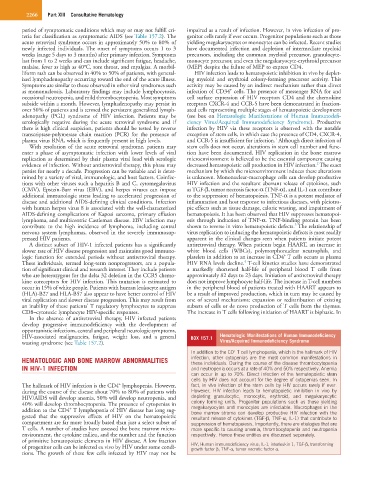
        adenopathy  (PGL)  syndrome  of  HIV  infection.  Patients  may  be   (see  box  on  Hematologic  Manifestations  of  Human  Immunodefi-
        serologically  negative  during  the  acute  retroviral  syndrome  and  if   ciency  Virus/Acquired  Immunodeficiency  Syndrome).  Productive
        there is high clinical suspicion, patients should be tested by reverse   infection  by  HIV  via  these  receptors  is  observed  with  the  notable
        transcriptase-polymerase  chain  reaction  (PCR)  for  the  presence  of   exception of stem cells, in which case the presence of CD4, CXCR-4,
                                                                                           1
        plasma virus RNA, which is frequently present in high levels.  and CCR-5 is insufficient for infection.  Although direct infection of
           With resolution of the acute retroviral syndrome, patients may   stem cells does not occur, alterations in stem cell number and func-
        enter  a  phase  of  asymptomatic  infection  with  lower  levels  of  viral   tion have been documented. HIV replication in the bone marrow
        replication as determined by their plasma viral load with serologic   microenvironment is believed to be the essential component causing
                                                                                                         2
        evidence of infection. Without antiretroviral therapy, this phase may   decreased hematopoietic cell production in HIV infection.  The exact
        persist for nearly a decade. Progression can be variable and is deter-  mechanism by which the microenvironment induces these alterations
        mined by a variety of viral, immunologic, and host factors. Coinfec-  is unknown. Mononuclear-macrophage cells can develop productive
        tions with other viruses such a hepatitis B and C, cytomegalovirus   HIV infection and the resultant aberrant release of cytokines, such
        (CMV),  Epstein-Barr  virus  (EBV),  and  herpes  viruses  can  impose   as TGF-β, tumor necrosis factor-α (TNF-α), and IL-1 can contribute
        additional immunologic stress leading to accelerated progression of   to the suppression of hematopoiesis. TNF-α is a potent mediator of
        disease and additional AIDS-defining clinical conditions. Infection   inflammation and host response to infectious diseases, with pleiotro-
        with human herpes virus 8 is associated with the well-characterized   pic effects such as tissue damage, caloric wasting, and impairment of
        AIDS-defining  complications  of  Kaposi  sarcoma,  primary  effusion   hematopoiesis. It has been observed that HIV suppresses hematopoi-
        lymphoma, and multicentric Castleman disease. EBV infection may   esis  through  induction  of TNF-α. TNF-binding  protein  has  been
                                                                                                 3
        contribute  to  the  high  incidence  of  lymphoma,  including  central   shown to reverse in vitro hematopoietic defects.  The relationship of
        nervous  system  lymphomas,  observed  in  the  severely  immunosup-  virus replication to inducing the hematopoietic defects is most readily
        pressed HIV patients.                                 apparent in the clinical changes seen when patients initiate potent
           A  distinct  subset  of  HIV-1  infected  patients  has  a  significantly   antiretroviral therapy. When patients begin HAART, an increase in
        slower rate of HIV disease progression and maintains good immuno-  white  blood  cells  (WBCs),  polymorphonuclear  neutrophils,  and
                                                                                              +
        logic  function  for  extended  periods  without  antiretroviral  therapy.   platelets in addition to an increase in CD4  T cells occurs as plasma
                                                                                 4
        These individuals, termed long-term nonprogressors, are a popula-  HIV RNA levels decline.  T-cell kinetics studies have demonstrated
        tion of significant clinical and research interest. They include patients   a  markedly  shortened  half-life  of  peripheral  blood  T  cells  from
        who are heterozygous for the delta 32 deletion in the CCR5 chemo-  approximately 82 days to 23 days. Initiation of antiretroviral therapy
        kine coreceptors for HIV infection. This mutation is estimated to   does not improve lymphocyte half-life. The increase in T-cell numbers
        occur in 15% of white people. Patients with human leukocyte antigen   in the peripheral blood of patients treated with HAART appears to
        (HLA)-B27 and HLA-B57 also appear to have better control of HIV   be a result of improved production, which in turn may be caused by
        viral replication and slower disease progression. This may result from   one of several mechanisms: expansion or redistribution of existing
        an inability of these patients’ T regulatory lymphocytes to suppress   subsets of cells or de novo production of T cells from the thymus.
        CD8–cytotoxic lymphocyte HIV-specific responses.      The increase in T cells following initiation of HAART is biphasic. In
           In  the  absence  of  antiretroviral  therapy,  HIV  infected  patients
        develop  progressive  immunodeficiency  with  the  development  of
        opportunistic infections, central and peripheral neurologic symptoms,
        HIV-associated  malignancies,  fatigue,  weight  loss,  and  a  general   BOX 157.1  Hematologic Manifestations of Human Immunodeficiency
        wasting syndrome (see Table 157.2).                              Virus/Acquired Immunodeficiency Syndrome
                                                                In addition to the CD  T cell lymphopenia, which is the hallmark of HIV
                                                                              +
        HEMATOLOGIC AND BONE MARROW ABNORMALITIES               infection,  other  cytopenias  are  the  most  common  manifestations  in
                                                                these individuals. During the course of the disease thrombocytopenia
        IN HIV-1 INFECTION                                      and neutropenia occurs at a rate of 40% and 50% respectively. Anemia
                                                                can occur in up to 70%. Direct infection of the hematopoietic stem
                                                                cells by HIV does not account for the degree of cytopenias seen. In
                                        +
        The hallmark of HIV infection is the CD4  lymphopenia. However,   fact,  in  vivo  infection  of  the  stem  cells  by  HIV  occurs  rarely  if  ever.
        during the course of the disease about 70% to 80% of patients with   However,  HIV  infection  leads  to  hematopoietic  inhibition  in  vivo  by
        HIV/AIDS will develop anemia, 50% will develop neutropenia, and   depleting  granulocytic,  monocytic,  erythroid,  and  megakaryocytic
        40% will develop thrombocytopenia. The presence of cytopenias in   colony  forming  units.  Progenitor  populations  such  as  those  yielding
                                                                megakaryocytes  and  monocytes  are  infectable.  Macrophages  in  the
                        +
        addition to the CD4  T lymphopenia of HIV disease has long sug-  bone  marrow  stroma  can  develop  productive  HIV  infection  with  the
        gested  that  the  suppressive  effects  of  HIV  on  the  hematopoietic   resultant release of cytokines (TGF-β, TNF-α, IL-1) that contribute to
        compartment are far more broadly based than just a select subset of   suppression of hematopoiesis. Importantly, there are etiologies that are
        T cells. A number of studies have assessed the bone marrow micro-  more specific to causing anemia, thrombocytopenia and neutropenia
        environment, the cytokine milieu, and the number and the function   respectively. Hence these entities are discussed separately.
        of primitive hematopoietic elements in HIV disease. A low fraction
        of progenitor cells can be infected ex vivo by HIV under some condi-  HIV, Human immunodeficiency virus; IL-1, interleukin 1; TGF-β, transforming
                                                               growth factor β; TNF-α, tumor necrotic factor α.
        tions. The growth of these few cells infected by HIV may not be

