


Page 2542 - Hematology_ Basic Principles and Practice ( PDFDrive )
P. 2542
Chapter 157  Hematologic Manifestations of HIV/AIDS  2265


             A                     B                                    C                                 D


             E                                    F                   G                H                I

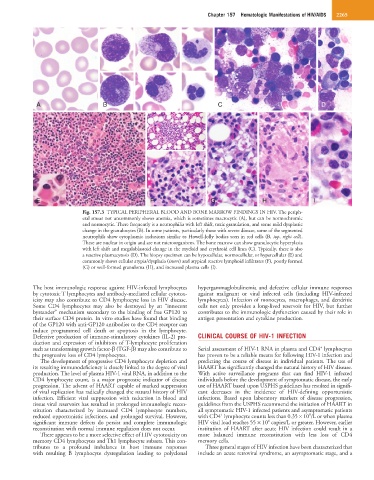
                            Fig. 157.3  TYPICAL PERIPHERAL BLOOD AND BONE MARROW FINDINGS IN HIV. The periph-
                            eral smear not uncommonly shows anemia, which is sometimes macrocytic (A), but can be normochromic
                            and normocytic. There frequently is a neutrophilia with left shift, toxic granulation, and some mild dysplastic
                            change in the granulocytes (B). In some patients, particularly those with severe disease, some of the segmented
                            neutrophils show cytoplasmic inclusions similar to Howell-Jolly bodies seen in red cells (B, top, right cell).
                            These are nuclear in origin and are not microorganisms. The bone marrow can show granulocytic hyperplasia
                            with left shift and megaloblastoid change in the myeloid and erythroid cell lines (C). Typically, there is also
                            a reactive plasmacytosis (D). The biopsy specimen can be hypocellular, normocellular, or hypercellular (E) and
                            commonly shows cellular atypia/dysplasia (insert) and atypical reactive lymphoid infiltrates (F), poorly formed
                            (G) or well-formed granuloma (H), and increased plasma cells (I).


            The host immunologic response against HIV-infected lymphocytes   hypergammaglobulinemia and defective cellular immune responses
            by cytotoxic T lymphocytes and antibody-mediated cellular cytotox-  against  malignant  or  viral  infected  cells  (including  HIV-infected
            icity may also contribute to CD4 lymphocyte loss in HIV disease.   lymphocytes). Infection of monocytes, macrophages, and dendritic
            Some  CD4  lymphocytes  may  also  be  destroyed  by  an  “innocent   cells  not  only  provides  a  long-lived  reservoir  for  HIV,  but  further
            bystander” mechanism secondary to the binding of free GP120 to   contributes to the immunologic dysfunction caused by their role in
            their surface CD4 protein. In vitro studies have found that binding   antigen presentation and cytokine production.
            of the GP120 with anti-GP120 antibodies to the CD4 receptor can
            induce  programmed  cell  death  or  apoptosis  in  the  lymphocyte.
            Defective production of immune-stimulatory cytokines (IL-2) pro-  CLINICAL COURSE OF HIV-1 INFECTION
            duction and expression of inhibitors of T-lymphocyte proliferation
                                                                                                          +
            such as transforming growth factor-β (TGF-β) may also contribute to   Serial assessment of HIV-1 RNA in plasma and CD4  lymphocytes
            the progressive loss of CD4 lymphocytes.              has proven to be a reliable means for following HIV-1 infection and
              The development of progressive CD4 lymphocyte depletion and   predicting  the  course  of  disease  in  individual  patients. The  use  of
            its resulting immunodeficiency is closely linked to the degree of viral   HAART has significantly changed the natural history of HIV disease.
            production. The level of plasma HIV-1 viral RNA, in addition to the   With  active  surveillance  programs  that  can  find  HIV-1  infected
            CD4 lymphocyte count, is a major prognostic indicator of disease   individuals before the development of symptomatic disease, the early
            progression. The advent of HAART capable of marked suppression   use of HAART based upon USPHS guidelines has resulted in signifi-
            of viral replication has radically changed the natural history of HIV   cant  decreases  in  the  incidence  of  HIV-defining  opportunistic
            infection.  Efficient  viral  suppression  with  reduction  in  blood  and   infections.  Based  upon  laboratory  markers  of  disease  progression,
            tissue viral reservoirs has resulted in prolonged immunologic recon-  guidelines from the USPHS recommend the initiation of HAART in
            stitution  characterized  by  increased  CD4  lymphocyte  numbers,   all symptomatic HIV-1 infected patients and asymptomatic patients
                                                                         +
                                                                                                      9
            reduced opportunistic infections, and prolonged survival. However,   with CD4  lymphocyte counts less than 0.35 × 10 /L or when plasma
                                                                                         6
            significant  immune  defects  do  persist  and  complete  immunologic   HIV viral load reaches 55 × 10  copies/L or greater. However, earlier
            reconstitution with normal immune regulation does not occur.  institution of HAART after acute HIV infection could result in a
              There appears to be a more selective effect of HIV cytotoxicity on   more  balanced  immune  reconstitution  with  less  loss  of  CD4
            memory CD4 lymphocytes and Th1 lymphocyte subsets. This con-  memory cells.
            tributes  to  a  profound  imbalance  in  host  immune  responses     Three general stages of HIV infection have been characterized that
            with  resulting  B  lymphocyte  dysregulation  leading  to  polyclonal   include an acute retroviral syndrome, an asymptomatic stage, and a

