


Page 256 - Hematology_ Basic Principles and Practice ( PDFDrive )
P. 256
208    Part III  Immunologic Basis of Hematology


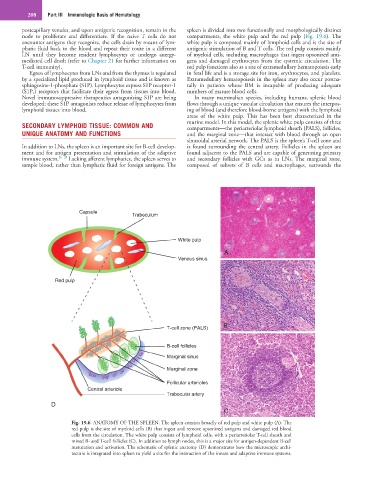
        postcapillary venules, and upon antigenic recognition, remain in the   spleen is divided into two functionally and morphologically distinct
        node  to  proliferate  and  differentiate.  If  the  naive  T  cells  do  not   compartments,  the  white  pulp  and  the  red  pulp  (Fig.  19.6). The
        encounter antigens they recognize, the cells drain by means of lym-  white pulp is composed mainly of lymphoid cells and is the site of
        phatic fluid back to the blood and repeat their route in a different   antigenic stimulation of B and T cells. The red pulp consists mainly
        LN  until  they  become  resident  lymphocytes  or  undergo  anergy-  of myeloid cells, including macrophages that ingest opsonized anti-
        mediated cell death (refer to Chapter 21 for further information on   gens and damaged erythrocytes from the systemic circulation. The
        T-cell immunity).                                     red pulp functions also as a site of extramedullary hematopoiesis early
           Egress of lymphocytes from LNs and from the thymus is regulated   in fetal life and is a storage site for iron, erythrocytes, and platelets.
        by a specialized lipid produced in lymphoid tissue and is known as   Extramedullary hematopoiesis in the spleen may also occur postna-
        sphingosine-1-phosphate (S1P). Lymphocytes express S1P receptor-1   tally  in  patients  whose  BM  is  incapable  of  producing  adequate
        (S1P 1) receptors that facilitate their egress from tissues into blood.   numbers of mature blood cells.
        Novel immunosuppressive therapeutics antagonizing S1P are being   In  many  mammalian  species,  including  humans,  splenic  blood
        developed; these S1P antagonists reduce release of lymphocytes from   flows through a unique vascular circulation that ensures the interpos-
        lymphoid tissues into blood.                          ing of blood (and therefore blood-borne antigens) with the lymphoid
                                                              areas  of  the  white  pulp.  This  has  been  best  characterized  in  the
        SECONDARY LYMPHOID TISSUE: COMMON AND                 murine model. In this model, the splenic white pulp consists of three
                                                              compartments—the periarteriolar lymphoid sheath (PALS), follicles,
        UNIQUE ANATOMY AND FUNCTIONS                          and the marginal zone—that interact with blood through an open
                                                              sinusoidal arterial network. The PALS is the spleen’s T-cell zone and
        In addition to LNs, the spleen is an important site for B-cell develop-  is  found  surrounding  the  central  artery.  Follicles  in  the  spleen  are
        ment and for antigen presentation and stimulation of the adaptive   found adjacent to the PALS and are capable of generating primary
        immune system. 26–28  Lacking afferent lymphatics, the spleen serves to   and  secondary  follicles  with  GCs  as  in  LNs.  The  marginal  zone,
        sample blood, rather than lymphatic fluid for foreign antigens. The   composed  of  subsets  of  B  cells  and  macrophages,  surrounds  the


                           Capsule
                                            Trabeculum


                                                           White pulp

                                                                          A
                                                           Venous sinus


                   Red pulp


                                                                          B
                                                        T-cell zone (PALS)

                                                        B-cell follicles
                                                        Marginal sinus

                                                        Marginal zone
                                                        Follicular arterioles
                              Central arteriole
                                                        Trabecular artery
                  D
                                                                          C

                        Fig. 19.6  ANATOMY OF THE SPLEEN. The spleen consists broadly of red pulp and white pulp (A). The
                        red pulp is the site of myeloid cells (B) that ingest and remove opsonized antigens and damaged red blood
                        cells from the circulation. The white pulp consists of lymphoid cells, with a periarteriolar T-cell sheath and
                        mixed B- and T-cell follicles (C). In addition to lymph nodes, this is a major site for antigen-dependent B-cell
                        maturation and activation. The schematic of splenic anatomy (D) demonstrates how the microscopic archi-
                        tecture is integrated into spleen to yield a site for the interaction of the innate and adaptive immune systems.

