


Page 2645 - Hematology_ Basic Principles and Practice ( PDFDrive )
P. 2645
e26    Part XIII  Consultative Hematology


          TABLE                                                   a
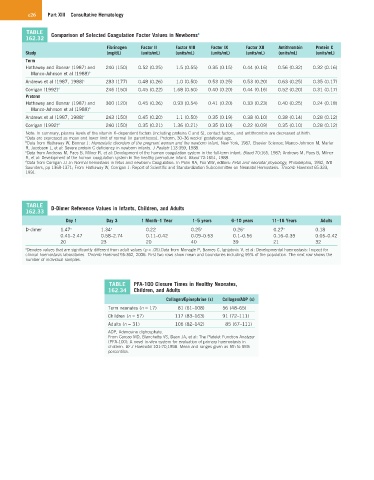
         162.32   Comparison of Selected Coagulation Factor Values in Newborns
                                    Fibrinogen   Factor II   Factor VIII   Factor IX   Factor XII   Antithrombin   Protein C
         Study                      (mg/dL)    (units/mL)  (units/mL)  (units/mL)  (units/mL)  (units/mL)  (units/mL)
         Term
         Hathaway and Bonnar (1987) and   240 (150)  0.52 (0.25)  1.5 (0.55)  0.35 (0.15)  0.44 (0.16)  0.56 (0.32)  0.32 (0.16)
           Manco-Johnson et al (1988) b
         Andrews et al (1987, 1988) c  283 (177)  0.48 (0.26)  1.0 (0.50)  0.53 (0.25)  0.53 (0.20)  0.63 (0.25)  0.35 (0.17)
         Corrigan (1992) d          246 (150)  0.45 (0.22)  1.68 (0.50)  0.40 (0.20)  0.44 (0.16)  0.52 (0.20)  0.31 (0.17)
         Preterm
         Hathaway and Bonnar (1987) and   300 (120)  0.45 (0.26)  0.93 (0.54)  0.41 (0.20)  0.33 (0.23)  0.40 (0.25)  0.24 (0.18)
           Manco-Johnson et al (1988) b
         Andrews et al (1987, 1988) c  243 (150)  0.45 (0.20)  1.1 (0.50)  0.35 (0.19)  0.38 (0.10)  0.38 (0.14)  0.28 (0.12)
         Corrigan (1992) d          240 (150)  0.35 (0.21)  1.36 (0.21)  0.35 (0.10)  0.22 (0.09)  0.35 (0.10)  0.28 (0.12)
         Note: In summary, plasma levels of the vitamin K–dependent factors (including proteins C and S), contact factors, and antithrombin are decreased at birth.
         a Data are expressed as mean and lower limit of normal (in parentheses). Preterm, 30–36 weeks’ gestational age.
         b Data from Hathaway W, Bonnar J: Hemostatic disorders of the pregnant woman and the newborn infant, New York, 1987, Elsevier Science; Manco-Johnson M, Marlar
         R, Jacobson L, et al: Severe protein C deficiency in newborn infants. J Pediatr 113:359, 1988.
         c Data from Andrews M, Paes B, Milner R, et al: Development of the human coagulation system in the full-term infant. Blood 70:165, 1987; Andrews M, Paes B, Milner
         R, et al: Development of the human coagulation system in the healthy premature infant. Blood 72:1651, 1988.
         d Data from Corrigan JJ Jr: Normal hemostasis in fetus and newborn: Coagulation. In Polin RA, Fox WW, editors: Fetal and neonatal physiology, Philadelphia, 1992, WB
         Saunders, pp 1368-1371; From Hathaway W, Corrigan J: Report of Scientific and Standardization Subcommittee on Neonatal Hemostasis. Thromb Haemost 65:323,
         1991.


          TABLE
         162.33   D-Dimer Reference Values in Infants, Children, and Adults
                       Day 1        Day 3      1 Month–1 Year   1–5 years    6–10 years   11–16 Years     Adults
         D-dimer     1.47 a       1.34 a         0.22           0.25 a       0.26 a        0.27 a       0.18
                     0.41–2.47    0.58–2.74      0.11–0.42      0.09–0.53    0.1–0.56     0.16–0.39     0.05–0.42
                     20           23             20             40           39           21            32
         a Denotes values that are significantly different from adult values (p < .05).Data from Monagle P, Barnes C, Ignjatovic V, et al: Developmental haemostasis: Impact for
         clinical haemostasis laboratories. Thromb Haemost 95:362, 2006. First two rows show mean and boundaries including 95% of the population. The next row shows the
         number of individual samples.


                                     TABLE   PFA-100 Closure Times in Healthy Neonates,
                                    162.34   Children, and Adults
                                                       Collagen/Epinephrine (s)  Collagen/ADP (s)
                                    Term neonates (n = 17)  81 (61–108)   56 (48–65)
                                    Children (n = 57)     117 (83–163)    91 (72–111)
                                    Adults (n = 31)       106 (82–142)     85 (67–111)
                                    ADP, Adenosine diphosphate.
                                    From Carcao MD, Blanchette VS, Dean JA, et al: The Platelet Function Analyzer
                                    (PFA-100): A novel in-vitro system for evaluation of primary haemostasis in
                                    children. Br J Haematol 101:70,1998. Mean and ranges given as 5th to 95th
                                    percentiles.

