


Page 272 - Hematology_ Basic Principles and Practice ( PDFDrive )
P. 272
Chapter 21  T-Cell Immunity  223


                             Prior to gene rearrangement:
                                  V-50     V-2    V-1  D-2J-6 J-5   J-2 J-1   C-2  D-1 J-7 J-6  J-2 J-1  C-1
                              β

                                  V-70     V-2    V-1  J-60  J-2 J-1  C
                              α
                                                        J-59
                             After gene rearrangement:
                                  Vn  DnJn             Cn
                              β

                                  Vn  Jn         C
                              α

                                                            Transcription
                                                            mRNA splicing


                                                  5   Vn  DnJn Cn  3
                                                 β
                                                  5   Vn  Jn  C  3
                                                 α


                                                            Translation


                                                       β α

                                                             ER


                                                             Cytosol

                                                      To cell surface

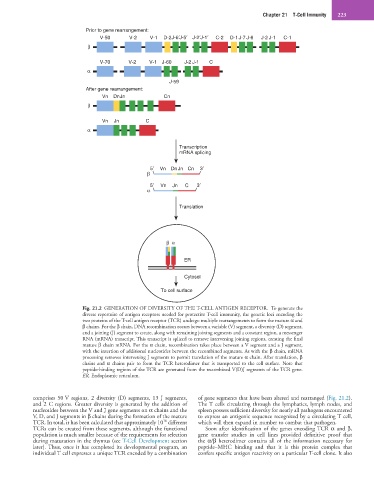
                            Fig. 21.2  GENERATION OF DIVERSITY OF THE T-CELL ANTIGEN RECEPTOR.  To generate the
                            diverse repertoire of antigen receptors needed for protective T-cell immunity, the genetic loci encoding the
                            two proteins of the T-cell antigen receptor (TCR) undergo multiple rearrangements to form the mature α and
                            β chains. For the β chain, DNA recombination occurs between a variable (V) segment, a diversity (D) segment,
                            and a joining (J) segment to create, along with remaining joining segments and a constant region, a messenger
                            RNA (mRNA) transcript. This transcript is spliced to remove intervening joining regions, creating the final
                            mature β chain mRNA. For the α chain, recombination takes place between a V segment and a J segment,
                            with the insertion of additional nucleotides between the recombined segments. As with the β chain, mRNA
                            processing removes intervening J segments to permit translation of the mature α chain. After translation, β
                            chains and α chains pair to form the TCR heterodimer that is transported to the cell surface. Note that
                            peptide-binding regions of the TCR are generated from the recombined V(D)J segments of the TCR gene.
                            ER, Endoplasmic reticulum.


            comprises  50 V  regions,  2  diversity  (D)  segments,  13  J  segments,   of gene segments that have been altered and rearranged (Fig. 21.2).
            and 2 C regions. Greater diversity is generated by the addition of   The T cells circulating through the lymphatics, lymph nodes, and
            nucleotides between the V and J gene segments on α chains and the   spleen possess sufficient diversity for nearly all pathogens encountered
            V, D, and J segments in β chains during the formation of the mature   to express an antigenic sequence recognized by a circulating T cell,
                                                      18
            TCR. In total, it has been calculated that approximately 10  different   which will then expand in number to combat that pathogen.
            TCRs can be created from these segments, although the functional   Soon after identification of the genes encoding TCR  α and β,
            population is much smaller because of the requirements for selection   gene  transfer  studies  in  cell  lines  provided  definitive  proof  that
            during maturation in the thymus (see T-Cell Development section   the  α/β  heterodimer  contains  all  of  the  information  necessary  for
            later). Thus, once it has completed its developmental program, an   peptide–MHC  binding  and  that  it  is  this  protein  complex  that
            individual T cell expresses a unique TCR encoded by a combination   confers specific antigen reactivity on a particular T-cell clone. It also

