


Page 271 - Hematology_ Basic Principles and Practice ( PDFDrive )
P. 271
222    Part III  Immunologic Basis of Hematology


                         MHC II                                                    MHC I


                            5               3                                         6

                                       4                                        MHC I
                                 MHC II
                         4
                                                                                    5
                      MHC II                                                              MHC I
                          2                                                    MHC I   4
                                                                             3
                                    1
                                   MHC II                            Proteosome
                                                                                                      ER

                                                                         2
                                             ER                   E3 ligase    1


                                                                                       Nucleus

                                Nucleus


            A                                                 B
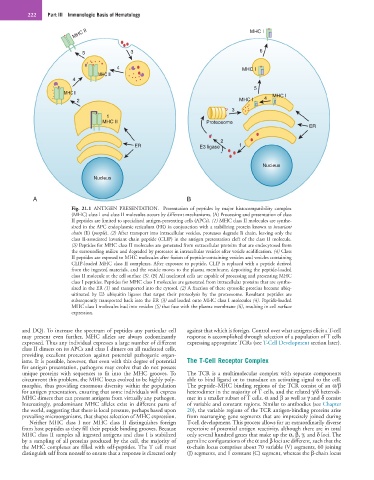
                        Fig.  21.1  ANTIGEN  PRESENTATION.    Presentation  of  peptides  by  major  histocompatibility  complex
                        (MHC) class I and class II molecules occurs by different mechanisms. (A) Processing and presentation of class
                        II peptides are limited to specialized antigen-presenting cells (APCs). (1) MHC class II molecules are synthe-
                        sized in the APC endoplasmic reticulum (ER) in conjunction with a stabilizing protein known as invariant
                        chain (Ii) (purple). (2) After transport into intracellular vesicles, proteases degrade Ii chain, leaving only the
                        class II-associated invariant chain peptide (CLIP) in the antigen presentation cleft of the class II molecule.
                        (3) Peptides for MHC class II molecules are generated from extracellular proteins that are endocytosed from
                        the surrounding milieu and degraded by proteases in intracellular vesicles after vesicle acidification. (4) Class
                        II peptides are exposed to MHC molecules after fusion of peptide-containing vesicles and vesicles containing
                        CLIP-loaded MHC class II complexes. After exposure to peptide, CLIP is replaced with a peptide derived
                        from the ingested materials, and the vesicle moves to the plasma membrane, depositing the peptide-loaded
                        class II molecule at the cell surface (5). (B) All nucleated cells are capable of processing and presenting MHC
                        class I peptides. Peptides for MHC class I molecules are generated from intracellular proteins that are synthe-
                        sized in the ER (1) and transported into the cytosol. (2) A fraction of these cytosolic proteins become ubiq-
                        uitinated  by  E3  ubiquitin  ligases  that  target  their  proteolysis  by  the  proteosome.  Resultant  peptides  are
                        subsequently transported back into the ER (3) and loaded onto MHC class I molecules (4). Peptide-loaded
                        MHC class I molecules bud into vesicles (5) that fuse with the plasma membrane (6), resulting in cell surface
                        expression.


        and DQ). To increase the spectrum of peptides any particular cell   against that which is foreign. Control over what antigens elicit a T-cell
        may  present  even  further,  MHC  alleles  are  always  codominantly   response is accomplished through selection of a population of T cells
        expressed. Thus any individual expresses a large number of different   expressing appropriate TCRs (see T-Cell Development section later).
        class II dimers on its APCs and class I dimers on all nucleated cells,
        providing  excellent  protection  against  potential  pathogenic  organ-
        isms. It is possible, however, that even with this degree of potential   The T-Cell Receptor Complex
        for antigen presentation, pathogens may evolve that do not possess
        unique  proteins  with  sequences  to  fit  into  the  MHC  grooves. To   The TCR  is  a  multimolecular  complex  with  separate  components
        circumvent this problem, the MHC locus evolved to be highly poly-  able to bind ligand or to transduce an activating signal to the cell.
        morphic, thus providing enormous diversity within the population   The peptide–MHC binding regions of the TCR consist of an α/β
        for antigen presentation, ensuring that some individuals will express   heterodimer in the majority of T cells, and the related γ/δ heterodi-
        MHC dimers that can present antigens from virtually any pathogen.   mer in a smaller subset of T cells. α and β as well as γ and δ consist
        Interestingly,  predominant  MHC  alleles  exist  in  different  parts  of   of variable and constant regions. Similar to antibodies (see Chapter
        the world, suggesting that there is local pressure, perhaps based upon   20), the variable regions of the TCR antigen-binding proteins arise
        prevailing microorganisms, that shapes selection of MHC expression.  from rearranging gene segments that are imprecisely joined during
           Neither  MHC  class  I  nor  MHC  class  II  distinguishes  foreign   T-cell development. This process allows for an extraordinarily diverse
        from host peptides as they fill their peptide binding grooves. Because   repertoire of potential antigen reactivity, although there are in total
        MHC class II samples all ingested antigens and class I is stabilized   only several hundred genes that make up the α, β, γ, and δ loci. The
        by a sampling of all proteins produced by the cell, the majority of   germline configurations of the α and β loci are different, such that the
        the MHC complexes are filled with self-peptides. The T cell must   α-chain locus comprises about 70 variable (V) segments, 60 joining
        distinguish self from nonself to ensure that a response is directed only   (J) segments, and 1 constant (C) segment, whereas the β-chain locus

