


Page 40 - Hematology_ Basic Principles and Practice ( PDFDrive )
P. 40
12    Part I  Molecular and Cellular Basis of Hematology


        mutations confers selective advantage in the face of unusual environ-  A
        mental  conditions,  such  as  malaria  epidemics.  These  “adaptive”   Hpa I  β S  Hpa I  Hpa I  Southern blot
        mutations  drive  the  dynamic  change  in  the  genome  with  time
        (evolution).                                                                                   bA bS
           Most  of  the  mutations  that  accumulate  in  the  DNA  of  Homo
        sapiens occur in either intergenic DNA or the “silent” bases of DNA,   13.0 kb
        such as the degenerate third bases of codons. They do not pathologi-  Hpa I  β A  Hpa I  Hpa I
        cally alter the function of the gene or its products. These clinically
        harmless mutations are called DNA polymorphisms. DNA polymor-
        phisms can be regarded in exactly the same way as other types of   7.6 kb       6.4 kb
        polymorphisms that have been widely recognized for years (e.g., eye
        and hair color, blood groups). They are variations in the population
        that occur without apparent clinical impact. Each of us differs from   B
        other  humans  in  the  precise  number  and  type  of  DNA  polymor-  Hpa I  a       Hpa I   Southern blots
        phisms  that  we  possess.  Most  polymorphisms  represent  single-  2  α 1     VNTR
        nucleotide changes and are called single-nucleotide polymorphisms   Pt#1                        Patients
        (SNPs).                                                  Hpa I                     Hpa I        1  2  3
           Similar to other types of polymorphisms, DNA polymorphisms   a 2    α 1     VNTR
        breed true. In other words, if an individual’s DNA contains a G 1200   Pt#2
        bases upstream from the α-globin gene, instead of the C most com-  Hpa I  a  α   Hpa I
        monly found in the population, that G will be transmitted to that   2   1    VNTR
        individual’s offspring. Note that if one had a means for distinguishing   Pt#3
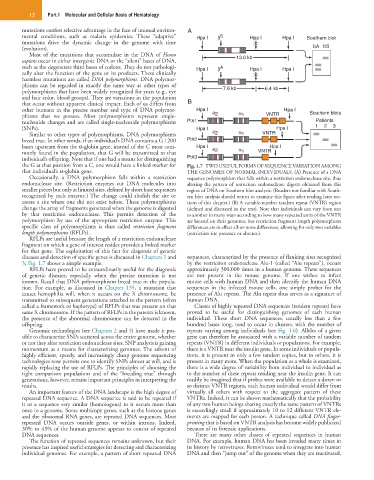
        the G at that position from a C, one would have a linked marker for   Fig. 1.7  TWO USEFUL FORMS OF SEQUENCE VARIATION AMONG
        that individual’s α-globin gene.                      THE GENOMES OF NORMAL INDIVIDUALS. (A) Presence of a DNA
           Occasionally,  a  DNA  polymorphism  falls  within  a  restriction   sequence polymorphism that falls within a restriction endonuclease site, thus
        endonuclease  site.  (Restriction  enzymes  cut  DNA  molecules  into   altering  the  pattern  of  restriction  endonuclease  digests  obtained  from  this
        smaller pieces but only at limited sites, defined by short base sequences   region of DNA on Southern blot analysis. (Readers not familiar with South-
        recognized by each enzyme.) The change could abolish the site or   ern blot analysis should return to examine this figure after reading later sec-
        create a site where one did not exist before. These polymorphisms   tions of this chapter.) (B) A variable-number tandem repeat (VNTR) region
        change the array of fragments generated when the genome is digested   (defined and discussed in the text). Note that individuals can vary from one
        by  that  restriction  endonuclease.  This  permits  detection  of  the   to another in many ways according to how many repeated units of the VNTR
        polymorphism  by  use  of  the  appropriate  restriction  enzyme. This   are located on their genomes, but restriction fragment length polymorphism
        specific  class  of  polymorphisms  is  thus  called  restriction  fragment   differences are in effect all-or-none differences, allowing for only two variables
        length polymorphisms (RFLPs).                         (restriction site presence or absence).
           RFLPs are useful because the length of a restriction endonuclease
        fragment on which a gene of interest resides provides a linked marker
        for that gene. The exploitation of this fact for diagnosis of genetic
        diseases and detection of specific genes is discussed in Chapters 2 and   sequences, characterized by the presence of flanking sites recognized
        3; Fig. 1.7 shows a simple example.                   by the restriction endonuclease Alu-1 (called “Alu repeats”), occurs
           RFLPs have proved to be extraordinarily useful for the diagnosis   approximately 300,000 times in a human genome. These sequences
        of  genetic  diseases,  especially  when  the  precise  mutation  is  not   are  not  present  in  the  mouse  genome.  If  one  wishes  to  infect
        known. Recall that DNA polymorphisms breed true in the popula-  mouse cells with human DNA and then identify the human DNA
        tion.  For  example,  as  discussed  in  Chapter  135,  a  mutation  that   sequences  in  the  infected  mouse  cells,  one  simply  probes  for  the
        causes  hemophilia  will,  when  it  occurs  on  the  X  chromosome,  be   presence of Alu repeats. The Alu repeat thus serves as a signature of
        transmitted to subsequent generations attached to the pattern (often   human DNA.
        called a framework or haplotype) of RFLPs that was present on that   Classes of highly repeated DNA sequences (tandem repeats) have
        same X chromosome. If the pattern of RFLPs in the parents is known,   proved  to  be  useful  for  distinguishing  genomes  of  each  human
        the presence of the abnormal chromosome can be detected in the   individual.  These  short  DNA  sequences,  usually  less  than  a  few
        offspring.                                            hundred bases long, tend to occur in clusters, with the number of
           Genomic technologies (see Chapters 2 and 3) have made it pos-  repeats varying among individuals (see Fig. 1.6). Alleles of a given
        sible to characterize SNPs scattered across the entire genome, whether   gene can therefore be associated with a variable number of tandem
        or not they alter restriction endonuclease sites. SNP analysis is gaining   repeats (VNTR) in different individuals or populations. For example,
        momentum as a means for characterizing genomes. The advent of   there is a VNTR near the insulin gene. In some individuals or popula-
        highly efficient, speedy, and increasingly cheap genome sequencing   tions, it is present in only a few tandem copies, but in others, it is
        technologies now permits one to identify SNPs almost at will, and is   present in many more. When the population as a whole is examined,
        rapidly replacing the use of RFLPs. The principles of choosing the   there is a wide degree of variability from individual to individual as
        right  comparison  populations  and  of  the  “breeding  true”  through   to the number of these repeats residing near the insulin gene. It can
        generations, however, remain important principles in interpreting the   readily be imagined that if probes were available to detect a dozen or
        results.                                              so distinct VNTR regions, each human individual would differ from
           An important feature of the DNA landscape is the high degree of   virtually  all  others  with  respect  to  the  aggregate  pattern  of  these
        repeated DNA sequence. A DNA sequence is said to be repeated if   VNTRs. Indeed, it can be shown mathematically that the probability
        it or a sequence very similar (homologous) to it occurs more than   of any two human beings sharing exactly the same pattern of VNTRs
        once in a genome. Some multicopy genes, such as the histone genes   is exceedingly small if approximately 10 to 12 different VNTR ele-
        and the ribosomal RNA genes, are repeated DNA sequences. Most   ments are mapped for each person. A technique called DNA finger-
        repeated  DNA  occurs  outside  genes,  or  within  introns.  Indeed,   printing that is based on VNTR analysis has become widely publicized
        30% to 45% of the human genome appears to consist of repeated   because of its forensic applications.
        DNA sequences.                                           There  are  many  other  classes  of  repeated  sequences  in  human
           The function of repeated sequences remains unknown, but their   DNA. For example, human DNA has been invaded many times in
        presence has inspired useful strategies for detecting and characterizing   its history by retroviruses. Retroviruses tend to integrate into human
        individual genomes. For example, a pattern of short repeated DNA   DNA and then “jump out” of the genome when they are reactivated,

