


Page 41 - Hematology_ Basic Principles and Practice ( PDFDrive )
P. 41
Chapter 1  Anatomy and Physiology of the Gene  13


            to complete their life cycle. The proviral genomes often carry with   other similar fragments, generating artificially recombined, or recom-
            them  nearby  bits  of  the  genomic  DNA  in  which  they  sat.  If  the   binant, DNA molecules. These ligated gene fragments can then be
            retrovirus infects the DNA of another individual at another site, it   inserted  into  bacteria  to  produce  more  copies  of  the  recombinant
            will insert this genomic bit. Through many cycles of infection, the   molecules  or  to  express  the  cloned  genes.  While  still  useful  in  a
            virus  will  act  as  a  transposon,  scattering  its  attached  sequence   number of contexts, restriction enzyme analysis is increasingly being
            throughout  the  genome. These  types  of  sequences  are  called  long   supplanted by direct DNA sequence analysis.
            interspersed  elements.  They  represent  footprints  of  ancient  viral
            infections.
                                                                  DNA, RNA, and Protein Blotting

            KEY METHODS FOR GENE ANALYSIS                         There are many ways that a cloned DNA sequence can be exploited
                                                                  to characterize the behavior of normal or pathologic genes. Blotting
            The foundation for the molecular understanding of gene structure   methods deserve special mention because of their widespread use in
            and expression is based on fundamental molecular biologic techniques   clinical and experimental hematology. A cloned DNA fragment can
            that were developed in the 1970s and 1980s. These techniques allow   be  easily  purified  and  tagged  with  a  radioactive  or  nonradioactive
            for the reduction of the multibillion nucleotide genome into smaller   label. The  fragment  provides  a  pure  and  highly  specific  molecular
            fragments  that  are  more  easily  analyzed.  Several  key  methods  are   hybridization  probe  for  the  detection  of  complementary  DNA
            outlined here.                                        (cDNA) or RNA molecules in any specimen of DNA or RNA. One
                                                                  set  of  assays  that  has  proved  particularly  useful  involves  Southern
                                                                  blotting,  named  after  Dr.  E.  Southern,  who  invented  the  method
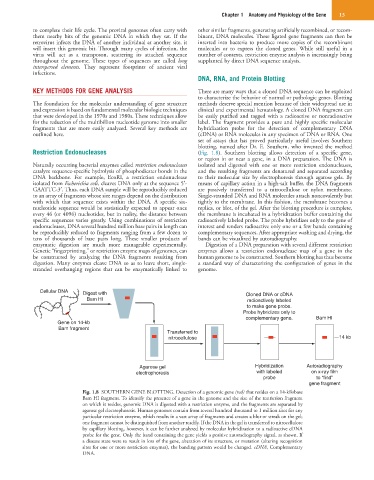
            Restriction Endonucleases                             (Fig.  1.8).  Southern  blotting  allows  detection  of  a  specific  gene,
                                                                  or  region  in  or  near  a  gene,  in  a  DNA  preparation. The  DNA  is
            Naturally occurring bacterial enzymes called restriction endonucleases   isolated  and  digested  with  one  or  more  restriction  endonucleases,
            catalyze sequence-specific hydrolysis of phosphodiester bonds in the   and the resulting fragments are denatured and separated according
            DNA  backbone.  For  example,  EcoRI,  a  restriction  endonuclease   to their molecular size by electrophoresis through agarose gels. By
            isolated from Escherichia coli, cleaves DNA only at the sequence 5′-   means of capillary action in a high-salt buffer, the DNA fragments
            GAATTC-3′. Thus, each DNA sample will be reproducibly reduced   are  passively  transferred  to  a  nitrocellulose  or  nylon  membrane.
            to an array of fragments whose size ranges depend on the distribution   Single-stranded DNA and RNA molecules attach noncovalently but
            with  which  that  sequence  exists  within  the  DNA.  A  specific  six-  tightly to the membrane. In this fashion, the membrane becomes a
            nucleotide sequence would be statistically expected to appear once   replica, or blot, of the gel. After the blotting procedure is complete,
            every 46 (or 4096) nucleotides, but in reality, the distance between   the membrane is incubated in a hybridization buffer containing the
            specific  sequences  varies  greatly.  Using  combinations  of  restriction   radioactively labeled probe. The probe hybridizes only to the gene of
            endonucleases, DNA several hundred million base pairs in length can   interest and renders radioactive only one or a few bands containing
            be reproducibly reduced to fragments ranging from a few dozen to   complementary sequences. After appropriate washing and drying, the
            tens  of  thousands  of  base  pairs  long.  These  smaller  products  of   bands can be visualized by autoradiography.
            enzymatic  digestion  are  much  more  manageable  experimentally.   Digestion of a DNA preparation with several different restriction
            Genetic “fingerprinting,” or restriction enzyme maps of genomes, can   enzymes  allows  a  restriction  endonuclease  map  of  a  gene  in  the
            be  constructed  by  analyzing  the  DNA  fragments  resulting  from   human genome to be constructed. Southern blotting has thus become
            digestion. Many enzymes cleave DNA so as to leave short, single-  a standard way of characterizing the configuration of genes in the
            stranded  overhanging  regions  that  can  be  enzymatically  linked  to   genome.


              Cellular DNA  Digest with                                          Cloned DNA or cDNA
                             Bam HI                                               radioactively labeled
                                                                                  to make gene probe.
                                                                                 Probe hybridizes only to
                                                                                 complementary gene.    Bam HI
                    Gene on 14-kb
                    Bam fragment
                                                        Transferred to
                                                        nitrocellulose                                          14 kb


                                               Agarose gel                           Hybridization   Autoradiography
                                             electrophoresis                         with labeled      on x-ray film
                                                                                       probe            to “find”
                                                                                                      gene fragment
                            Fig. 1.8  SOUTHERN GENE BLOTTING. Detection of a genomic gene (red) that resides on a 14-kilobase
                            Bam HI fragment. To identify the presence of a gene in the genome and the size of the restriction fragment
                            on which it resides, genomic DNA is digested with a restriction enzyme, and the fragments are separated by
                            agarose gel electrophoresis. Human genomes contain from several hundred thousand to 1 million sites for any
                            particular restriction enzyme, which results in a vast array of fragments and creates a blur or streak on the gel;
                            one fragment cannot be distinguished from another readily. If the DNA in the gel is transferred to nitrocellulose
                            by capillary blotting, however, it can be further analyzed by molecular hybridization to a radioactive cDNA
                            probe for the gene. Only the band containing the gene yields a positive autoradiography signal, as shown. If
                            a disease state were to result in loss of the gene, alteration of its structure, or mutation (altering recognition
                            sites for one or more restriction enzymes), the banding pattern would be changed. cDNA, Complementary
                            DNA.

