


Page 39 - Hematology_ Basic Principles and Practice ( PDFDrive )
P. 39
Chapter 1  Anatomy and Physiology of the Gene  11


            rate-limiting components of the translational apparatus, but mRNAs
            that are inherently less translatable tend to be translated less efficiently                     dsRNA
            in the face of limited access to other translational components. For
            example, the translation factor eIF-4 tends to be produced in higher
            amounts  when  cells  encounter  transforming  or  mitogenic  events.        Dicer
            This causes an increase in overall rates of protein synthesis but also
            leads to a selective increase in the synthesis of some proteins that were
            underproduced before mitogenesis.
              Translational regulation of individual mRNA species is critical for
            some  events  important  to  blood  cell  homeostasis.  For  example,  as
            discussed in Chapter 35, the amount of iron entering a cell is an
            exquisite  regulator  of  the  rate  of  ferritin  mRNA  translation.  An
            mRNA sequence called the iron response element is recognized by a                           21-23 nt siRNA
            specific mRNA-binding protein but only when the protein lacks iron.
            mRNA  bound  to  the  protein  is  translationally  inactive.  As  iron
            accumulates in the cell, the protein becomes iron bound and loses its        RISC
            affinity  for  the  mRNA,  resulting  in  translation  into  apoferritin
            molecules that bind the iron.
              Tubulin synthesis involves coordinated regulation of translation        RISC
            and mRNA stability. Tubulin regulates the stability of its own mRNA
            by  a  feedback  loop.  As  tubulin  concentrations  rise  in  the  cell,  it
            interacts with its own mRNA through the intermediary of an mRNA-                           AAAA
                                                                    7
            binding protein. This results in the formation of an mRNA–protein   m G                         (n)
            complex  and  nucleolytic  cleavage  of  the  mRNA.  The  mRNA  is
            destroyed, and further tubulin production is halted.   m G                                   AAAA
              These few examples of posttranscriptional regulation emphasize   7                             (n)
            that  cells  tend  to  use  every  step  in  the  complex  pathway  of  gene
            expression as points at which exquisite control over the amounts of
            a particular protein can be regulated. In other chapters, additional
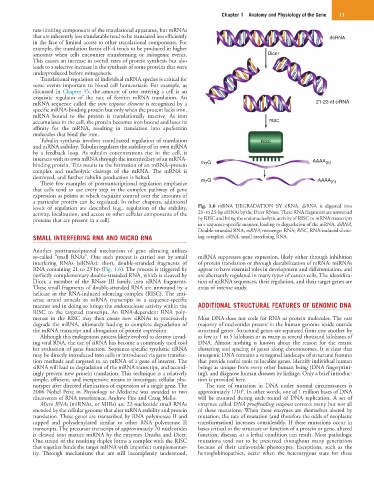
            levels  of  regulation  are  described  (e.g.,  regulation  of  the  stability,   Fig.  1.6  mRNA  DEGRADATION  BY  siRNA.  dsRNA  is  digested  into
            activity, localization, and access to other cellular components of the   21- to 23-bp siRNAs by the Dicer RNase. These RNA fragments are unwound
            proteins that are present in a cell).                 by RISC and bring the endonucleolytic activity of RISC to mRNA transcripts
                                                                  in a sequence-specific manner, leading to degradation of the mRNA. dsRNA,
                                                                  Double-stranded RNA; mRNA, messenger RNA; RISC, RNA-induced silenc-
            SMALL INTERFERING RNA AND MICRO RNA                   ing complex; siRNA, small interfering RNA.
            Another  posttranscriptional  mechanism  of  gene  silencing  utilizes
            so-called  “small  RNAs”.  One  such  process  is  carried  out  by  small   miRNA suppresses gene expression, likely either through inhibition
            interfering  RNAs  (siRNAs):  short,  double-stranded  fragments  of   of protein translation or through destabilization of mRNA. miRNAs
            RNA containing 21 to 23 bp (Fig. 1.6). The process is triggered by   appear to have essential roles in development and differentiation, and
            perfectly complementary double-stranded RNA, which is cleaved by   are aberrantly regulated in many types of cancer cells. The identifica-
            Dicer,  a  member  of  the  RNase  III  family,  into  siRNA  fragments.   tion of miRNA sequences, their regulation, and their target genes are
            These small fragments of double-stranded RNA are unwound by a   areas of intense study.
            helicase in the RNA-induced silencing complex (RISC). The anti-
            sense  strand  anneals  to  mRNA  transcripts  in  a  sequence-specific
            manner and in doing so brings the endonuclease activity within the   ADDITIONAL STRUCTURAL FEATURES OF GENOMIC DNA
            RISC  to  the  targeted  transcript.  An  RNA-dependent  RNA  poly-
            merase  in  the  RISC  may  then  create  new  siRNAs  to  processively   Most DNA does not code for RNA or protein molecules. The vast
            degrade the mRNA, ultimately leading to complete degradation of   majority of nucleotides present in the human genome reside outside
            the mRNA transcript and abrogation of protein expression.  structural genes. Structural genes are separated from one another by
              Although this endogenous process likely evolved to destroy invad-  as few as 1 to 5 kilobases or as many as several thousand kilobases of
            ing viral RNA, the use of siRNA has become a commonly used tool   DNA.  Almost  nothing  is  known  about  the  reason  for  the  erratic
            for evaluation of gene function. Sequence-specific synthetic siRNA   clustering and spacing of genes along chromosomes. It is clear that
            may be directly introduced into cells or introduced via gene transfec-  intergenic DNA contains a variegated landscape of structural features
            tion methods and targeted to an mRNA of a gene of interest. The   that provide useful tools to localize genes, identify individual human
            siRNA will lead to degradation of the mRNA transcript, and accord-  beings as unique from every other human being (DNA fingerprint-
            ingly prevent new protein translation. This technique is a relatively   ing), and diagnose human diseases by linkage. Only a brief introduc-
            simple, efficient, and inexpensive means to investigate cellular phe-  tion is provided here.
            notypes after directed elimination of expression of a single gene. The   The  rate  of  mutation  in  DNA  under  normal  circumstances  is
                                                                                6
            2006  Nobel  Prize  in  Physiology  or  Medicine  was  awarded  to  two   approximately 1/10 . In other words, one of 1 million bases of DNA
            discoverers of RNA interference, Andrew Fire and Craig Mello.  will  be  mutated  during  each  round  of  DNA  replication.  A  set  of
              Micro RNAs (miRNAs, or MIRs) are 22-nucleotide small RNAs   enzymes called DNA proofreading enzymes corrects many but not all
            encoded by the cellular genome that alter mRNA stability and protein   of these mutations. When these enzymes are themselves altered by
            translation. These genes are transcribed by RNA polymerase II and   mutation, the rate of mutation (and therefore the odds of neoplastic
            capped  and  polyadenylated  similar  to  other  RNA  polymerase  II   transformation) increases considerably. If these mutations occur in
            transcripts. The precursor transcript of approximately 70 nucleotides   bases critical to the structure or function of a protein or gene, altered
            is cleaved into mature miRNA by the enzymes Drosha and Dicer.   function, disease, or a lethal condition can result. Most pathologic
            One strand of the resulting duplex forms a complex with the RISC   mutations  tend  not  to  be  preserved  throughout  many  generations
            that together binds the target mRNA with imperfect complementar-  because  of  their  unfavorable  phenotypes.  Exceptions,  such  as  the
            ity.  Through  mechanisms  that  are  still  incompletely  understood,   hemoglobinopathies,  occur  when  the  heterozygous  state  for  these

