


Page 476 - Hematology_ Basic Principles and Practice ( PDFDrive )
P. 476
Chapter 30  Aplastic Anemia  397


            autosomal  dominant  patients  with  this  constitutional  BM  failure   function  is  implicit  in  the  success  of  BM  transplantation  in  AA
            syndrome provided a genetic basis for DKC. Central to the repair   because important stromal elements remain of host origin.
            machinery is an RNA template, encoded by TERC, on which telom-
            erase, a reverse transcriptase encoded by TERT, elongates the nucleo-
            tide  repeat  structure;  other  proteins,  including  the  DKC1  gene   PATHOPHYSIOLOGIC PATHWAYS LEADING TO
            product dyskenin, are associated with the telomere repair complex.   APLASTIC ANEMIA
            Systematic  surveys  of  DNA  disclosed  first  TERC  and  later  TERT
            mutations in some patients with apparently acquired AA, including   Direct Hematopoietic Injury
                     4
            older  adults.   Family  members  who  share  the  mutation,  despite
            normal  or  near-normal  blood  counts,  have  hypocellular  marrows,   The most common form of AA is iatrogenic; transient BM failure
                       +
            reduced CD34  cell counts and poor hematopoietic colony forma-  routinely follows treatment with cytotoxic chemotherapeutic drugs
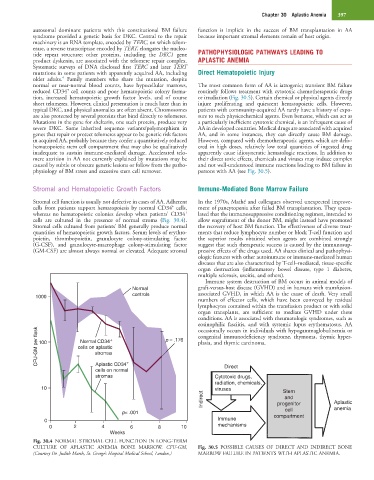
            tion,  increased  hematopoietic  growth  factor  levels,  and  of  course   or irradiation (Fig. 30.5). Certain chemical or physical agents directly
            short telomeres. However, clinical presentation is much later than in   injure  proliferating  and  quiescent  hematopoietic  cells.  However,
            typical DKC, and physical anomalies are often absent. Chromosomes   patients with community-acquired AA rarely have a history of expo-
            are also protected by several proteins that bind directly to telomeres.   sure to such physicochemical agents. Even benzene, which can act as
            Mutations in the gene for shelterin, one such protein, produce very   a particularly inefficient cytotoxic chemical, is an infrequent cause of
            severe  DKC.  Some  inherited  sequence  variants/polymorphism  in   AA in developed countries. Medical drugs are associated with acquired
            genes that repair or protect telomeres appear to be genetic risk factors   AA,  and  in  some  instances,  they  can  directly  cause  BM  damage.
            in acquired AA, probably because they confer a quantitatively reduced   However, compared with chemotherapeutic agents, which are deliv-
            hematopoietic stem cell compartment that may also be qualitatively   ered  in  high  doses,  relatively low  total  quantities of ingested  drug
            inadequate to sustain immune-mediated damage. Accelerated telo-  apparently cause idiosyncratic hematologic reactions. In addition to
            mere attrition in AA not currently explained by mutations may be   their direct toxic effects, chemicals and viruses may induce complex
            caused by subtle or obscure genetic lesions or follow from the patho-  and not well-understood immune reactions leading to BM failure in
            physiology of BM stress and excessive stem cell turnover.  persons with AA (see Fig. 30.5).


            Stromal and Hematopoietic Growth Factors              Immune-Mediated Bone Marrow Failure
            Stromal cell function is usually not defective in cases of AA. Adherent   In the 1970s, Mathé and colleagues observed unexpected improve-
                                                         +
            cells from patients support hematopoiesis by normal CD34  cells,   ment of pancytopenia after failed BM transplantation. They specu-
                                                              +
            whereas no hematopoietic colonies develop when patients’ CD34    lated that the immunosuppressive conditioning regimen, intended to
            cells  are  cultured  in  the  presence  of  normal  stroma  (Fig.  30.4).   allow engraftment of the donor BM, might instead have promoted
            Stromal cells cultured from patients’ BM generally produce normal   the recovery of host BM function. The effectiveness of diverse treat-
            quantities of hematopoietic growth factors. Serum levels of erythro-  ments that reduce lymphocyte number or block T-cell function and
            poietin,  thrombopoietin,  granulocyte  colony-stimulating  factor   the  superior  results  obtained  when  agents  are  combined  strongly
            (G-CSF),  and  granulocyte-macrophage  colony-stimulating  factor   suggest that such therapeutic success is caused by the immunosup-
            (GM-CSF) are almost always normal or elevated. Adequate stromal   pressive effects of the drugs used. AA shares clinical and pathophysi-
                                                                  ologic features with other autoimmune or immune-mediated human
                                                                  diseases that are also characterized by T-cell–mediated, tissue-specific
                                                                  organ  destruction  (inflammatory  bowel  disease,  type  1  diabetes,
                                                                  multiple sclerosis, uveitis, and others).
                                                                    Immune system destruction of BM occurs in animal models of
                                            Normal                graft-versus-host disease (GVHD) and in humans with transfusion-
             1000                           controls              associated GVHD, in which AA is the cause of death. Very small
                                                                  numbers  of  effector  cells,  which  have  been  conveyed  by  residual
                                                                  lymphocytes contained within the transfusion product or with solid
                                                                  organ  transplants,  are  sufficient  to  mediate  GVHD  under  these
                                                                  conditions. AA is associated with rheumatologic syndromes, such as
                                                                  eosinophilic  fasciitis,  and  with  systemic  lupus  erythematosus.  AA
             CFU-GM per flask  100  cells on aplastic +  p = .176  congenital  immunodeficiency  syndrome,  thymoma,  thymic  hyper-
                                                                  occasionally occurs in individuals with hypogammaglobulinemia or
                           Normal CD34
                                                                  plasia, and thymic carcinoma.
                                stromas

                                Aplastic CD34
                                cells on normal +                         Direct
                                stromas                                Cytotoxic drugs,
                                                                       radiation, chemicals,
               10                                                      viruses                Stem
                                                                   Indirect                 progenitor        Aplastic
                                                                                              and
                                                                                              cell
                                         p< .001                                           compartment        anemia
                0                                                       Immune
                 0       2        4         6        8      10          mechanisms
                                     Weeks
            Fig. 30.4  NORMAL STROMAL CELL FUNCTION IN LONG-TERM
            CULTURE  OF  APLASTIC  ANEMIA  BONE  MARROW.  CFU-GM,   Fig.  30.5  POSSIBLE  CAUSES  OF  DIRECT  AND  INDIRECT  BONE
            (Courtesy Dr. Judith Marsh, St. George’s Hospital Medical School, London.)  MARROW FAILURE IN PATIENTS WITH APLASTIC ANEMIA.

