


Page 479 - Hematology_ Basic Principles and Practice ( PDFDrive )
P. 479
400    Part IV  Disorders of Hematopoietic Cell Development


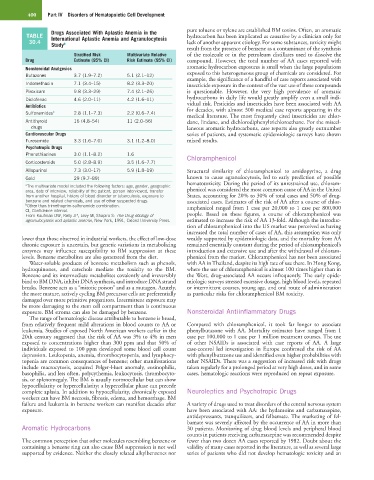
                  Drugs Associated With Aplastic Anemia in the   pure toluene or xylene are established BM toxins. Often, an aromatic
          TABLE   International Aplastic Anemia and Agranulocytosis   hydrocarbon has been implicated as causative by a clinician only for
          30.4    Study a                                     lack of another apparent etiology. For some substances, toxicity might
                                                              result from the presence of benzene as a contaminant of the synthesis
                         Stratified Risk   Multivariate Relative   of the molecule or in the petroleum distillates used to dissolve the
         Drug            Estimate (95% CI)  Risk Estimate (95% CI)  compound. However, the total number of AA cases reported with
         Nonsteroidal Analgesics                              aromatic hydrocarbon exposures is small when the large populations
         Butazones       3.7 (1.9–7.2)     5.1 (2.1–12)       exposed to this heterogeneous group of chemicals are considered. For
                                                              example, the significance of a handful of case reports associated with
         Indomethacin    7.1 (3.4–15)      8.2 (3.3–20)       insecticide exposure in the context of the vast use of these compounds
         Piroxicam       9.8 (3.3–29)      7.4 (2.1–26)       is  questionable.  However,  the  very  high  prevalence  of  aromatic
         Diclofenac      4.6 (2.0–11)      4.2 (1.6–11)       hydrocarbons in daily life would greatly amplify even a small indi-
         Antibiotics                                          vidual risk. Pesticides and insecticides have been associated with AA
                                                              for decades, with almost 300 medical case reports appearing in the
         Sulfonamides b  2.8 (1.1–7.3)     2.2 (0.6–7.4)
                                                              medical literature. The most frequently cited insecticides are chlor-
         Antithyroid     16 (4.8–54)       11 (2.0–56)        dane, lindane, and dichlorodiphenyltrichloroethane. For the miscel-
           drugs                                              laneous aromatic hydrocarbons, case reports also greatly outnumber
         Cardiovascular Drugs                                 series of patients, and systematic epidemiologic surveys have shown
         Furosemide      3.3 (1.6–7.0)     3.1 (1.2–8.0)      mixed results.
         Psychotropic Drugs
         Phenothiazines  3.0 (1.1–8.2)     1.6                Chloramphenicol
         Corticosteroids  5.0 (2.8–8.9)    3.5 (1.6–7.7)
         Allopurinol     7.3 (3.0–17)      5.9 (1.8–19)       Structural  similarity  of  chloramphenicol  to  amidopyrine,  a  drug
         Gold            29 (9.7–89)                          known to cause agranulocytosis, led to early prediction of possible
                                                              hematotoxicity. During the period of its unrestrained use, chloram-
         a The multivariate model included the following factors: age, gender, geographic
         area, date of interview, reliability of the patient, person interviewed, transfer   phenicol was considered the most common cause of AA in the United
         from another hospital, history of blood disorder or tuberculosis, exposure to   States, accounting for 20% to 30% of total cases and 50% of drug-
         benzene and related chemicals, and use of other suspected drugs.  associated cases. Estimates of the risk of AA after a course of chlor-
         b Other than trimethoprim-sulfonamide combination.   amphenicol ranged from 1 case per 20,000 to 1 case per 800,000
         CI, Confidence interval.
         From Kaufman DW, Kelly JP, Levy M, Shapiro S: The Drug etiology of   people.  Based  on  these  figures,  a  course  of  chloramphenicol  was
         agranulocytosis and aplastic anemia, New York, 1991, Oxford University Press.  estimated to increase the risk of AA 13-fold. Although the introduc-
                                                              tion of chloramphenicol into the US market was perceived as having
                                                              increased the total number of cases of AA, this assumption was only
        lower than those observed in industrial workers, the effect of low-dose   weakly supported by epidemiologic data, and the mortality from AA
        chronic exposure is uncertain, but genetic variations in metabolizing   remained essentially constant during the period of chloramphenicol’s
        enzymes  may  influence  susceptibility  to  BM  suppression  at  these   introduction and extensive use and after the withdrawal of chloram-
        levels. Benzene metabolites are also generated from the diet.  phenicol from the market. Chloramphenicol has not been associated
           Water-soluble products of benzene metabolism such as phenols,   with AA in Thailand, despite its high rate of use there. In Hong Kong,
        hydroquinones,  and  catechols  mediate  the  toxicity  to  the  BM.   where the use of chloramphenicol is almost 100 times higher than in
        Benzene and its intermediate metabolites covalently and irreversibly   the West, drug-associated AA occurs infrequently. The early epide-
        bind to BM DNA, inhibit DNA synthesis, and introduce DNA strand   miologic surveys stressed excessive dosage, high blood levels, repeated
        breaks. Benzene acts as a “mitotic poison” and as a mutagen. Acutely,   or intermittent courses, young age, and oral route of administration
        the more mature, actively cycling BM precursor cells are preferentially   as particular risks for chloramphenicol BM toxicity.
        damaged over more primitive progenitors. Intermittent exposure may
        be more damaging to the stem cell compartment than is continuous
        exposure. BM stroma can also be damaged by benzene.   Nonsteroidal Antiinflammatory Drugs
           The range of hematologic disease attributable to benzene is broad,
        from relatively frequent mild alterations in blood counts to AA or   Compared  with  chloramphenicol,  it  took  far  longer  to  associate
        leukemia. Studies of exposed North American workers earlier in the   phenylbutazone  with  AA.  Mortality  estimates  have  ranged  from  1
        20th century suggested that the risk of AA was 3% to 4% in men   case per 100,000 to 1 case per 1 million treatment courses. The use
        exposed  to  concentrations  higher  than  300 ppm  and  that  50%  of   of  other  NSAIDs  is  associated  with  case  reports  of  AA.  A  large
        individuals  exposed  to  100 ppm  developed  some  blood  cell  count   case-control  led  investigation  in  Europe  confirmed  the  risk  of  AA
        depression. Leukopenia, anemia, thrombocytopenia, and lymphocy-  with phenylbutazone use and identified even higher probabilities with
        topenia are common consequences of benzene; other manifestations   other NSAIDs. There was a suggestion of increased risk with drugs
        include  macrocytosis,  acquired  Pelger-Huet  anomaly,  eosinophilia,   taken regularly for a prolonged period at very high doses, and in some
        basophilia, and less often, polycythemia, leukocytosis, thrombocyto-  cases, hematologic reactions were reproduced on repeat exposure.
        sis, or splenomegaly. The BM is usually normocellular but can show
        hypocellularity or hypercellularity; a hypercellular phase can precede
        complete aplasia. In addition to hypocellularity, chronically exposed   Neuroleptics and Psychotropic Drugs
        workers can have BM necrosis, fibrosis, edema, and hemorrhage. BM
        failure and leukemia in benzene workers can manifest decades after   A variety of drugs used to treat disorders of the central nervous system
        exposure.                                             have been associated with AA: the hydantoins and carbamazepine,
                                                              antidepressants, tranquilizers, and felbamate. The marketing of fel-
                                                              bamate was severely affected by the occurrence of AA in more than
        Aromatic Hydrocarbons                                 30 patients. Monitoring of drug blood levels and peripheral blood
                                                              counts in patients receiving carbamazepine was recommended despite
        The common perception that other molecules resembling benzene or   fewer than two dozen AA cases reported by 1982. Doubt about the
        containing a benzene ring can also cause BM suppression is not well   validity of many cases reported in the literature, as well as several large
        supported by evidence. Neither the closely related alkylbenzenes nor   series of patients who did not develop hematologic toxicity and an

