


Page 480 - Hematology_ Basic Principles and Practice ( PDFDrive )
P. 480
Chapter 30  Aplastic Anemia  401


            estimated AA case rate of approximately 1 in 200,000 treated patients,   Retrospective studies of AA associated with drugs and viruses and
            have led to questions concerning the relationship between carbam-  the  observation  of  the  occasional  patient  with  serially  monitored
            azepine and AA.                                       blood  counts  suggest  a  latent  period  of  6–8  weeks  between  the
                                                                  inciting event and the onset of pancytopenia. The interval can be
                                                                  more prolonged when pancytopenia is well tolerated or moderate.
            Gold and Heavy Metals                                   With identification of genetic risk factor, the family history has
                                                                  assumed great importance in the evaluation of pancytopenia. Leuke-
            Gold  salts  have  an  extraordinarily  high  frequency  of  fatal  adverse   mia and myelodysplastic syndrome (MDS) can occur in FA and DKC
            reactions,  estimated  at  1.6  cases  per  10,000  prescriptions.  Dose-  pedigrees.  In  the  telomeropathies  secondary  to  TERT  and  TERC
            dependent leukopenia is common, but several dozen cases of AA have   mutations,  hematologic  findings  in  other  family  members  may  be
            been reported. In the IAAAS, exposure to gold salts was the most   mild,  such  as  modest  thrombocytopenia  or  macrocytosis  with  or
            significant drug association for developing AA, with a relative risk of   without anemia. These mutations also contribute to the development
            29  and  an  excess  risk  of  23  cases  per  1  million  users  in  1  week.   of cirrhosis and pulmonary fibrosis, which may be present as diagno-
            Spontaneous recovery rarely occurs. Patients have been successfully   ses in the pedigree. Early graying of the hair is sometimes prominent
            treated with stem-cell transplantation or immunosuppressive therapy;   in  telomere  disease  pedigrees.  Inherited  mutations  in  other  genes
            chelation usually has not been helpful.               predispose  to  BM  failure  and  myeloid  neoplasms.  Mutations  in
                                                                  GATA2 also lead to susceptibility to specific infections (which may
                                                                  manifest as warts). Germline mutations in RUNX1, ETV-6, CEBP1a
            TYPICAL AND ATYPICAL PRESENTATIONS                    and MPL cause AA or leukemia, in childhood. Genetic testing for
                                                                  genes that are mutated in constitutional BM failure is commercially
            Most  patients  with  AA  seek  medical  attention  for  symptoms  that   available.
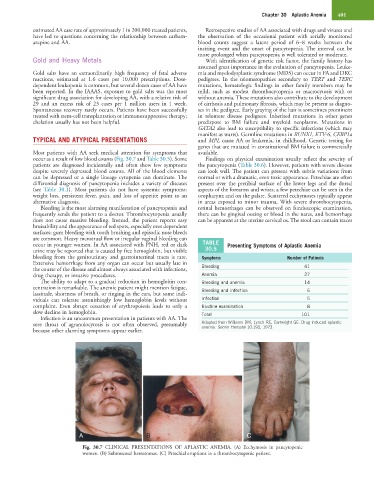
            occur as a result of low blood counts (Fig. 30.7 and Table 30.5). Some   Findings on physical examination usually reflect the severity of
            patients  are  diagnosed  incidentally  and  often  show  few  symptoms   the pancytopenia (Table 30.6). However, patients with severe disease
            despite severely depressed blood counts. All of the blood elements   can look well. The patient can present with subtle variations from
            can  be  depressed  or  a  single  lineage  cytopenia  can  dominate. The   normal or with a dramatic, even toxic appearance. Petechiae are often
            differential diagnosis of pancytopenia includes a variety of diseases   present  over  the  pretibial  surface  of  the  lower  legs  and  the  dorsal
            (see  Table  30.1).  Most  patients  do  not  have  systemic  symptoms:   aspects of the forearms and wrists; a few petechiae can be seen in the
            weight loss, persistent fever, pain, and loss of appetite point to an   oropharynx and on the palate. Scattered ecchymoses typically appear
            alternative diagnosis.                                in areas exposed to minor trauma. With severe thrombocytopenia,
              Bleeding is the most alarming manifestation of pancytopenia and   retinal hemorrhages can be observed on funduscopic examination,
            frequently sends the patient to a doctor. Thrombocytopenia usually   there can be gingival oozing or blood in the nares, and hemorrhage
            does  not  cause  massive  bleeding.  Instead,  the  patient  reports  easy   can be apparent at the uterine cervical os. The stool can contain traces
            bruisability and the appearance of red spots, especially over dependent
            surfaces; gum bleeding with tooth brushing and episodic nose bleeds
            are common. Heavy menstrual flow or irregular vaginal bleeding can
            occur in younger women. In AA associated with PNH, red or dark   TABLE   Presenting Symptoms of Aplastic Anemia
            urine may be reported that is caused by free hemoglobin, but visible   30.5
            bleeding  from  the  genitourinary  and  gastrointestinal  tracts  is  rare.   Symptoms  Number of Patients
            Extensive hemorrhage from any organ can occur but usually late in
            the course of the disease and almost always associated with infections,   Bleeding       41
            drug therapy, or invasive procedures.                  Anemia                            27
              The ability to adapt to a gradual reduction in hemoglobin con-  Bleeding and anemia    14
            centration is remarkable. The anemic patient might mention fatigue,   Bleeding and infection  6
            lassitude, shortness of breath, or ringing in the ears, but some indi-
            viduals  can  tolerate  astonishingly  low  hemoglobin  levels  without   Infection      5
            complaint. Even abrupt cessation of erythropoiesis leads to only a   Routine examination  8
            slow decline in hemoglobin.                            Total                            101
              Infection is an uncommon presentation in patients with AA. The
            sore  throat  of  agranulocytosis  is  not  often  observed,  presumably   Adapted from Williams DM, Lynch RE, Cartwright GE: Drug induced aplastic
                                                                   anemia. Semin Hematol 10:195, 1973.
            because other alarming symptoms appear earlier.


                           A                     B                                C

                            Fig.  30.7  CLINICAL  PRESENTATIONS  OF  APLASTIC  ANEMIA.  (A)  Ecchymosis  in  pancytopenic
                            women. (B) Submucosal hematomas. (C) Petechial eruptions in a thrombocytopenic patient.

