


Page 477 - Hematology_ Basic Principles and Practice ( PDFDrive )
P. 477
398    Part IV  Disorders of Hematopoietic Cell Development


           Laboratory support for the immune hypothesis first came from    Acute                      Chronic
        coculture experiments in which mononuclear cells from AA patients’
        blood or BM were shown to suppress in vitro colony formation by   10  BMT conditioning
        hematopoietic progenitor cells. T-cell depletion sometimes improved   100% mortality with routine medical support
        colony formation in vitro. Patients’ blood and BM cells were shown
        to produce a soluble factor that inhibited hematopoiesis, ultimately   LD  (human experience)
        identified as interferon (IFN)-γ. Patients’ T cells overproduce IFN-γ   50
        and tumor necrosis factor (TNF), two cytokines that inhibit hema-    Radiation sickness
        topoietic proliferation. Tbet, a transcriptional regulator that is critical   Bone marrow hypoplasia
        to Th1 polarization, is constitutionally expressed in a majority of AA   LD  (animal models)
                                                                           50
        patients. AA blood and BM also contains elevated numbers of acti-  1
        vated cytotoxic lymphocytes, and activity and levels of these cytotoxic   Leukemogenesis in
        cells  are  decreased  with  antithymocyte  globulin  (ATG)  therapy. T   A-bomb survivors  Increased
        regulatory cells, as in other human immune-mediated diseases, are                     spontaneous
        decreased in AA. IFN-γ and TNF negative effects on the proliferation                  mutation rate
        of early and late hematopoietic progenitor and stem cells is far more
        potent when these cytokines are secreted into the BM microenviron-
        ment than when they were simply added to the cultures. IFN-γ and
        TNF  can  suppress  hematopoiesis  by  inhibiting  cell  proliferation,   .1  Loss of glycophorin phenotype
        inducing Fas-mediated apoptosis, and blocking hematopoietic growth
        factor intracellular signals. The early immune system events that must
        precede the global destruction of hematopoietic cells are not clear.
        Involvement of CD4 lymphocytes has been suggested based on the
        overrepresentation  of  HLA-DR15  among  patients  with  immune-
        mediated AA. Clones of HLA-DR–restricted T cells derived from a   Dose, Gy
        few patients have been shown to proliferate in response to BM cells.
           Many features of human AA can be reproduced in mouse models   .01
        of GVHD in which the donor inoculum lacks stem cells. Major and
        minor  histocompatibility  mismatch  demonstrates  the  potency  and   Thyroid scan
        specificity of small numbers of T cells, the role of cytokines, efficacy            Maximal permissible
        of immunosuppressive therapies, an “innocent bystander effect,” and                 occupational exposure/year
        roles for specific lymphocyte regulatory and effector T cell subsets. 7  Liver-spleen scan


        Radiation                                               .001     CT scan            5000 feet  natural
                                                                                            sea level  radiation/year
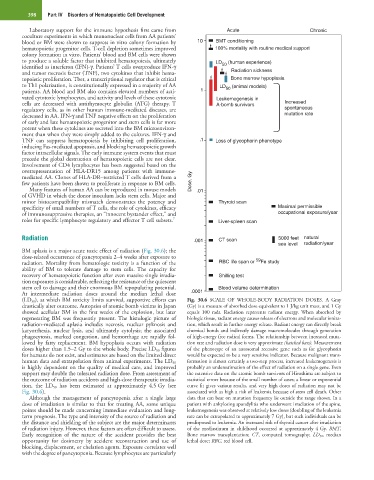
        BM aplasia is a major acute toxic effect of radiation (Fig. 30.6); the
        dose-related occurrence of pancytopenia 2–4 weeks after exposure to          59
        radiation. Mortality from hematologic toxicity is a function of the   RBC life span or  Fe study
        ability  of  BM  to  tolerate  damage  to  stem  cells.  The  capacity  for
        recovery of hematopoietic function after even massive single irradia-  Shilling test
        tion exposures is considerable, reflecting the resistance of the quiescent
        stem cell to damage and their enormous BM repopulating potential.   Blood volume determination
        At  intermediate  radiation  doses  around  the  median  lethal  dose   .0001
        (LD 50 ), at which BM toxicity limits survival, supportive efforts can   Fig.  30.6  SCALE  OF  WHOLE-BODY  RADIATION  DOSES.  A  Gray
        drastically alter outcome. Autopsies of atomic bomb victims in Japan   (Gy) is a measure of absorbed dose equivalent to 1 J/kg unit mass, and 1 Gy
        showed acellular BM in the first weeks of the explosion, but later   equals  100  rads.  Radiation  represents  radiant  energy.  When  absorbed  by
        regenerating BM was frequently present. The histologic picture of   biologic tissue, radiant energy causes release of electrons and molecular ioniza-
        radiation-mediated  aplasia  includes  necrosis,  nuclear  pyknosis  and   tion, which result in further energy release. Radiant energy can directly break
        karyorrhexis,  nuclear  lysis,  and  ultimately  cytolysis;  the  associated   chemical bonds and indirectly damage macromolecules through generation
        phagocytosis,  marked  congestion,  and  hemorrhage  are  rapidly  fol-  of high-energy free radical forms. The relationship between increased muta-
        lowed  by  fatty  replacement.  BM  hypoplasia  occurs  with  radiation   tion rate and radiation dose is very approximate (hatched bars). Measurement
        doses higher than 1.5–2 Gy to the whole body. Precise LD 50  figures   of  the  phenotype  of  an  autosomal  recessive  gene  such  as  for  glycophorin
        for humans do not exist, and estimates are based on the limited direct   would be expected to be a very sensitive indicator. Because malignant trans-
        human data and extrapolation from animal experiments. The LD 50    formation is almost certainly a two-step process, increased leukemogenesis is
        is highly dependent on the quality of medical care, and improved   probably an underestimation of the effect of radiation on a single gene. Even
        support may double the tolerated radiation dose. From assessment of   the extensive data on the atomic bomb survivors of Hiroshima are subject to
        the outcome of radiation accidents and high-dose therapeutic irradia-  statistical errors because of the small number of cases; a linear or exponential
        tion,  the  LD 50   has  been  estimated  at  approximately  4.5 Gy  (see   curve fit gives various results, and very high doses of radiation may not be
        Fig. 30.6).                                           associated with as high a risk of leukemia because of stem cell death. Other
           Although  the  management  of  pancytopenia  after  a  single  large   data that can bear on mutation frequency lie outside the range shown. In a
        dose of irradiation is similar to that for treating AA, some unique   patient with ankylosing spondylitis who underwent irradiation of the spine,
        points should be made concerning immediate evaluation and long-  leukemogenesis was observed at relatively low doses (doubling of the leukemia
        term prognosis. The type and intensity of the source of radiation and   rate can be extrapolated to approximately 7 Gy), but such individuals can be
        the distance and shielding of the subject are the major determinants   predisposed to leukemia. An increased risk of thyroid cancer after irradiation
        of radiation injury. However, these factors are often difficult to assess.   of  the  mediastinum  in  childhood  occurred  at  approximately  4 Gy.  BMT,
        Early  recognition  of  the  nature  of  the  accident  provides  the  best   Bone  marrow  transplantation;  CT,  computed  tomography;  LD 50,  median
        opportunity  for  dosimetry  by  accident  reconstruction  and  use  of   lethal dose; RBC, red blood cell.
        blocking, displacement, or chelation agents. Exposure correlates well
        with the degree of pancytopenia. Because lymphocytes are particularly

